
The Executive AI Implementation Playbook: From Strategy to Execution
The Executive AI Implementation Playbook is a free resource from Jones IT that provides structured frameworks for AI adoption across strategy, security, risk management, and governance; built for business leaders navigating AI implementation from first assessment to production deployment.
Download Your Free Copy Of The ebook
Complete the form below to receive your copy instantly.
What This Playbook Covers
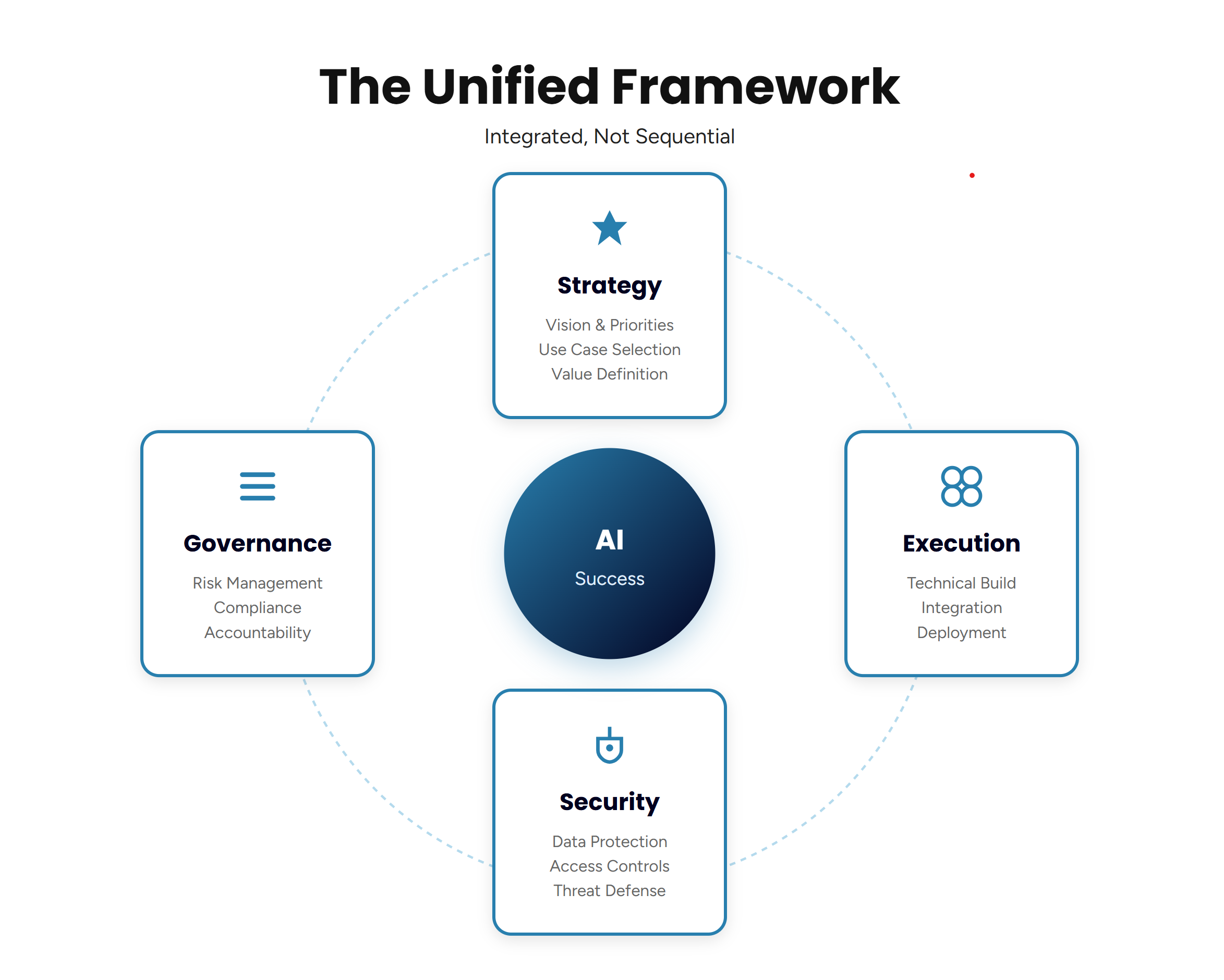
Master the complete AI implementation journey with proven frameworks:
Close the AI Adoption Gap: Understand why 96% of small businesses are falling behind and how to avoid the common pitfalls that prevent successful AI adoption.
Build Strategic Implementation Roadmaps: Access step-by-step frameworks covering everything from initial assessment through production deployment and scaling.
Navigate AI Security Requirements: Implement comprehensive security measures specific to AI systems, from data protection to model governance and adversarial attack prevention.
Establish Risk Management Frameworks: Deploy proven frameworks for identifying, assessing, and mitigating AI-specific risks, including opacity, probabilistic behavior, and emergent threats.
Leverage Agentic AI Capabilities: Understand the paradigm shift from task automation to autonomous AI agents that can transform operations and deliver 10x productivity gains.
Access Practical Implementation Tools: Get vendor evaluation scorecards, budget templates, security checklists, and 90-day implementation timelines ready for immediate use

Who This Playbook Is For
This playbook is designed for:
C-Suite Executives and Business Leaders: Those responsible for strategic technology decisions and digital transformation initiatives who need to understand AI's business impact and implementation requirements.
CTOs and IT Directors: Technology leaders tasked with evaluating AI solutions, building implementation roadmaps, and ensuring successful deployment while managing technical risks.
CISOs and Security Teams: Security professionals who need to understand AI-specific security requirements, establish governance frameworks, and protect against emerging AI threats.
Operations and Strategy Leaders: Executives exploring how AI can transform business processes, improve efficiency, and create competitive advantages in their specific industry.
Jones IT helps San Francisco and Bay Area businesses navigate AI adoption safely, from infrastructure readiness to security and compliance. Learn more about our AI IT services or Cybersecurity & Compliance offering.
Why Download This Playbook
This playbook helps you:
Avoid the $670K Mistake: Learn from real-world examples of shadow AI deployments gone wrong and understand how to prevent costly security breaches and compliance failures.
Accelerate Time to Value: Follow proven implementation roadmaps that have helped organizations move from evaluation to production in 90 days instead of struggling for years.
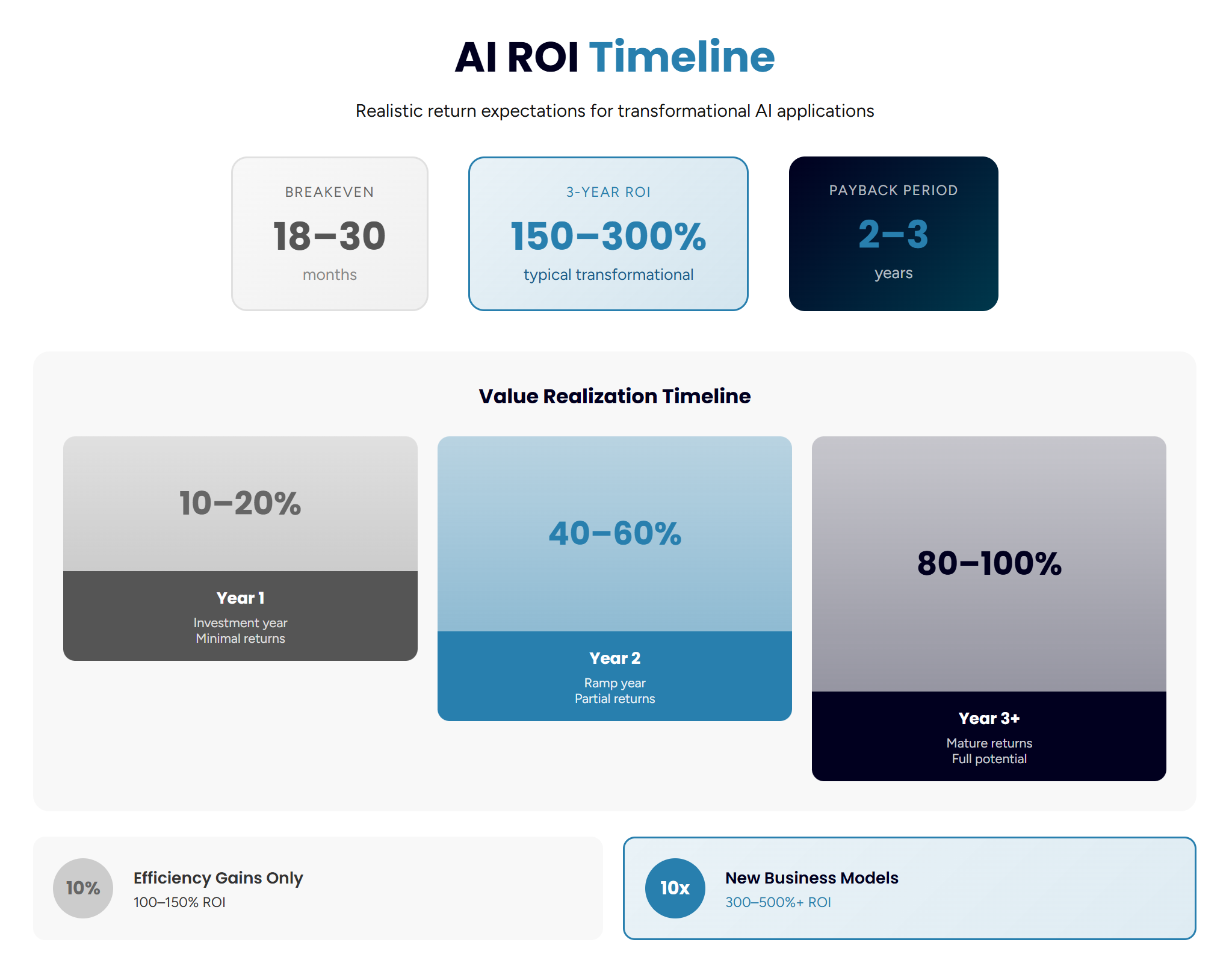
Make Informed Investment Decisions: Access detailed budget planning templates and ROI frameworks that justify AI investments and set realistic expectations for returns.
Build Competitive Advantage: Understand how leading organizations are leveraging AI to create sustainable competitive moats and transform industry dynamics.
Implement Security from Day One: Deploy comprehensive security and governance frameworks that protect your organization while enabling innovation.
-
This playbook bridges the gap between high-level AI strategy and practical implementation. While most resources
focus on either "why AI matters" or deeply technical implementation details, this guide provides the complete middle layer:
actionable frameworks, real budgets, security requirements, and proven roadmaps that executives can actually use. It's built
specifically for business leaders who need to make AI decisions now, with insights from organizations that have successfully
navigated the journey.
-
Implementation timelines vary by scope, but this playbook provides realistic frameworks: foundational AI capabilities
typically require 3-6 months for initial deployment, with Phase 1 budgets ranging from $660K-$1.4M depending on organization
size. The playbook includes detailed budget templates breaking down infrastructure, licensing, professional services, and
ongoing operational costs. More importantly, it helps you avoid the common mistake of underestimating the total cost of
ownership and ongoing security requirements.
-
AI introduces six specific risk categories that traditional IT risk frameworks don't address: model opacity (black box
decision-making), probabilistic behavior (non-deterministic outputs), data dependency vulnerabilities, emergent risks from
model interactions, adversarial attacks, and amplification of biases. The playbook provides the NIST AI Risk Management
Framework adapted for practical implementation, including risk assessment templates and mitigation strategies for each
category. It also covers the critical "shadow AI" problem, where employees deploy AI tools without IT oversight, which poses one
of the largest security and compliance risks.
-
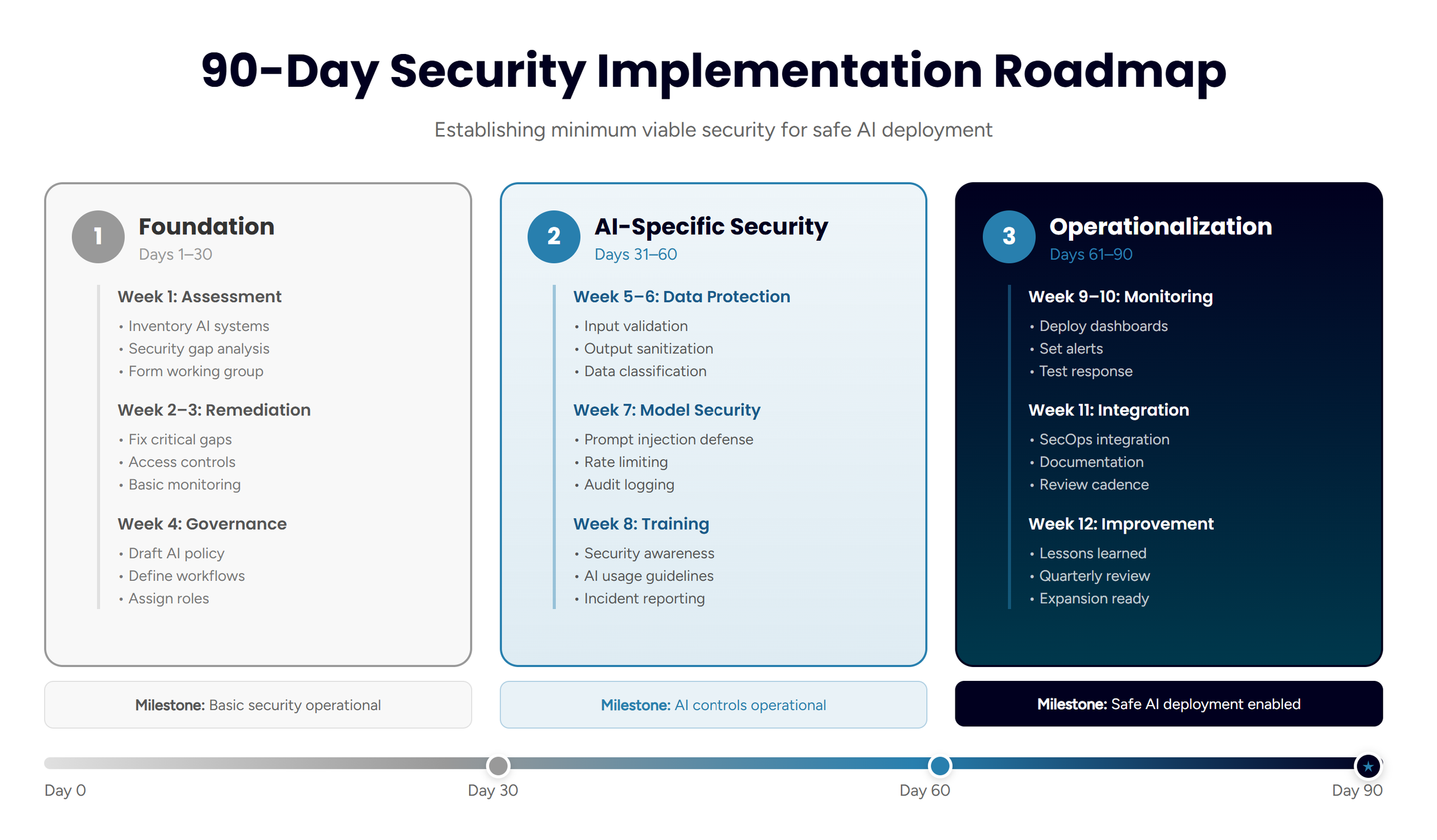
Yes, AI requires security capabilities beyond traditional cybersecurity. This playbook outlines a three-layer security
framework: foundational cybersecurity hygiene, AI-specific security essentials (data governance, model security, API protection),
and AI risk governance structures. It provides specific tool recommendations, implementation checklists, and a 90-day security
roadmap. The good news is you can build on existing security infrastructure, the playbook shows exactly what additional
capabilities are needed and how to prioritize investments.
-
Traditional AI focuses on task automation, taking specific inputs and producing defined outputs (like image
classification or text generation). Agentic AI represents autonomous systems that can pursue goals, make decisions, adapt
strategies, and take actions with minimal human intervention. Think of it as the difference between a calculator (traditional AI)
and an autonomous analyst who can research, analyze, and recommend actions (agentic AI). The playbook explains why this
shift matters strategically and provides frameworks for implementing agentic capabilities safely and effectively.