
SOC 2 Type 1 vs Type 2: Which Does Your Startup Actually Need?
If you're a founder or CTO navigating enterprise sales for the first time, the distinction between SOC 2 Type 1 and Type 2 can feel unnecessarily complicated. But understanding the difference matters because choosing the wrong path can cost you months of time and tens of thousands of dollars.
At Jones IT, we went through this decision ourselves when pursuing our own SOC 2 attestation, and we've also helped dozens of startups navigate the same choice. This post shares what we've learned about when each type makes sense, and how to make the decision strategically rather than reactively.

The Simple Explanation: Snapshot vs. Movie
The easiest way to understand the difference is this analogy:
SOC 2 Type 1 is a snapshot. It validates that your security controls are properly designed and in place at a specific moment in time. Think of it like a home inspection when you're buying a house: someone checks that everything looks good on inspection day.
SOC 2 Type 2 is a movie. It validates that your controls didn't just exist at one moment, but they've been operating effectively over a sustained period (typically 3-12 months). This is like having a home inspector visit monthly for a year to verify everything keeps working properly.
Both are legitimate SOC 2 reports. Both come from AICPA-certified auditors. Both address the five Trust Services Criteria (Security, Availability, Processing Integrity, Confidentiality, and Privacy). The fundamental difference is time: one moment versus continuous operation over months.
Why This Distinction Exists
Before we dive into which one you need, it's worth understanding why SOC 2 has two types in the first place.
When the AICPA developed SOC 2, they recognized that proving something works right now is very different from proving it works consistently over time. Any company can implement good controls for a week. Maintaining them flawlessly for months requires operational discipline, proper training, automated monitoring, and genuine organizational commitment.
Type 1 answers: "Are your controls designed appropriately?"
Type 2 answers: "Do your controls actually work the way you claim, day after day, month after month?"
For enterprise buyers evaluating vendor risk, that second question is far more valuable. They're not just worried about whether you have a firewall today, but want to know you'll maintain that firewall, apply patches consistently, monitor logs regularly, and respond to incidents promptly for as long as they're your customer.
The Reality Most Founders Face
Most sophisticated enterprise customers require Type 2. This is something many founders learn the hard way.
When we talk with founders who are pursuing SOC 2, the conversation usually goes like this:
"Our biggest prospect said they need us to be SOC 2 compliant to move forward with the contract. We're thinking Type 1 to get compliant quickly."
Our response: "What exactly did the prospect ask for? Did they specifically say they'd accept Type 1?"
Nine times out of ten, when founders dig deeper, they discover the prospect either specifically requires Type 2 or their vendor risk management team will only accept Type 2. Type 1 might technically check the "SOC 2 compliant" box, but it won't satisfy the procurement process.
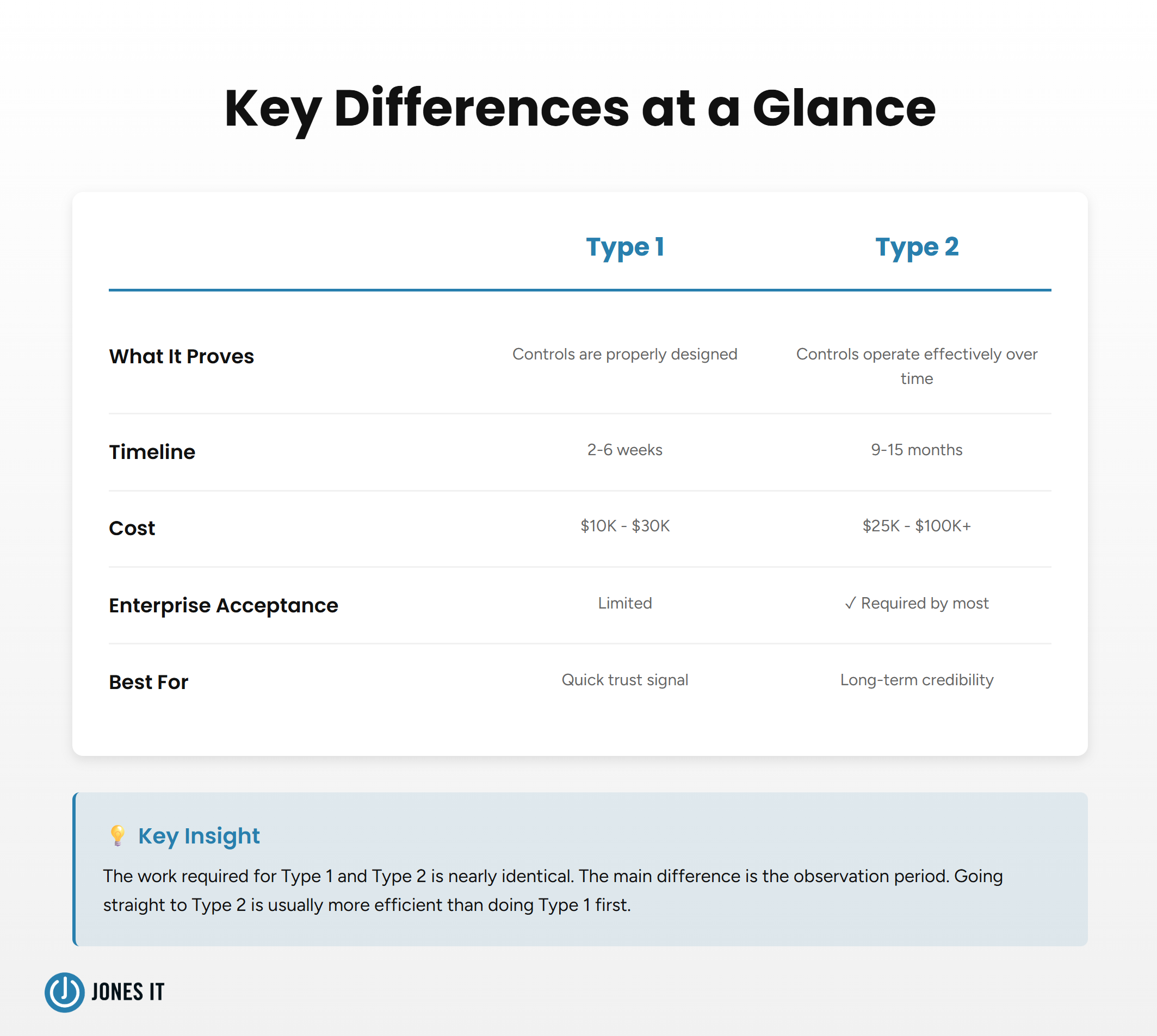
This matters because the timeline difference is substantial:
Type 1: 2-6 weeks once you're ready for audit.
Type 2: 3-12 months for observation period plus 2-8 weeks for audit.
If you pursue Type 1 thinking it satisfies the requirement, only to discover you actually need Type 2, you've just added months to your sales cycle, and potentially lost the deal entirely.
When Type 1 Actually Makes Sense
Despite what we just said, there are legitimate scenarios where Type 1 is the right choice:
Scenario 1: You Need a Trust Signal Yesterday
You're a seed-stage company that just got inbound interest from an enterprise prospect. They're willing to move forward with a pilot if you can demonstrate basic security controls. They haven't gone through full procurement yet, so they're not requiring the full Type 2 process.
In this case, Type 1 can serve as an immediate trust signal. It proves you're serious about security, you've implemented proper controls, and an independent auditor has validated your design. This might be enough to start the relationship while you work toward Type 2 for the full contract.
Example: A Series A SaaS company uses Type 1 to secure a six-month pilot with an Enterprise client. During the pilot, they complete their Type 2 observation period. And by the time the pilot converts to a full contract, they will have the Type 2 report ready.
Scenario 2: You Want to Test Your Controls
Type 1 can serve as a "dry run" before committing to the longer Type 2 process. The audit will identify gaps in your control design, helping you understand what needs fixing before you start the observation period.
This approach makes sense if you're unsure about your readiness. Spending $15K-$30K on Type 1 to discover and fix problems is cheaper than starting a Type 2 observation period only to fail controls and have to restart.
Our Take: While this logic is sound, most companies are better served by conducting a thorough readiness assessment with a compliance consultant rather than paying for a formal Type 1 audit. You'll get similar gap identification at lower cost and faster turnaround.
Scenario 3: You Have Severe Budget Constraints
If you're an early-stage startup with limited runway, the cost difference matters:
Type 1: $10,000-$30,000
Type 2: $25,000-$100,000+
If you absolutely cannot afford Type 2 right now but need some form of compliance certification to keep deals moving forward, Type 1 provides a milestone at lower cost.
Warning: This is a short-term solution. You'll almost certainly need to pursue Type 2 within 12-18 months, so budget accordingly. Don't treat Type 1 as your permanent compliance state.
Scenario 4: Your Customers Explicitly Accept Type 1
Some smaller companies genuinely don't require Type 2. If you can confirm (in writing, from someone with procurement authority) that Type 1 satisfies their vendor security requirements, then Type 1 is sufficient for that relationship.
Pro Tip: Get this confirmation before you start the audit process. Don't assume. We've seen too many founders discover mid-audit that their interpretation of customer requirements was wrong.
When You Should Go Straight for Type 2
For most growth-stage startups (Series A and beyond), we recommend going directly to Type 2. Here's why:
You're Selling to Enterprises
If your ideal customer profile includes Fortune 500 companies, financial institutions, healthcare organizations, or any heavily regulated industry, just plan for Type 2 from the start.
These organizations have mature vendor risk management programs and their procurement processes explicitly require Type 2. Showing up with Type 1 won't satisfy them; you'll just need to do Type 2 anyway.
When we pursued SOC 2, we went straight for Type 2 because we knew our target customers (technology companies serving regulated industries) would require it. Starting with Type 1 would have meant doing much of the work twice.
Your Investors Are Asking About Compliance
If you're raising a Series A or Series B and investors are asking about your compliance posture, they're evaluating operational maturity. Type 2 demonstrates that maturity far more effectively than Type 1.
Type 1 says: "We've documented good controls."
Type 2 says: "We've operated those controls successfully for months, demonstrating the discipline and infrastructure necessary to maintain compliance at scale."
Which signal do you think resonates more with investors evaluating whether you can execute as you grow?
You Want Long-Term ROI
Yes, Type 2 costs more upfront. But consider the total cost of ownership:
Type 1 → Type 2 Path:
Type 1 audit: $15,000.
Wait until you need Type 2.
Type 2 observation period: 6-12 months.
Type 2 audit: $15,000.
Total timeline: 12-18 months from starting Type 1 to completing Type 2
Total cost: $30,000+ plus twice the internal effort
Direct to Type 2 Path:
Gap assessment and remediation: 2-4 months
Observation period: 6-12 months
Type 2 audit: $15,000
Total timeline: 9-15 months from start to completion
Total cost: $15,000 plus single implementation effort
Going straight to Type 2 is actually more efficient unless you have a very specific short-term need for Type 1.
You Want to Avoid Repeating Work
This is the part that often surprises founders: much of the work for Type 1 and Type 2 is identical.
Both require:
Documenting policies and procedures,
Implementing security controls,
Deploying monitoring and logging tools,
Training employees,
Setting up access management, and
Establishing incident response processes.
The only real difference is the observation period and the depth of evidence collection. If you're going to do all this work anyway, why not collect evidence during implementation and go straight for the more valuable report?
Practical Reality: After achieving Type 1, you don't get to pause and relax. You need to immediately enter the Type 2 observation period if you want to maximize the value of your investment. You're essentially committing to the Type 2 timeline anyway; you're just adding complexity by staging it.
The "Bridge Letter" Problem
Here's something that catches many founders off-guard: even after you get your Type 2 report, you might need bridge letters.
SOC 2 Type 2 reports cover a historical period: say, January 1 to June 30. The auditor issues the report in August. But now it's November, and a prospect wants to know about your controls today. That 5-month gap between the report's end date and today creates uncertainty.
Many enterprise customers require "bridge letters" or "gap letters" where you confirm that controls continue to operate effectively after the report period.
Type 1 has this problem even worse because it's literally a snapshot of a single day. The moment time passes, the report becomes less relevant. Most enterprise buyers won't accept a Type 1 report older than 3-6 months without additional attestation.
This is yet another reason Type 2 is generally the better long-term investment since it provides assurance over a period, making it more durable and requiring fewer updates.
The Migration Path: How to Move from Type 1 to Type 2
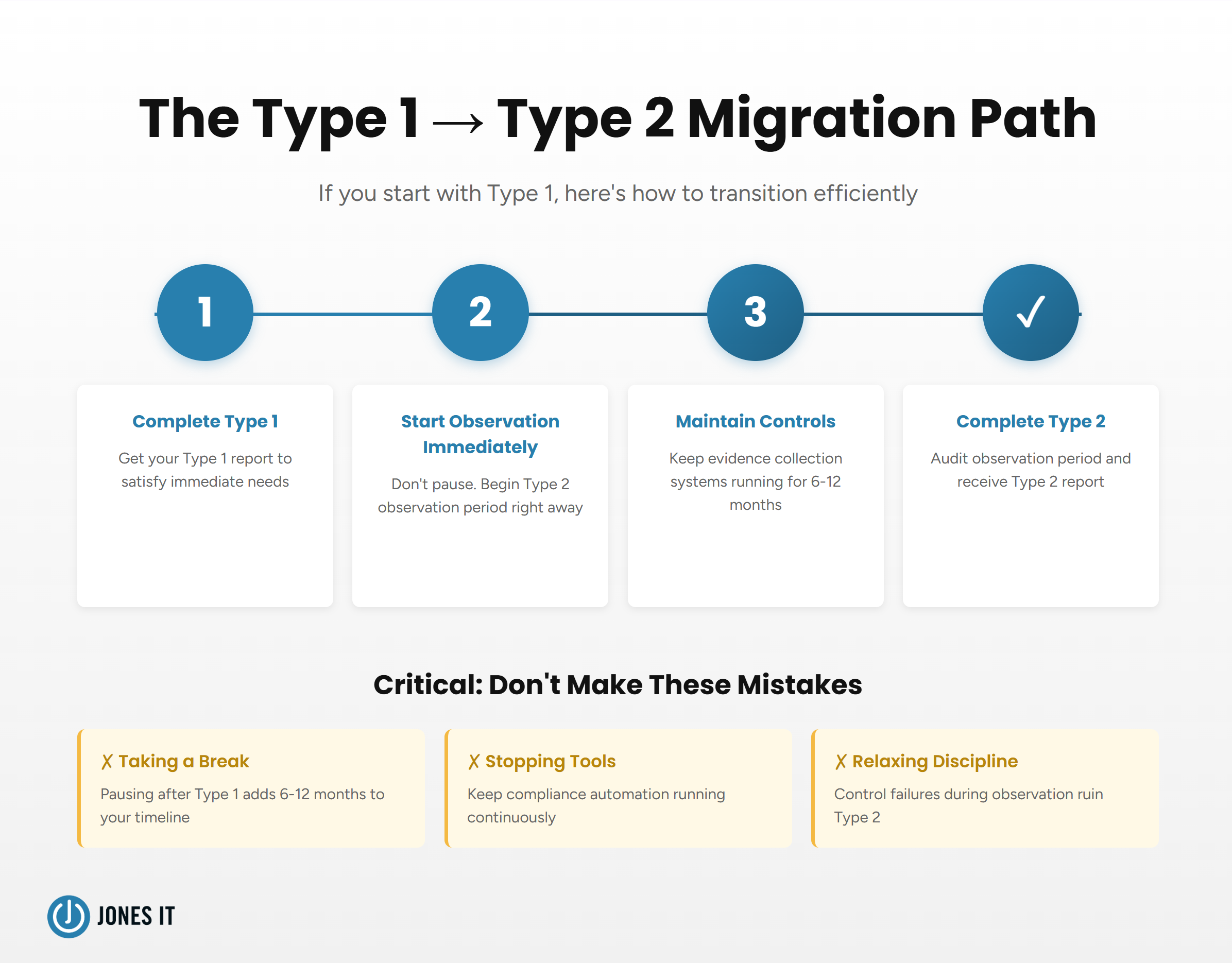
If you do start with Type 1 (for any of the legitimate reasons we discussed), here's how to transition to Type 2 efficiently:
Start the Observation Period Immediately
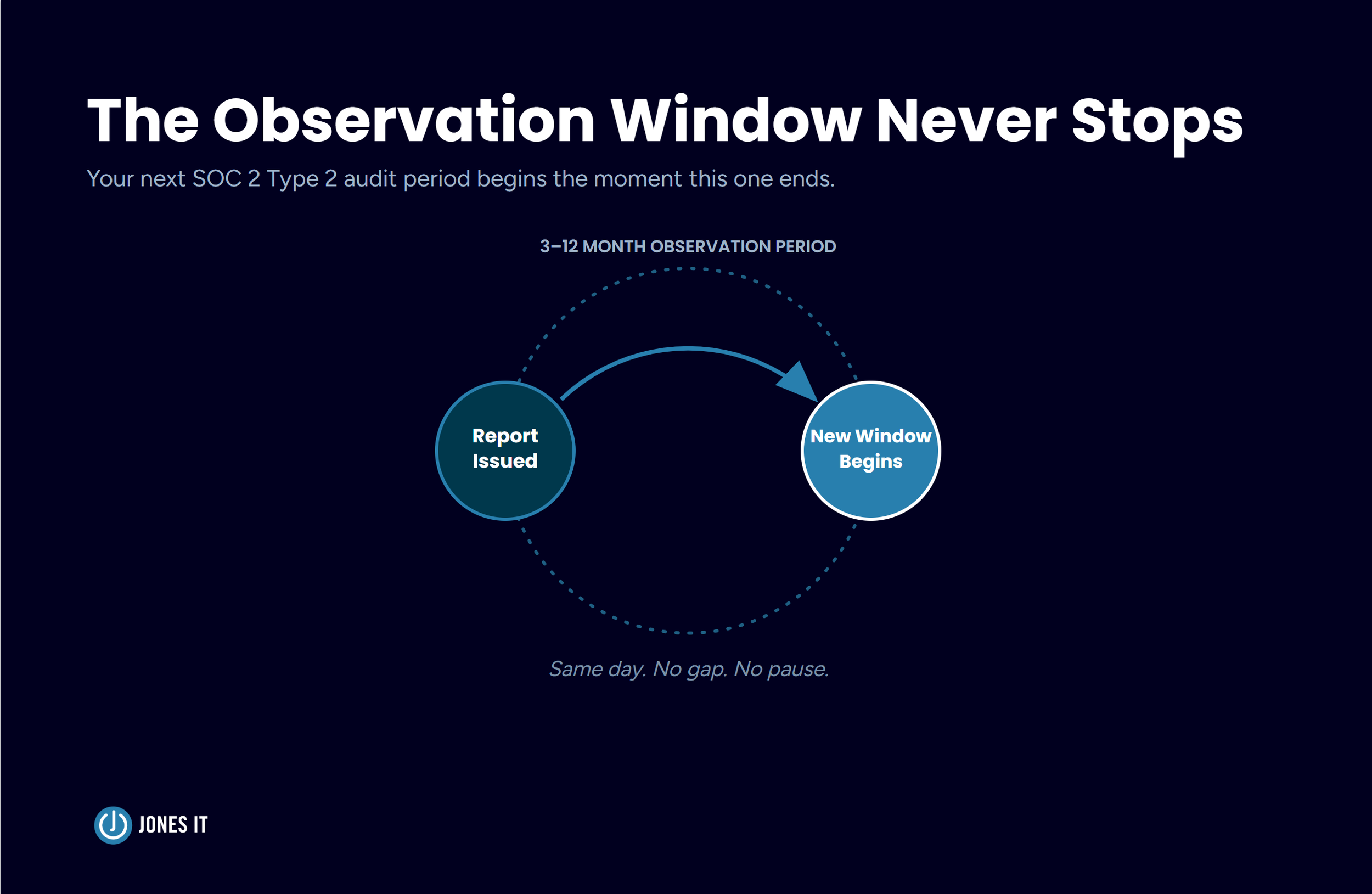
The moment your Type 1 audit is complete, begin your Type 2 observation period. Don't wait. Don't pause. Your controls are already in place and operating, so it’s best to start collecting evidence immediately.
Many companies make the mistake of treating Type 1 as a finish line and taking a break. Then six months later they realize they need Type 2 and discover they have to wait another 6-12 months for the observation period. This is wasted time.
Use the Type 1 Audit Findings Constructively
Your Type 1 audit will identify control deficiencies. Fix them before or during the early part of your observation period. The cleaner your controls operate during observation, the cleaner your Type 2 report will be.
Keep Evidence Collection Systems Running
Don't shut down your compliance automation tools (Vanta, Drata, etc.) after Type 1. You'll need continuous evidence collection for Type 2. Letting evidence collection lapse means you'll need to restart your observation period.
Communicate the Plan
Make sure everyone on your team understands that Type 1 is a milestone, not the destination. The same discipline required for Type 1 needs to continue through the entire Type 2 observation period. If people think they can relax after Type 1, you'll have control failures during observation.
The Tools That Make This Easier
Whether you choose Type 1 or Type 2, compliance automation tools are essentially mandatory because manual evidence collection for either type is incredibly time-consuming and error-prone.
Compliance Platforms (Drata, Vanta):
These platforms continuously monitor your environment and automatically collect evidence. They integrate with your cloud infrastructure, identity management, code repositories, and security tools.
Cost: $12,000-$40,000/year
ROI: These tools typically save enough internal time to pay for themselves within the first audit cycle. More importantly, they dramatically reduce the risk of missing evidence during your observation period.
[Read our complete SOC 2 compliance journey including all the obstacles we faced: The Real Story of Achieving SOC 2 Compliance.]

Our Recommendation: A Decision Framework
After helping dozens of startups through this decision, here's our framework:
Go Straight to Type 2 If:
You're Series A or later.
You're actively selling to Fortune 500 companies.
You're in a regulated industry (fintech, healthcare, etc.).
You have 12+ months before you absolutely need the report.
You can afford $40K+ in compliance investment.
You want to build a sustainable, long-term compliance program.
Consider Type 1 First If:
You're pre-Series A with an immediate enterprise opportunity.
You have a specific customer who explicitly accepts Type 1 (confirmed in writing).
You need a trust signal in the next 2-3 months for a pilot or POC.
Your budget absolutely cannot support Type 2 right now.
You want to validate control design before committing to a long observation period.
Whichever Path You Choose:
Use compliance automation tools (Vanta, Drata).
Start collecting evidence from day one.
Plan for Type 2 as the ultimate destination.
Budget for annual renewal.
Factor in bridge letters for gaps between reports.
What We Did
When Jones IT pursued SOC 2, we went straight for Type 2. We knew our target customers (technology companies, many in regulated industries) would require it. We didn't want to do the work twice.
Our timeline:
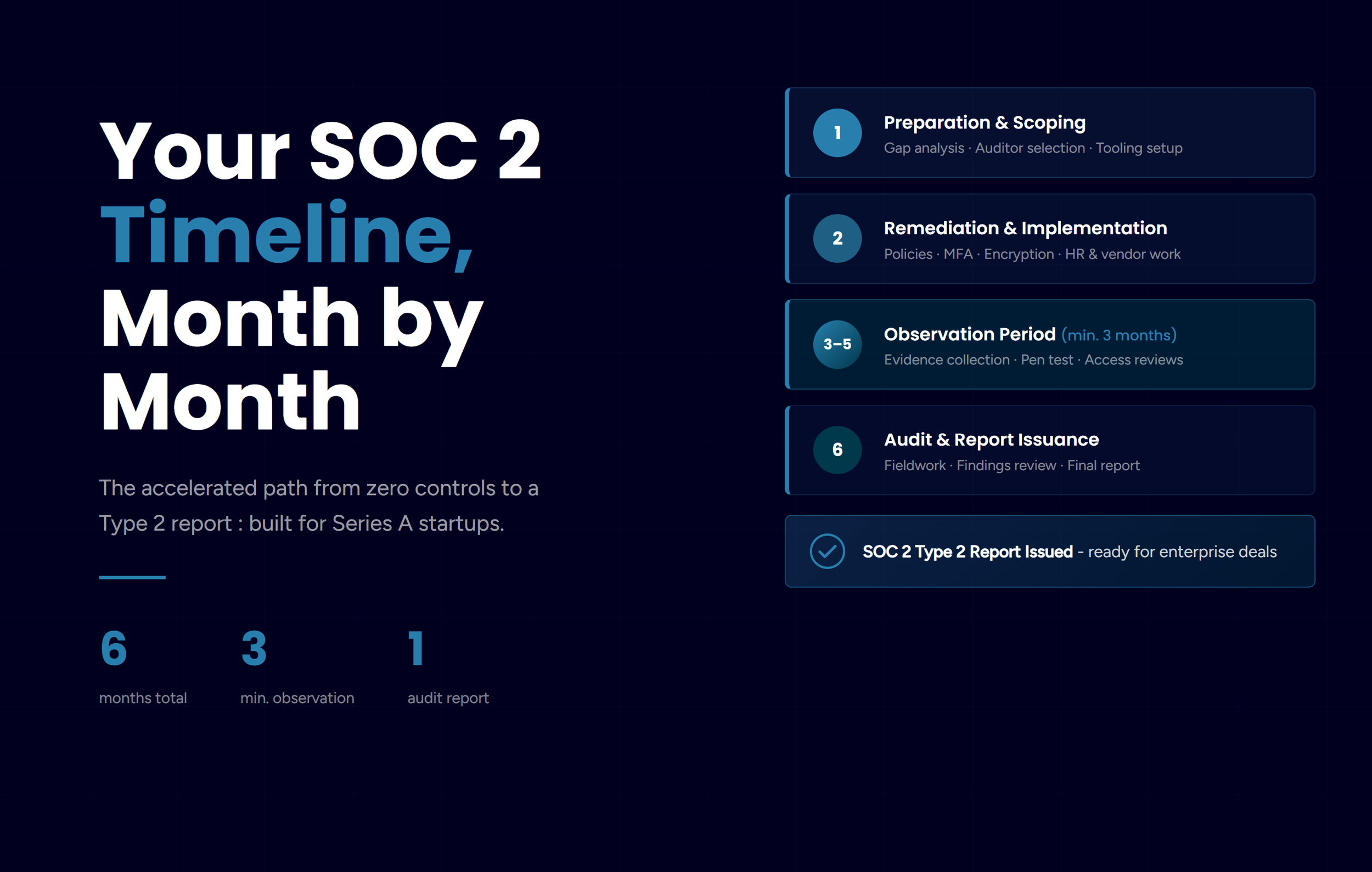
Month 1-2: Readiness assessment and gap analysis.
Month 3-5: Remediation and control implementation.
Month 6-12: Observation period with continuous evidence collection.
Month 13: Audit and report issuance.
Was it worth it? Absolutely. We shortened sales cycles by 30%, won deals specifically because of our compliance status, and achieved 75% faster incident response SLA through the improved processes.
Learn more about essential tools for SOC 2 compliance in our comprehensive case study.
The Bottom Line
For most startups reading this post, the honest answer is: you need Type 2 eventually, so you might as well plan for it from the start.
Type 1 serves a purpose, but it's a stepping stone, not a destination. If you choose Type 1, go into it with clarity about why you're making that choice and what your path to Type 2 looks like.
The worst outcome is pursuing Type 1 without a plan, realizing months later that it doesn't satisfy your customers' requirements, and then starting over with Type 2. We've seen this happen too many times.
The decision framework is simple:
Do your customers require Type 2? → Start with Type 2.
Do you have time to complete Type 2 before you need it? → Start with Type 2.
Can you afford the full Type 2 investment? → Start with Type 2.
Are you building for enterprise scale? → Start with Type 2.
Type 1 is for the specific scenarios where you need an immediate trust signal or have severe constraints. For everyone else, go straight to the gold standard.
How Jones IT Can Help
We've been through this journey ourselves and helped dozens of startups make this decision strategically. We can help you:
Assess Your Actual Requirements
Review customer contracts and vendor questionnaires.
Identify whether Type 1 or Type 2 is truly required.
Create a realistic timeline based on your constraints.
Plan Your Compliance Journey
Conduct readiness assessment.
Identify gaps and prioritize remediation.
Choose the right tools and auditor.
Budget accurately for the full process.
Implement and Maintain Compliance
Deploy and configure security controls.
Set up evidence collection automation.
Manage the observation period.
Coordinate with auditors.
Maintain ongoing compliance.
We're not consultants who hand you a plan and disappear. We do the work with you. Because we're SOC 2 Type 2 compliant ourselves, we understand both the requirements and the practical reality of implementation.
Frequently Asked Questions
Q: Can I go from Type 1 to Type 2 without redoing everything?
A: Yes. The controls you implement for Type 1 are the same ones you'll use for Type 2. The difference is Type 2 requires proving those controls operated consistently over time. Start your observation period immediately after Type 1 and keep collecting evidence.
Q: How long is a SOC 2 report valid?
A: Type 2 reports are typically considered valid for 12 months. After that, you'll need to complete another audit with a new observation period. Most companies establish an annual audit cycle.
Q: What if I get a Type 1 report and my customer still won't accept it?
A: This happens more often than founders expect. If you find yourself in this situation, you'll need to immediately begin the Type 2 observation period. You can show the customer your Type 1 report as evidence of progress while explaining your Type 2 timeline.
Q: Is it better to do 3 months, 6 months, or 12 months for the Type 2 observation period?
A: Most companies do 6 months as a balance between demonstrating operational maturity and getting the report completed reasonably quickly. 12 months provides the strongest assurance but delays your report. 3 months is the minimum and may not satisfy more sophisticated buyers.
Q: Do I need Type 1 before I can do Type 2?
No. You can go straight to Type 2. Many companies do this successfully. Type 1 is optional, not a prerequisite for Type 2.
Q: Can my startup afford Type 2?
A: If you're actively selling to enterprises who require SOC 2, you can't afford NOT to do Type 2. Budget $75K-$200K for small startups (10-50 employees) including all costs. Plan this into your Series A raise if necessarily; investors understand this is required for enterprise sales.

About The Author

Hari SubediMarketing Manager at Jones IT
Hari is an online marketing professional with a focus on content marketing. He writes on topics related to IT, Security, and Small Business. He is also the founder and managing director of Girivar Kft., a business services company located in Budapest, Hungary.

Preparing to scale? Biotech startups need robust IT compliance, IAM, and immutable backups before their next funding round. Learn how to secure your data here.