
Part 1 of 2: Why Autonomous Systems Separate Market Leaders from the Disrupted
The Inflection Point That Changes Everything
If you're still thinking about AI as a tool for incremental efficiency gains, you've already fallen behind. The enterprise technology landscape is experiencing a structural shift that makes previous AI adoption waves look evolutionary by comparison. Agentic AI represents a fundamental reimagining of how organizations operate, not through better tools, but through autonomous systems that think, coordinate, and execute at scale.
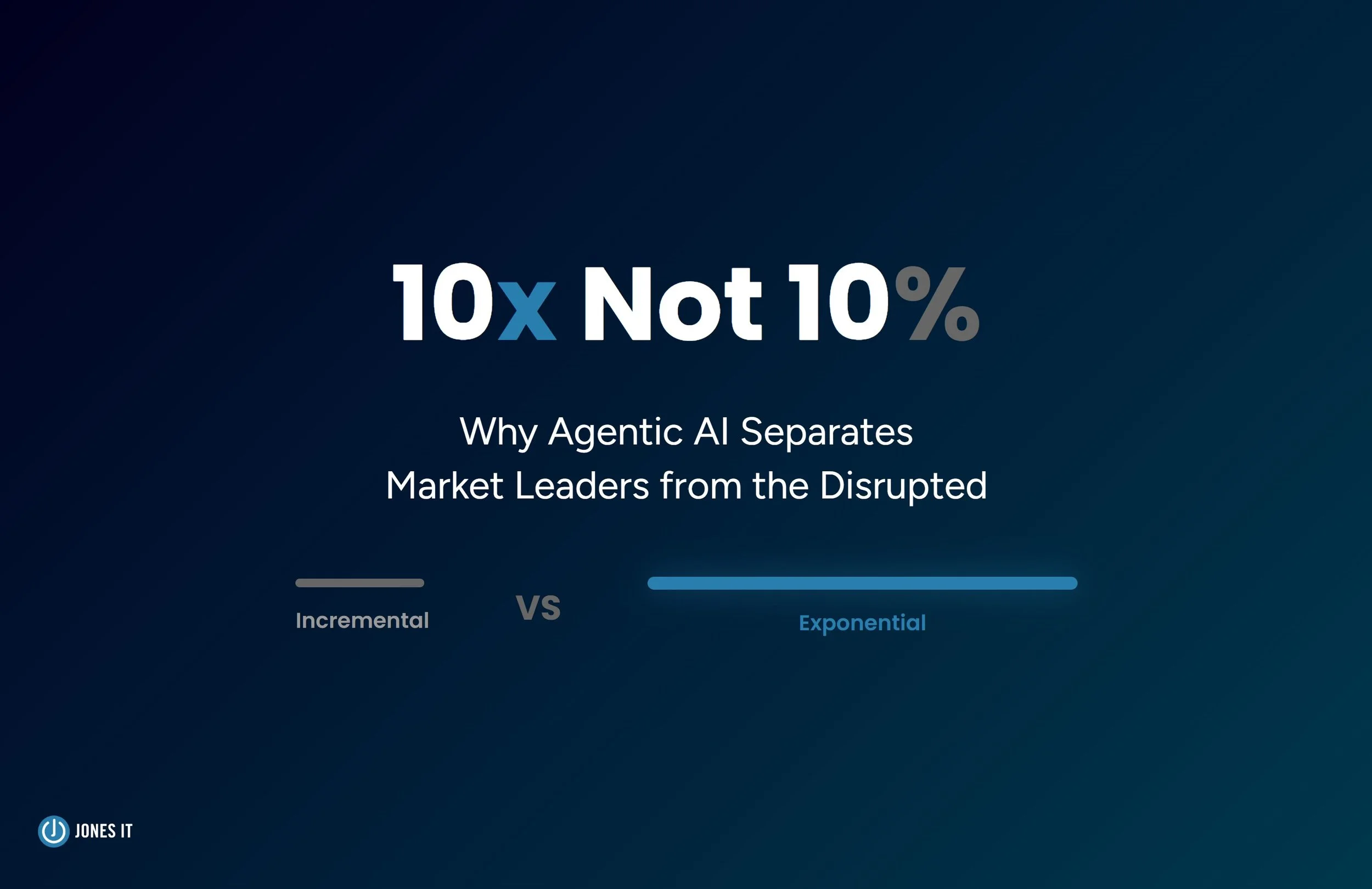
This isn't hyperbole. Organizations implementing agentic AI systems are reporting not 10% improvements, but 10x productivity transformations. The difference between these outcomes isn't incremental investment. It's a categorical difference in strategic vision.
The uncomfortable reality: Companies that approach agentic AI as an automation upgrade will be structurally outcompeted by those building autonomous enterprises. Time is another element that adds to more complexity to this change. The window to lead this transition is measured in months, not years.
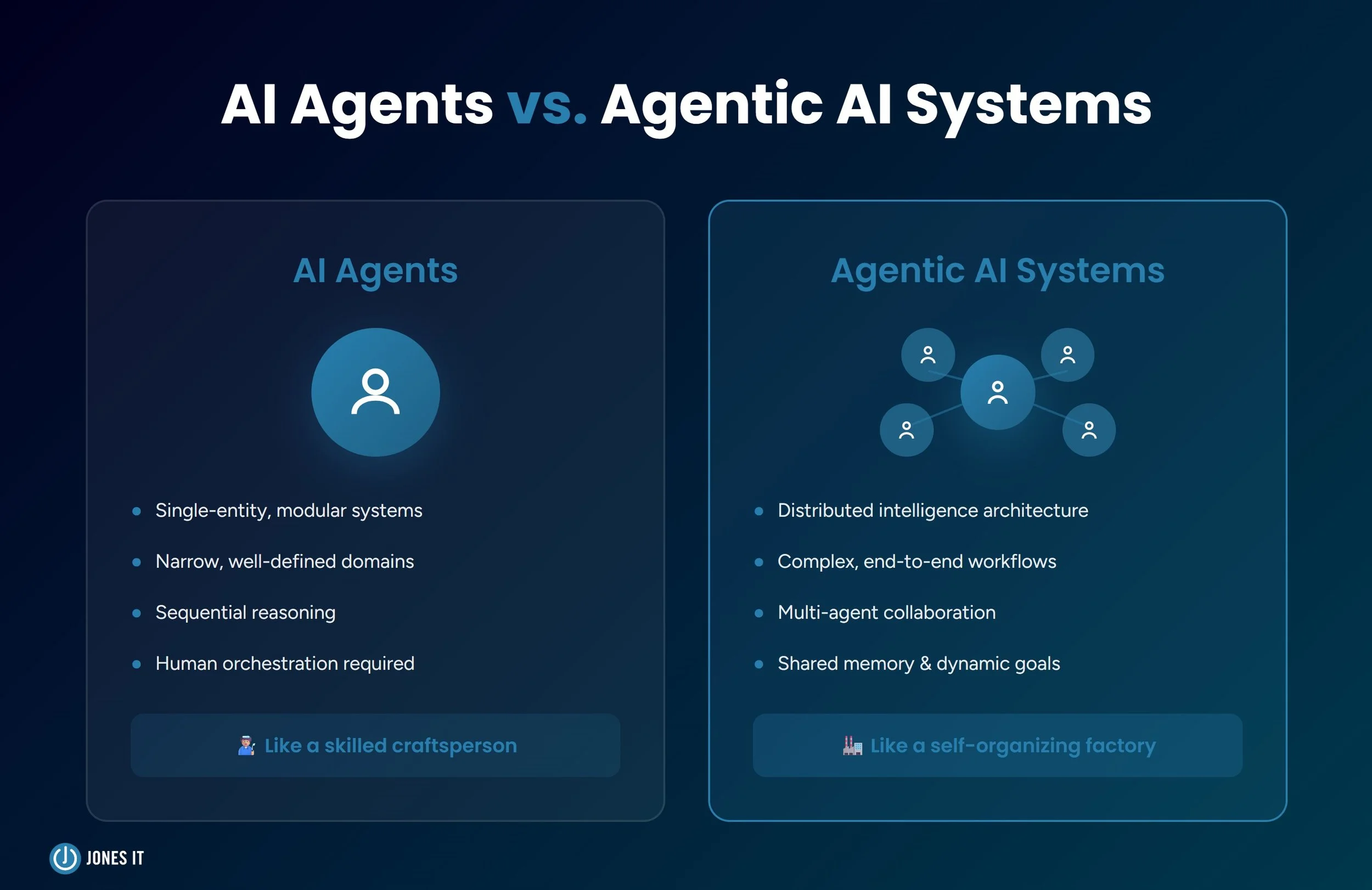
AI Agents vs. Agentic Systems
Here, the terminology matters because the distinction is fundamental. Most organizations have experimented with AI agents: single-entity systems that use large language models (LLMs) to execute specific tasks with external tools. These are sophisticated, useful, and increasingly common.
Agentic AI systems, on the other hand, are categorically different.
AI Agents
Think of AI agents as highly capable specialists with the following characteristics:
Structure: Modular, single-entity systems that leverage LLMs and tools,
Autonomy: High capability within narrow, well-defined domains,
Mechanism: Sequential reasoning using external tools and APIs, and
Goal: Execute a specific task efficiently and accurately.
An AI agent might excel at analyzing customer support tickets, generating code from specifications, or summarizing research papers. Each agent operates independently, requires human orchestration between tasks, and delivers value within its specialized function.
Agentic AI Systems
Agentic AI systems represent orchestrated ecosystems of multiple specialized agents working together. It has the following characteristics:
Structure: Distributed intelligence architectures where multiple agents coordinate seamlessly,
Autonomy: Broad capability managing multi-step, complex workflows end-to-end,
Mechanism: Multi-agent collaboration with dynamic goal decomposition and shared persistent memory, and
Goal: Automate complex workflows and achieve high-level business objectives autonomously.
The critical analogy: AI agents are skilled craftspeople. Agentic AI systems are self-organizing factories where specialized workers coordinate seamlessly, share information through common memory systems, and adapt dynamically to achieve complex production goals with minimal human oversight.
This evolution demands a design philosophy shift from optimizing single-model outputs to architecting distributed intelligence for system-level behavior. You're no longer deploying tools, rather you're building autonomous capability.
Why 10x Matters More Than 10%
Every technology adoption wave creates a divergence between companies pursuing incremental gains and those achieving transformational advantage. Agentic AI amplifies this divergence because the technology itself enables non-linear returns.
The 10x Value Principle
The strategic question you need to ask is: Where can agentic AI deliver exponential ROI rather than marginal improvement?
The answer determines whether you're using cutting-edge technology to automate existing mediocrity or fundamentally reimagining what's possible.
10% thinking looks like this:
Deploy agents to speed up existing processes,
Automate routine customer inquiries,
Accelerate document review cycles, and
Improve forecasting accuracy by single-digit percentages.
10x thinking looks like this:
Create entirely new business models that couldn't exist without autonomous coordination,
Enable real-time, personalized service at scale previously requiring massive human teams,
Solve complex optimization problems across interconnected systems that exceed human cognitive capacity, and
Transform cost centers into revenue generators through capabilities impossible with human-only operations.
The critical distinction is that 10% improvements compete on cost while 10x capabilities compete on value creation through new services, previously impossible experiences, and business models that didn't exist before.
Accelerating the Business Flywheel
Agentic AI doesn't just make things faster. It accelerates the rate at which organizations learn, adapt, and build new capabilities.
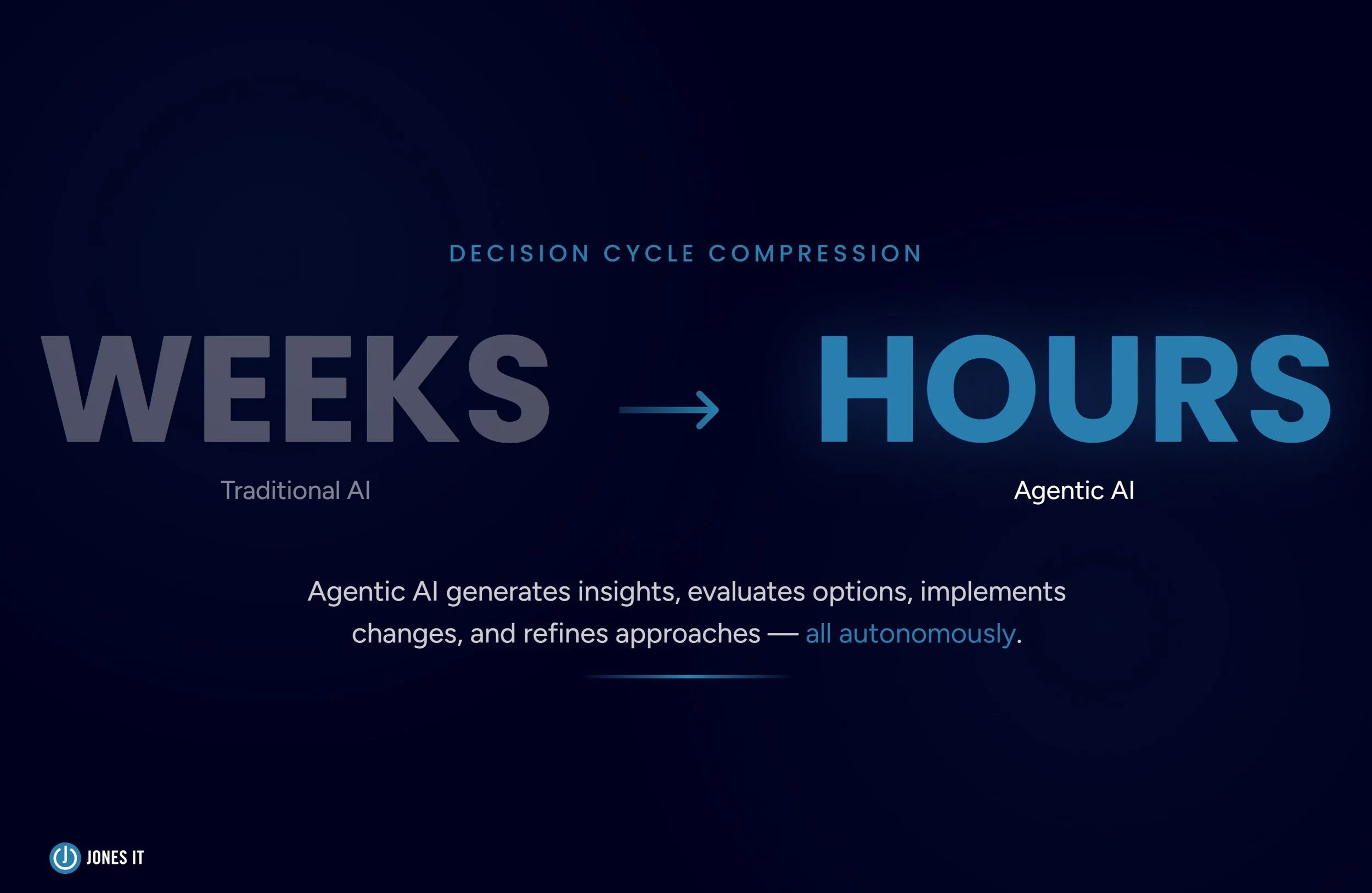
Traditional AI delivers insights that humans interpret and act upon. Implementation requires meetings, approvals, coordination, and execution cycles measured in weeks.
Agentic AI generates insights, evaluates strategic options, implements changes, measures results, and refines approaches, compressing decision cycles from weeks to hours.
Moreover, this acceleration compounds. Organizations deploying agentic systems build capabilities faster, respond to market changes more dynamically, and create feedback loops that continuously improve autonomous operations.
The competitive implication of this is that your competitors aren't just getting more efficient as they're operating at a fundamentally different velocity.
Workflow Reinvention, Not Workflow Automation
Most implementations fail because of bolting agentic capabilities onto existing workflows.
The transformative value only emerges from reimagining entire processes with autonomous agents at the core, eliminating constraints inherent in human-sequential, rule-bound systems.
Example: Customer Support Transformation
Automation mindset: Deploy agents to handle Tier 1 support, escalate complex issues to humans:
Result: Reduce human workload by 30%.
Limitation: Sequential handoffs, context loss, resolution delays persist.
Reinvention mindset: Architect agentic system where specialized agents collaborate on complex issues:
Diagnostic agent analyzes technical details,
Policy agent evaluates contract terms and entitlements,
Solution agent identifies resolution approaches,
Orchestration agent coordinates across systems and escalates strategically.
Result: Resolve complex multi-dimensional issues autonomously that previously required three departments and 48 hours
The difference is that you're not automating the existing process, but designing workflows that leverage autonomous coordination humans can't replicate.
First-Mover Advantages
Whenever there are paradigm shifts, markets reward early movers. Here’s why early movers benefit the most:
Define industry standards: Early implementations establish best practices that become market expectations,
Build network effects: Agentic systems that integrate with partner ecosystems create switching costs,
Accumulate learning advantages: Proprietary data on what works compounds into operational expertise competitors can't purchase, and
Attract talent: The best AI practitioners want to work on cutting-edge implementations, not catch-up projects.
Companies that enter late face markets where competitors have refined autonomous operations, established customer expectations around agentic capabilities, and built cost structures reflecting autonomous economics.
In effect, you're not deciding whether to adopt agentic AI or not, but deciding whether to lead the transition or struggle to compete against organizations that did.
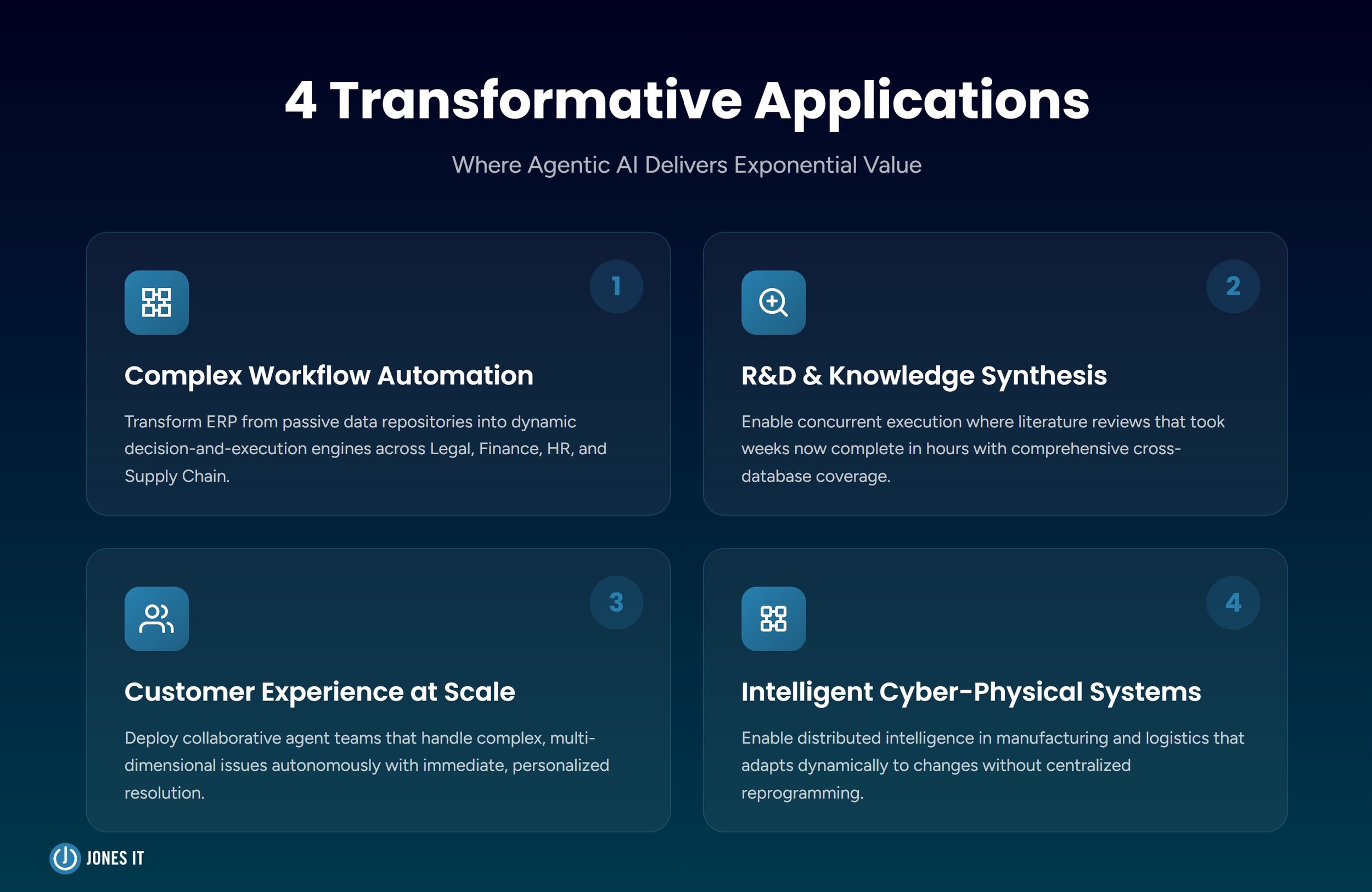
Applications Where Agentic AI Delivers Transformative Value
The most compelling implementations share a pattern in which complexity and coordination challenges overwhelm human-sequential processes.
1. Complex Workflow Automation
The traditional Enterprise Resource Planning (ERP) system is a passive data repository. Humans access information, make decisions, and manually trigger actions across disconnected modules.
Agentic AI transforms ERP into a dynamic decision-and-execution engine where specialized agents continuously monitor, optimize, and act.
Legal Operations:
Contract review agents analyze agreements against policy,
Compliance agents monitor regulatory changes,
Negotiation agents suggest terms based on historical outcomes, and
Execution agents coordinate signature workflows and storage.
Finance Operations:
Reconciliation agents match transactions across systems,
Anomaly detection agents flag unusual patterns,
Forecasting agents update projections based on real-time data, and
Reporting agents generate customized analyses for stakeholders.
HR Operations:
Recruiting agents screen candidates and coordinate interviews,
Onboarding agents orchestrate multi-department processes,
Performance agents track objectives and suggest interventions, and
Compensation agents analyze market data and recommend adjustments.
Supply Chain:
Demand forecasting agents predict requirements across locations,
Procurement agents negotiate with suppliers autonomously,
Logistics agents optimize routing and inventory placement, and
Risk agents monitor supplier stability and geopolitical factors.
The value proposition: Middle and back-office functions operate continuously, respond instantly to changes, and optimize across interconnected constraints that exceed human cognitive capacity.
2. Accelerating R&D and Knowledge Synthesis
Scientific research and knowledge work remain bottlenecked by human serial processing: one literature review, one analysis, one draft at a time.
Agentic R&D systems enable concurrent execution:
Retrieval agents search across databases simultaneously,
Summarization agents distill findings in parallel,
Synthesis agents identify patterns across disconnected research,
Drafting agents generate sections concurrently,
Validation agents cross-check claims against primary sources, and
Citation agents ensure proper attribution and formatting.
Example impact: Literature reviews that require researchers weeks of full-time work now complete in hours, with comprehensive coverage across databases a single person couldn't access in reasonable time.
The transformation extends beyond speed to scope. Agentic systems can maintain coherent understanding across research domains that exceed individual expertise, enabling truly interdisciplinary synthesis.
3. Personalized Customer Experience at Scale
Traditional customer service operates through tiered escalation where simple questions get automated responses, and complex issues get human attention, creating friction and delays.
Agentic customer experience architectures deploy collaborative agent teams:
Context agents assemble complete customer history across touchpoints,
Diagnostic agents analyze technical issues or account anomalies,
Policy agents evaluate contractual terms and entitlements,
Solution agents generate personalized resolution approaches,
Sentiment agents monitor customer emotion and adjust strategy,
Execution agents implement solutions across systems, and
Follow-up agents verify resolution and capture feedback.
This capability shift enables the handling of complex, multi-dimensional issues autonomously that traditionally required coordination across departments and made the delivery of immediate, personalized resolution impossible at scale.
4. Intelligent Cyber-Physical Systems
Manufacturing and logistics face coordination challenges where centralized control creates bottlenecks and fragility.
Agentic robotics architectures enable distributed intelligence through specialized agents working together.
Warehouse automation example:
Picker agents (on individual robots) optimize item retrieval,
Transporter agents coordinate movement between zones,
Mapper agents maintain shared spatial memory of dynamic environment,
Traffic agents prevent collisions and congestion,
Charging agents manage energy across fleet, and
Orchestration agents optimize task allocation based on real-time state.
The advantage of this system is that it adapts dynamically to equipment failures, demand spikes, or layout changes without centralized reprogramming. Each agent optimizes locally while coordination agents ensure system-level efficiency.
Similar architectures apply to agricultural robotics for orchard inspection, construction site coordination, hospital logistics, and smart building systems managing energy and comfort.
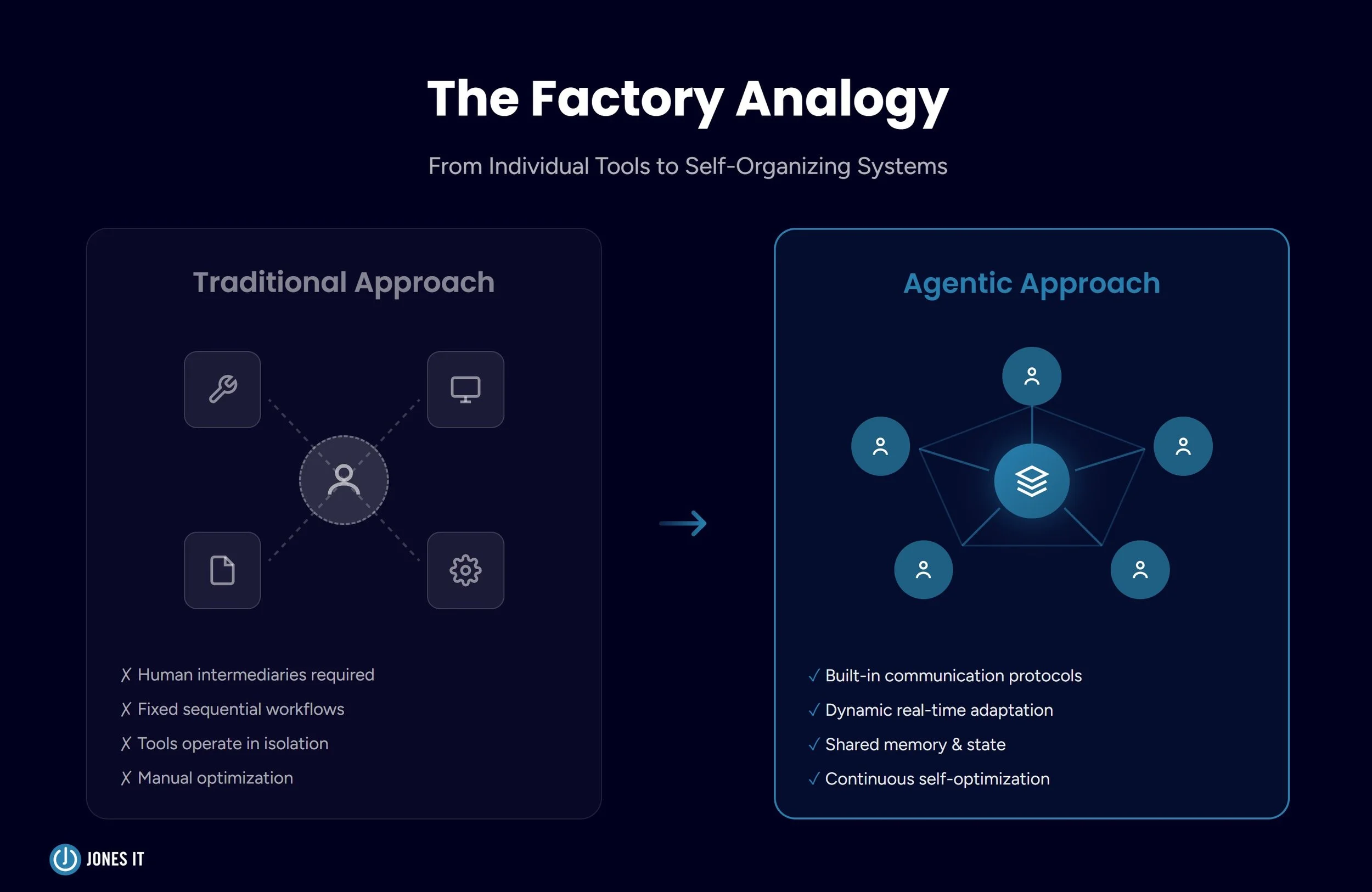
Understanding System-Level Design
Deploying agentic AI resembles building a modern specialized factory, not purchasing better tools.
Traditional approach (AI Agents): You equipped individual workers with sophisticated single-function tools. Each tool excels at specific tasks, but humans coordinate between tools, manage workflows, and ensure work progresses logically from one stage to the next.
Agentic approach (Agentic AI Systems): You're designing an entire ecosystem where specialized robotic arms communicate, coordinate tasks, manage shared resources, and self-correct autonomously, all overseen by human supervisors in strategic roles.
The critical differences:
Communication: Individual tools require human intermediaries. The agentic factory has built-in communication protocols allowing machines to exchange information, request assistance, and synchronize timing.
Shared understanding: Tools operate independently on isolated tasks. The agentic factory maintains shared memory of state, inventory, priorities, and constraints accessible to all components.
Dynamic adaptation: Tool-based workflows follow fixed sequences. The agentic factory adapts in real-time to equipment issues, demand changes, or resource constraints.
Optimization: Humans optimize tool usage sequentially. The agentic factory continuously optimizes across interconnected components for system-level efficiency.
Your role transforms: From operating equipment to architecting the collaborative operating system, you define how components interact, what rules govern coordination, when humans intervene, and how the system improves continuously.
The successful enterprise recognizes this isn't about better automation. It's about designing orchestrated, adaptive systems that produce complex outcomes at scale through distributed autonomous intelligence.
What This Means for Your Organization
Understanding agentic AI is one thing. Successfully implementing it requires navigating substantial technical, organizational, and cultural challenges that kill most transformations before they scale.
The implementation reality: Organizations grasp the potential but struggle to move beyond pilots. Most remain stuck in proof-of-concept purgatory, unable to operationalize because they underestimate the depth of transformation required.
What separates success from failure:
The organizations achieving 10x value recognize this isn't an IT project. It's a fundamental business transformation requiring executive commitment, architectural reimagining, workforce evolution, and cultural change.
In Part 2, we'll cover:
The five critical challenges that kill agentic AI transformations
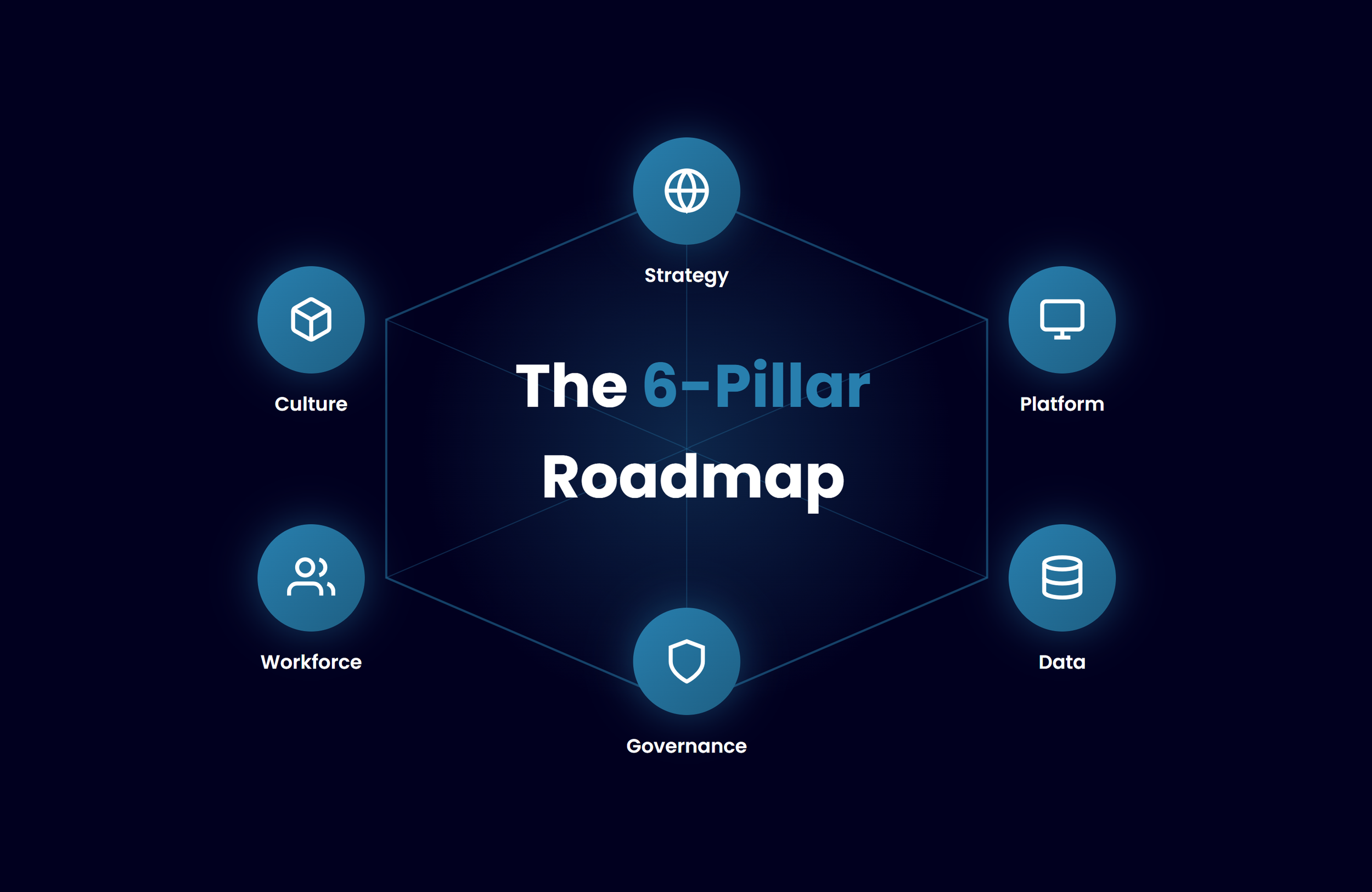
The six-pillar strategic roadmap for successful implementation
How to architect agent-ready infrastructure
Building intelligent data ecosystems that fuel autonomous operations
Governance frameworks for distributed autonomous systems
Workforce transformation and role redesign
Change management strategies that overcome adoption resistance
The Strategic Choice Before You
Agentic AI represents more than technological advancement. It's an economic restructuring where cognitive capital becomes as fundamental as financial capital or human talent.
Organizations approaching this as an IT upgrade will find themselves competing against entities that fundamentally reimagined their operating models around autonomous capabilities. The performance gap won't be incremental. It will be categorical.
The question isn't whether your industry will undergo agentic transformation. It's whether your organization will lead that transformation or struggle to survive it.
Read Part 2: Implementing Agentic AI: The 6-Pillar Transformation Roadmap.
The Bottom Line: You now understand what agentic AI is and why it matters strategically. The next question is how to implement it successfully when most organizations fail to scale beyond pilots. Part 2 provides the roadmap.


About The Author

Hari SubediMarketing Manager at Jones IT
Hari is an online marketing professional with a focus on content marketing. He writes on topics related to IT, Security, and Small Business. He is also the founder and managing director of Girivar Kft., a business services company located in Budapest, Hungary.

AI risk management for SMEs doesn't require enterprise-level resources. Get direct answers on NIST AI RMF, shadow AI prevention, bias mitigation, and vendor security from Jones IT.