
Beyond AI Hype: The ROI-Focused GenAI Playbook for SMEs
Part 1 of 2: Implementation Tactics and Technology Capabilities
"Wait and See" Is Not A Strategy
There's a conversation happening in boardrooms across the country right now. It usually sounds something like this: "We're keeping an eye on AI. We'll move when the time is right."
Here's the problem. The time is already right. And "wait and see" has a translation that nobody says out loud: "fall behind."
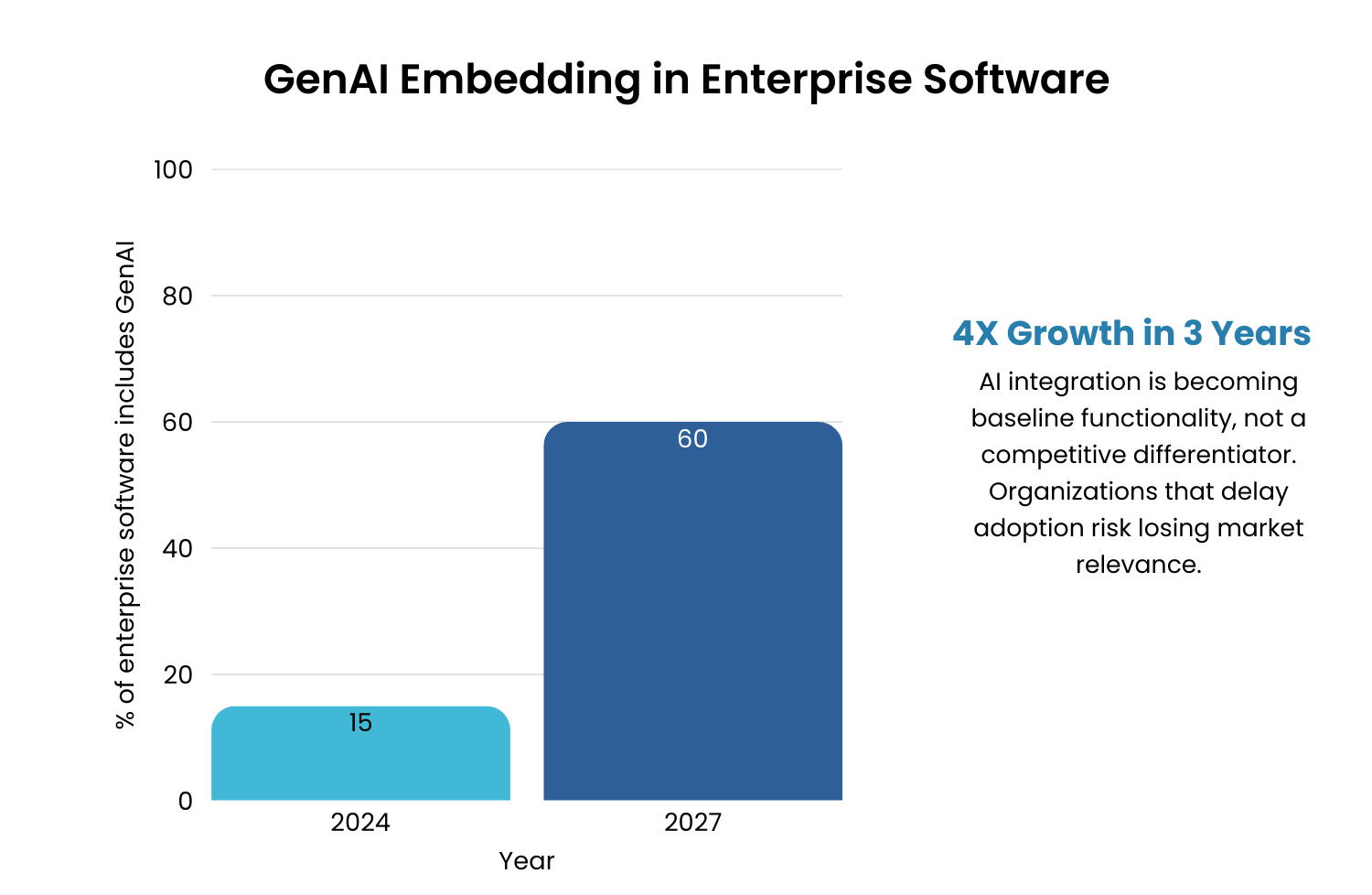
Gartner reports that by 2027, generative AI will be integrated into 60% of enterprise software offerings, up from just 15% in 2024. That's not a gradual shift. That's a market restructure happening in real time. Your competitors aren't waiting. Your customers aren't waiting. And the software you rely on every day is being rebuilt around AI whether you're ready for it or not.
The question facing SME leaders right now isn't whether to adopt GenAI. It's whether you'll do it deliberately enough to actually get value from it.
The Most Common GenAI Mistake
Here's something we see often. A business decides to get serious about AI. They pick a tool, roll it out, and wait for the productivity gains to show up. A few months later, the tool is barely being used and nobody can point to a concrete improvement.
The failure wasn't technical, but It was strategic.
The most common GenAI implementation mistake isn't choosing the wrong tool. It's deploying a tool before you understand what problem you're actually trying to solve.
Before you spend a dollar on AI, do this: map the specific friction points in your current workflows where manual effort is creating bottlenecks. Quantify what those bottlenecks are costing you in time, accuracy, and customer satisfaction. Talk to the people doing the work, not just the managers overseeing it. And define upfront what success actually looks like, which specific metrics will improve, and by how much.
This discipline is what separates AI initiatives that transform businesses from expensive experiments that look good in a slide deck but deliver nothing measurable.
Start With AI Capabilities You Already Have
Here's a counterintuitive insight that saves a lot of money: the most powerful AI implementations aren't always the most sophisticated ones. They're the most seamlessly integrated.
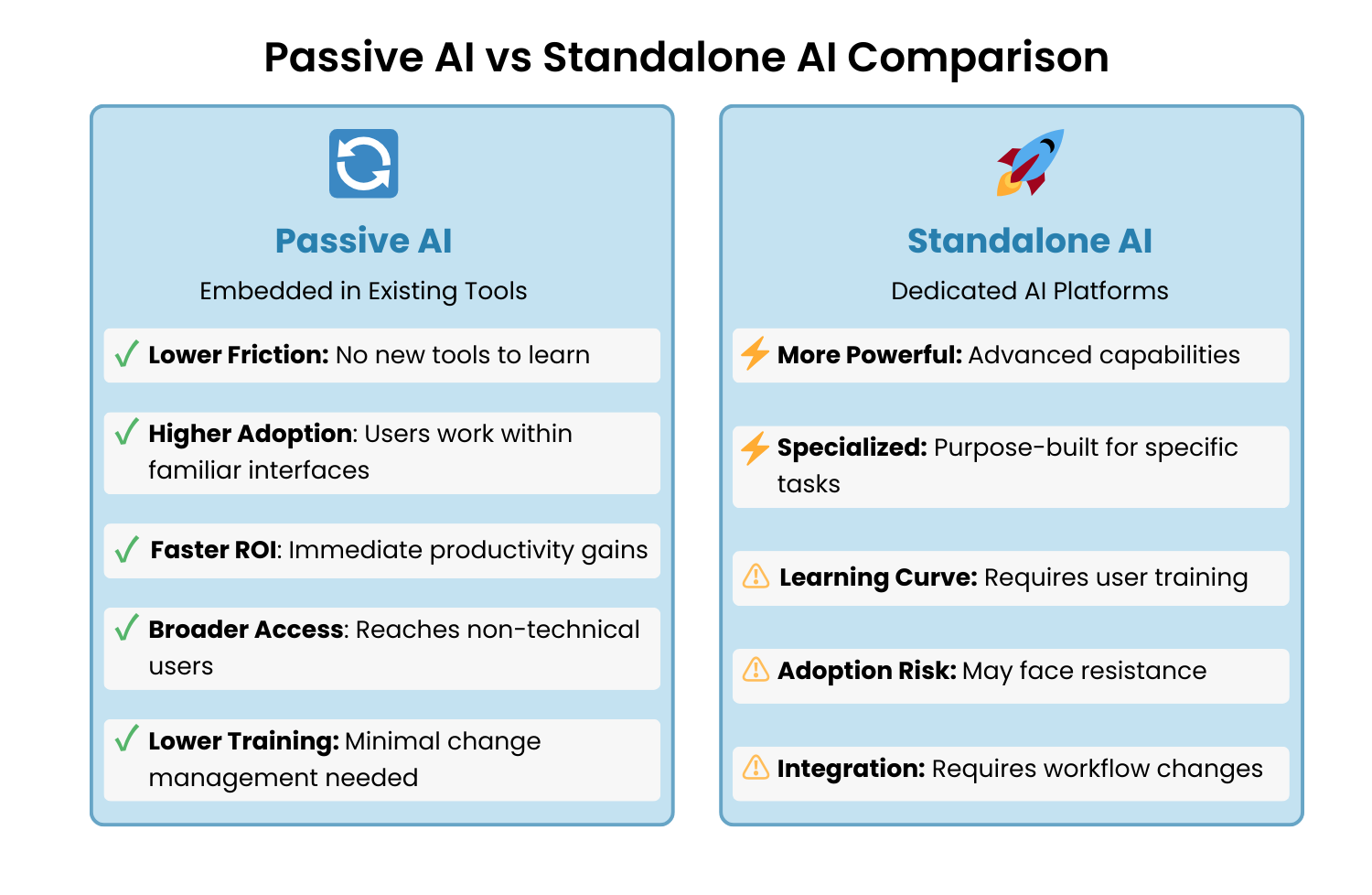
We call this Passive AI. It refers to AI capabilities that are already embedded inside the tools your team uses every day, your office productivity suite, your CRM, your project management platform, your design tools. Users don't have to learn a new interface or change their habits. The AI is just there, inside the workflow they already know.
The advantages are real. There's no learning curve, so adoption happens naturally rather than requiring a change management program. Productivity gains show up quickly because there's no disruption to existing workflows. And the capabilities become available to everyone on your team, including people who would never master a standalone AI tool.
Before you invest in any new AI platform, audit your existing software stack. The tools you're already paying for almost certainly have AI features you're not fully using. Maximizing those embedded capabilities typically delivers better ROI than purchasing new AI-specific tools, and it's where most SMEs should start.
Three AI Capabilities Worth Understanding
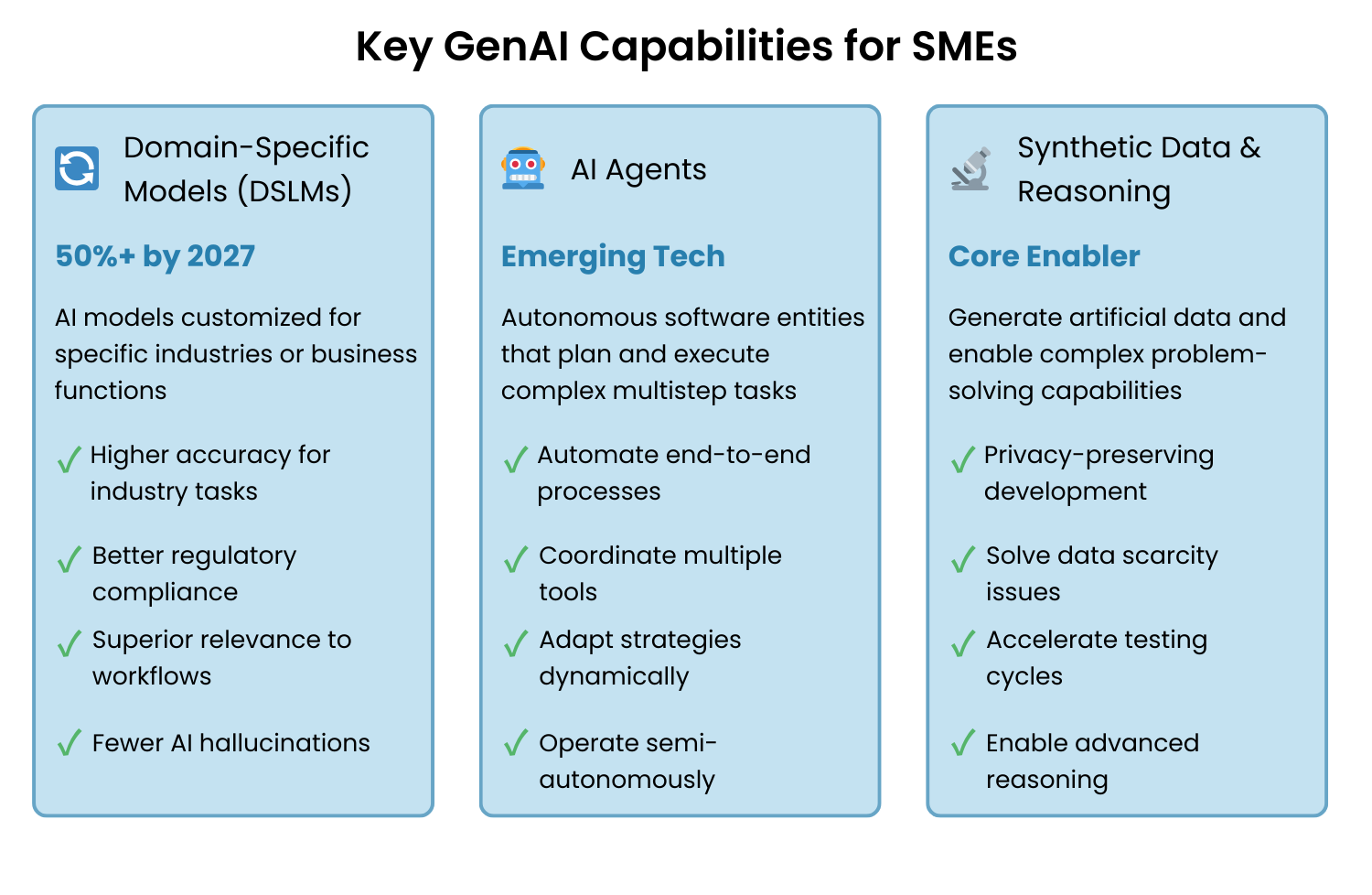
Once you've gotten the most out of your existing tools, there are three emerging capabilities that stand out for their real-world impact on SMEs.
1. Domain-Specific Language Models (DSLMs)
You've probably used ChatGPT or a similar general-purpose AI. These tools are impressive, but they're trained on broad, general knowledge. For specialized business needs, that generality can actually become a liability.
Domain-Specific Language Models, or DSLMs, are AI models fine-tuned for particular industries or business functions: legal contract analysis, medical diagnostics, financial forecasting, technical documentation, customer service for specific sectors. Because they're trained on industry-specific data, they understand your terminology, your regulatory environment, and your workflows in ways that general models don't.
The practical benefits are meaningful. DSLMs tend to be more accurate, more compliant with sector regulations, and less prone to the confident-but-wrong outputs that can cause real problems in specialized fields. By 2027, over half of GenAI models used by enterprises are expected to be domain-specific fine-tuned versions.
For most SMEs, the right move isn't to build or fine-tune these models internally. That requires technical expertise and data resources that most smaller businesses don't have. The better path is to partner with vendors who already offer industry-specific AI solutions, and that market is growing quickly.
2. AI Agents
Today's AI tools are responsive. You ask, they answer. AI Agents are something different: software that can plan and execute complex, multi-step tasks with minimal human input.
The difference is easier to understand with an example. Today's AI: "Draft an email responding to this customer complaint." An AI Agent: "Monitor customer complaints, categorize them by urgency and type, draft appropriate responses, escalate complex issues to human staff, and track resolution times."
Agents can plan sequences of actions, use multiple tools in coordination, adapt based on what they find along the way, and operate within defined parameters without constant supervision. Early implementations are already showing up in software development, sales, customer support, and data analysis.
Most SMEs aren't ready to build AI Agents internally, and that's fine. But it's worth understanding which of your workflows could eventually be transformed by agent-based automation, so you're positioned to move quickly when vendor solutions in your space mature.
3. Synthetic Data and Advanced Reasoning: Solving the Data Problem
Many AI initiatives stall because organizations don't have enough high-quality data to train or test their models. Synthetic data solves that problem by generating artificial data that mimics real-world characteristics without exposing sensitive information.
For SMEs, this is particularly useful in regulated industries like healthcare or finance, where using actual customer data for AI development creates privacy and compliance risks. It's also useful for generating training data for rare scenarios that don't appear frequently enough in real data. And it dramatically speeds up development timelines by making test datasets available instantly.
Cloud AI platforms increasingly offer synthetic data generation as a standard feature. Before investing in expensive data collection or labeling programs, it's worth exploring whether synthetic data can meet your needs.
The SME AI Adoption Playbook
Advanced technology adoption rates are consistently twice as high in large firms compared to smaller organizations. That gap reflects real differences in capital, talent, and risk tolerance. SMEs can't just copy what enterprises do and expect the same results.
What SMEs need is a fundamentally different adoption strategy. Here's what that actually looks like.
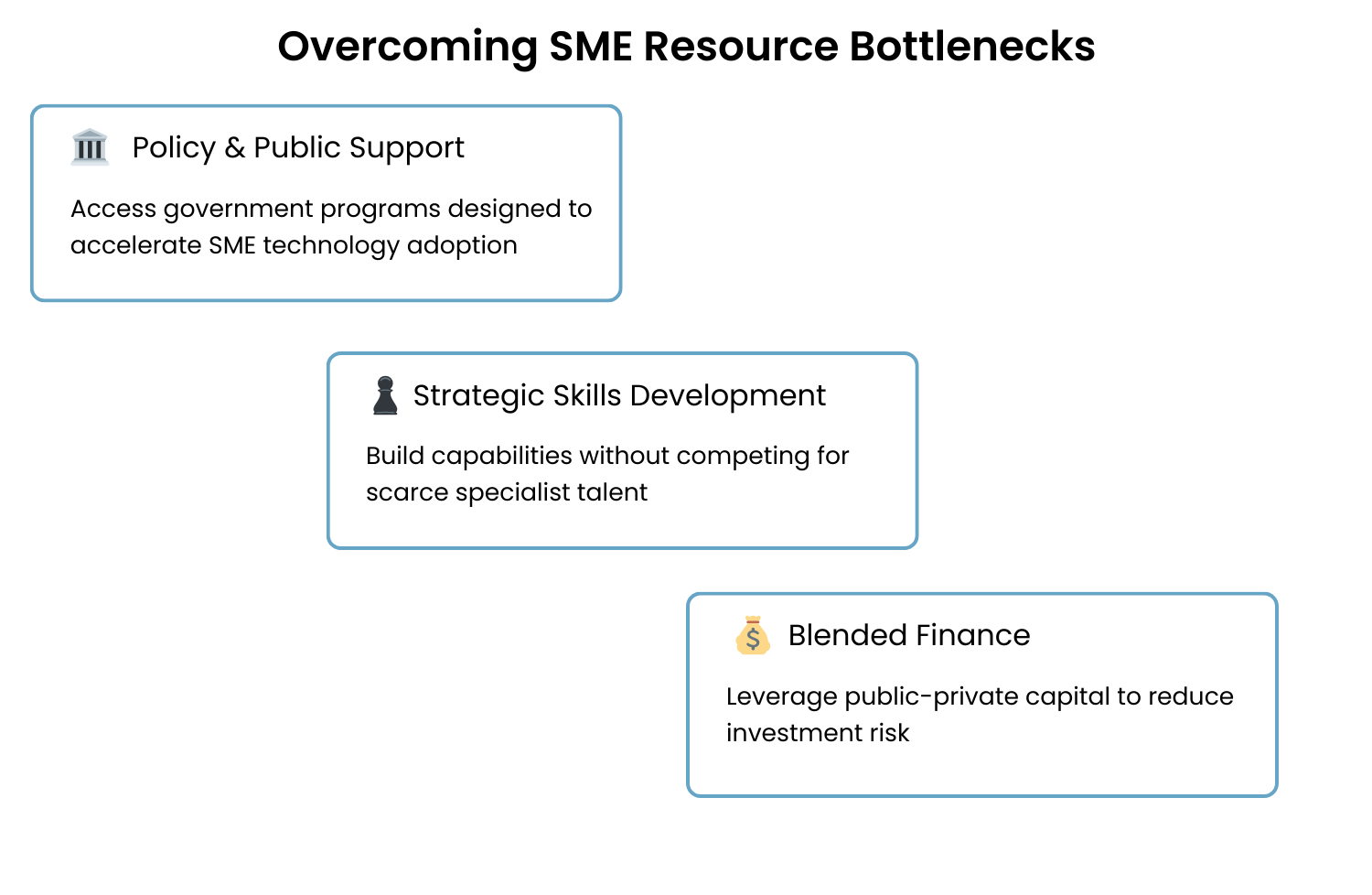
Use the public support programs that already exist. Governments increasingly recognize that SME technology adoption is an economic competitiveness issue, and there's more support available than most business owners realize. Technology diffusion funding, simplified vendor selection guidelines, university collaboration programs, and innovation vouchers are all out there. Your industry association or chamber of commerce can usually point you in the right direction.
Be strategic about the skills gap. You can't out-recruit large enterprises for scarce AI talent, and you probably shouldn't try. Instead, develop your existing team. Look for people who combine domain expertise with technical curiosity, marketers who can get the most out of AI marketing tools, finance professionals who can leverage AI analytics. Joining regional industry consortia to share training costs with other SMEs is another underused option.
Look into blended finance. Governments are experimenting with mechanisms that combine public and private capital to make technology investment more accessible for smaller businesses. This includes loan guarantees, subsidized interest rates, risk-sharing arrangements for technology pilots, and co-investment programs that match private sector investment with public funds. Your regional economic development agency is the right place to start.
A Simple Way to Think About All of This
If the frameworks and capabilities feel overwhelming, here's a mental model that cuts through it.
Think of your organization as a factory floor. GenAI tools, whether domain-specific models, AI agents, or synthetic data capabilities, are specialized modern machinery that can boost your output and quality. But machinery only delivers value if it fits your existing layout and workflow.
Passive AI, the AI already embedded in your existing tools, is like upgrading the machines you already own with better components. Your workers don't need retraining. The floor plan doesn't change. Productivity improves immediately. That's why it should be your first investment.
You're not building a new factory. You're systematically upgrading the one you have, focusing on the improvements that deliver measurable returns while keeping operations running smoothly.
AI Implementation Action Plan For SMEs
Based on everything covered, here's your immediate action plan:
Week 1-2: Audit and Assess
Inventory existing software for embedded AI capabilities.
Identify the top 3 workflow bottlenecks where AI could help.
Research industry-specific DSLM vendors.
Week 3-4: Prioritize and Plan
Define success metrics for each AI use case.
Validate demand with actual users.
Identify applicable public support programs.
Month 2: Pilot and Learn
Start with Passive AI in existing tools.
Launch a small pilot with measurable outcomes.
Document lessons and ROI data.
Month 3+: Scale and Optimize
Expand successful pilots.
Begin vendor evaluation for specialized tools.
Develop internal AI literacy through training.
What's Coming In Part 2
You now have a clearer picture of what to deploy and how to fund it. But there's a critical piece that most implementation guides skip over entirely: rapid AI deployment without proportional security investment creates vulnerabilities that can wipe out every productivity gain you've worked for.
In Part 2 of this series, we cover why SMEs are increasingly prime cybersecurity targets, how to secure AI implementations without an enterprise budget, the managed services approach that levels the playing field, and how to prepare for emerging threats including quantum computing.
Read Part 2: The SME Security Playbook for AI Deployment
The window for deliberate, strategic GenAI adoption is open right now. Organizations that move with focus and ROI discipline will build competitive advantages that compound over time. Those waiting for the perfect strategy will find the market has moved on without them.
The question, therefore, isn't whether to adopt GenAI, it's whether you'll execute quickly enough to shape your competitive position rather than react to it.
At Jones IT, we've guided hundreds of Bay Area organizations through implementation roadmaps, vendor selection, strategic planning, and security. Reach out if you'd like to talk through your specific situation.

About The Author

Hari SubediMarketing Manager at Jones IT
Hari is an online marketing professional with a focus on content marketing. He writes on topics related to IT, Security, and Small Business. He is also the founder and managing director of Girivar Kft., a business services company located in Budapest, Hungary.

Learn to build an IT investment business case that gets approved. We show you how to prove the cost of waiting vs. the cost of acting to win CFO buy-in.