
Updated: June 11, 2026
The call I remember came in on a Monday, from the head of engineering at a SaaS company in Mission Bay. He did not open with the network. He opened with the all-hands. Friday afternoon, the whole company on a video call, their CEO halfway through the quarterly numbers, and the screen froze. Not for him. For everyone. 40-odd people staring at a stalled slide while the audio chopped into syllables. Somebody dropped a laughing emoji in the chat, and then somebody else, and the CEO had to finish the quarter to a wall of frozen faces.
That was the thing that made him call. Not the months of small failures before it, the ones everybody had quietly learned to route around. By the time we talked, the team had a whole folklore of workarounds. You did not push a big build between two and three, because that was when people got back from lunch, and the VPN went underwater. You tethered to your phone for anything that mattered. You scheduled the demo for the conference room with the good signal, because the other rooms were a coin flip.
None of that had ever made it onto a list of problems, because none of it had ever broken hard enough to be a problem. It was just friction, and friction is easy to absorb when you are busy. Then the all-hands froze in front of the entire company, and suddenly the friction had a face.
What Was Actually Wrong With Their IT Infrastructure
Here is what I have learned in over a decade of getting these calls. The thing that breaks is almost never the thing that is wrong. The frozen all-hands was a symptom. The actual issue was that this company was running a 40-person operation on infrastructure that had been sized, sensibly, for a 12-person one.
When they set it up, they were a seed-stage startup in a small office, and somebody, probably a smart engineer doing IT on the side, bought good consumer gear and wired it up over a weekend. That was the correct decision at the time. I want to be clear about that, because founders beat themselves up over it. For 12 people, a prosumer router and a couple of access points is not a shortcut. It is the right call. You do not buy enterprise networking for a team that fits around one table.
The problem was that the setup did not have a “next gear”. They had gone from 12 to 22 to 41 in not much more than a year, and every one of those people brought a laptop, a phone, sometimes a tablet, all of it hammering the same access points and the same single internet line that had been comfortable at a third of the load. The router was holding more simultaneous connections than it was ever built for. The one internet circuit had no backup, so an afternoon of heavy use and a flaky ISP were enough to bring the whole office to its knees. And the engineer who owned all of this had long since stopped being able to fix it on the side, because keeping it limping along had quietly become a part-time job he never signed up for.
That last part is the one founders underestimate most. When IT infrastructure does not scale, it does not just degrade quietly in a closet. It reaches out and takes a chunk of your most expensive person's week. At this company, one of their strongest backend engineers was spending afternoons power-cycling access points instead of writing the product the round had been raised to build. That is the real bill for infrastructure that cannot grow, and it almost never shows up on the invoice.
Patch or Rebuild: The Choice Every Scaling Company Faces
When we sat down with them, the question on the table was not really “what router should we buy.” It was the question underneath that, the one that decides how the next two years go: do you keep patching what you have, or do you build something that can grow?
Patching is seductive because each individual patch is cheap. Add a mesh extender here. Reboot on a schedule. Move the heavy users to a different room. Every one of those is a small, defensible decision, and together they are how companies end up rebuilding their entire infrastructure under emergency conditions eighteen months later, usually right when a big customer or an investor is watching. The dirty secret of the cheap patch is that you pay for it twice. Once when you buy it, and again when you rip it out.
Building for scale costs more on day one and less over the life of the thing. The whole craft of it comes down to a simple idea: design systems that can expand without being torn out. That is what scalable infrastructure means in plain terms: infrastructure that gains capacity as you grow instead of hitting a wall you have to demolish. Everything technical we did for that Mission Bay company was in service of that one idea.
How We Made Their IT Infrastructure Scalable
I will walk through the real decisions, because the reasoning matters more than the parts list. The parts change every couple of years. The thinking does not.
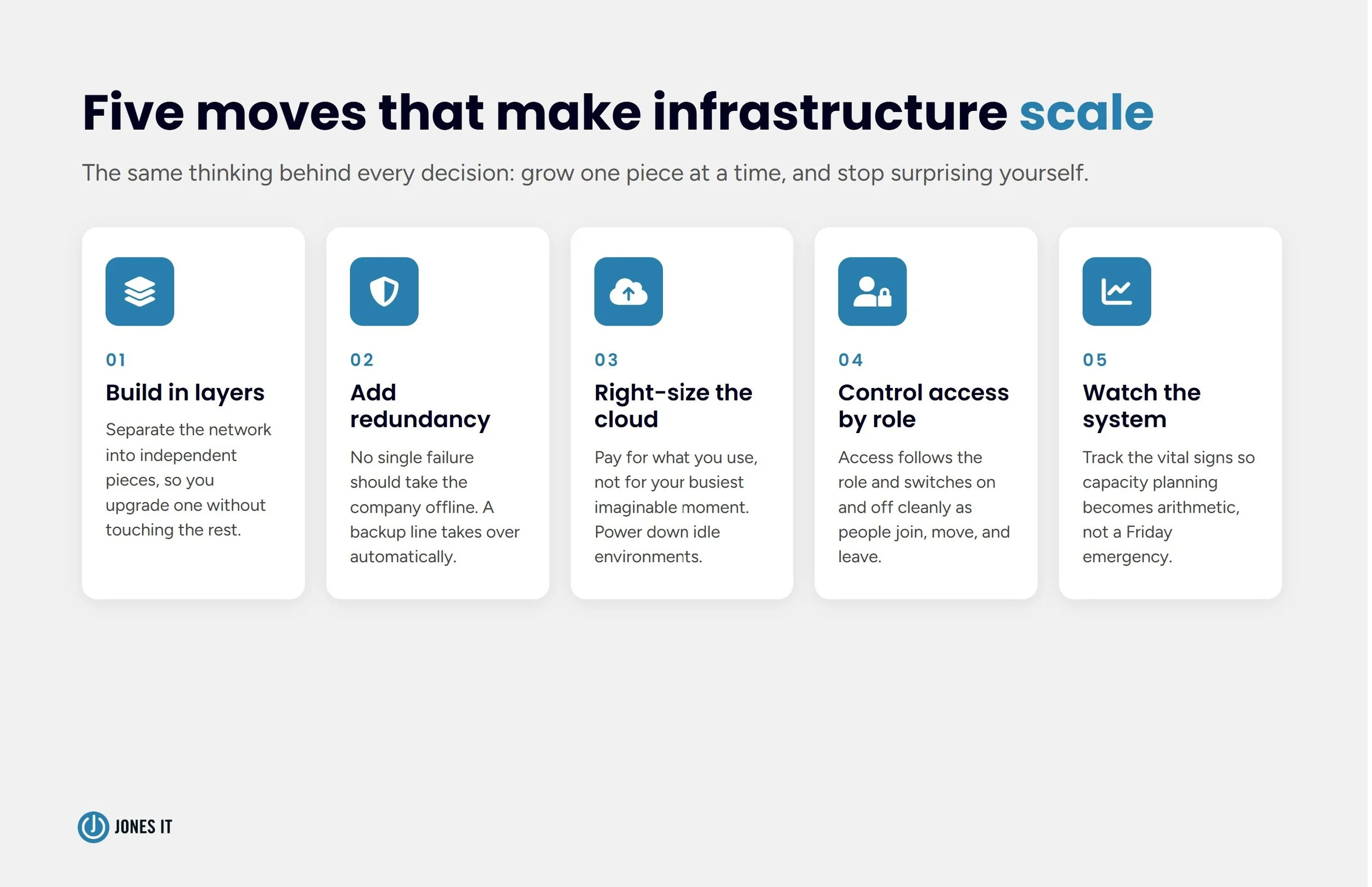
The first move was to stop treating the network as one fragile thing and start treating it as separate layers that could each grow on their own. This is the single most useful idea in all of infrastructure design, and it has an ugly name: modularity. In practice, it just means you build out of pieces that do not depend on each other, so when one piece hits its limit you upgrade that piece alone instead of touching everything. We segmented their network so the guest Wi-Fi, the office devices, and the production-adjacent systems lived in their own lanes. The day they later needed more wireless capacity, we added access points to a network that was already built to receive them. No rebuild. An afternoon, not a weekend.
The second move was redundancy, which is a fancy word for not having a single thing whose failure ruins your day. They had one internet circuit, so a single ISP hiccup was a company-wide outage. We added a second line on a different provider that takes over automatically when the primary drops. The first time their main circuit went down after that, nobody noticed, which is exactly the point. Good redundancy is invisible. We did the same thinking at the hardware level, so no one box failing could take down the office. When you are 12 people, one of everything is fine. When an outage means 40 people cannot work and a customer call drops, one of everything is a gamble you have decided to keep making.
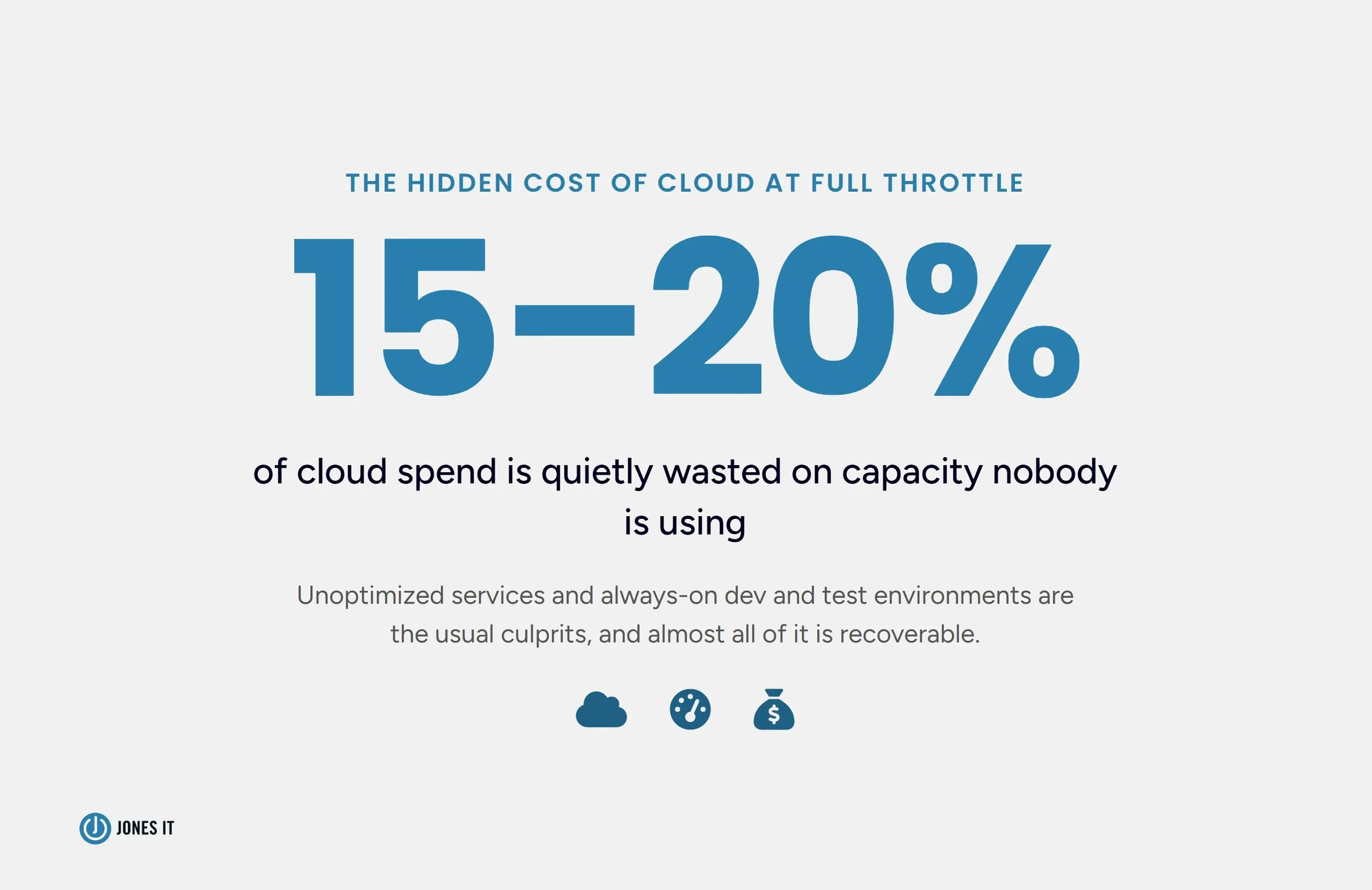
The third move lived in the cloud rather than the office. A lot of what strains a growing company is not the building; it is the compute, and the elegant thing about cloud infrastructure is that it stretches and shrinks on demand. You can resize a single server when one workload gets heavy, the approach people call scaling up, or you can spread the load across many machines and add more as you grow, which is scaling out. The catch nobody warns you about is the bill. Cloud that is left on its highest setting around the clock is how startups quietly burn fifteen to twenty percent of their cloud spend on capacity they are not using. We matched their resources to their actual demand, right-sized what was oversized, and set non-production environments to power down when nobody is using them. The AWS Well-Architected Framework is the reference I point teams to when they want to formalize this kind of thinking, but the instinct is simpler than the document: pay for what you use, not for what you might use at your busiest imaginable moment.
The fourth move was about people, not gear. As a team grows, the question of who can touch what stops being academic. At 12 people, you trust everyone with everything because you have to. At 40, that same openness is a liability, and at eighty it is a finding in your first security review. We put role-based access in place, which simply means access follows your role and gets switched on and off cleanly as people join, move, and leave. It is a security measure, but it is also a scaling measure, because the alternative is an ever-growing tangle of one-off permissions that nobody fully understands by the time you are a hundred people.
The last move was the one that makes all the others sustainable: we started watching the system on purpose. Before, the way they found out about a problem was that the problem found them, usually in front of an audience. We put monitoring in place that tracks the boring vital signs, how hard the processors are working, how much memory is in use, how much traffic the network is carrying, how fast applications respond. The value is not the dashboard. The value is that capacity planning turns into arithmetic. When you can see memory climb five points a month for three months, you know roughly when you will run short, and you provision for it on a calm Tuesday instead of discovering it on a Friday all-hands.
The Principles Behind Scalable IT Infrastructure
If you strip away the specific gear, every one of those decisions was the same decision wearing different clothes. Build in layers so you can grow one piece at a time. Never let a single failure become a company failure. Pay for what you use. Decide who can touch what before the answer gets complicated. Watch the system so it stops surprising you. That is the whole philosophy. The brands and the model numbers underneath it will be different by the time you read this, and it will not matter, because the thinking is what scales, not the hardware.
The network layer specifically has more depth to it than I can fairly cover inside one company's story, and if that is where your pain is right now, we have written a fuller treatment in our guide to enterprise network best practices for performance, security, and scalability. And if the reason all of this is suddenly urgent is that you have a round closing or a raise on the horizon, the IT side of that conversation has its own shape, which we cover in our IT infrastructure checklist for Series A startups and our guide to scaling IT after Series A funding.
What Scaling IT Infrastructure Buys You
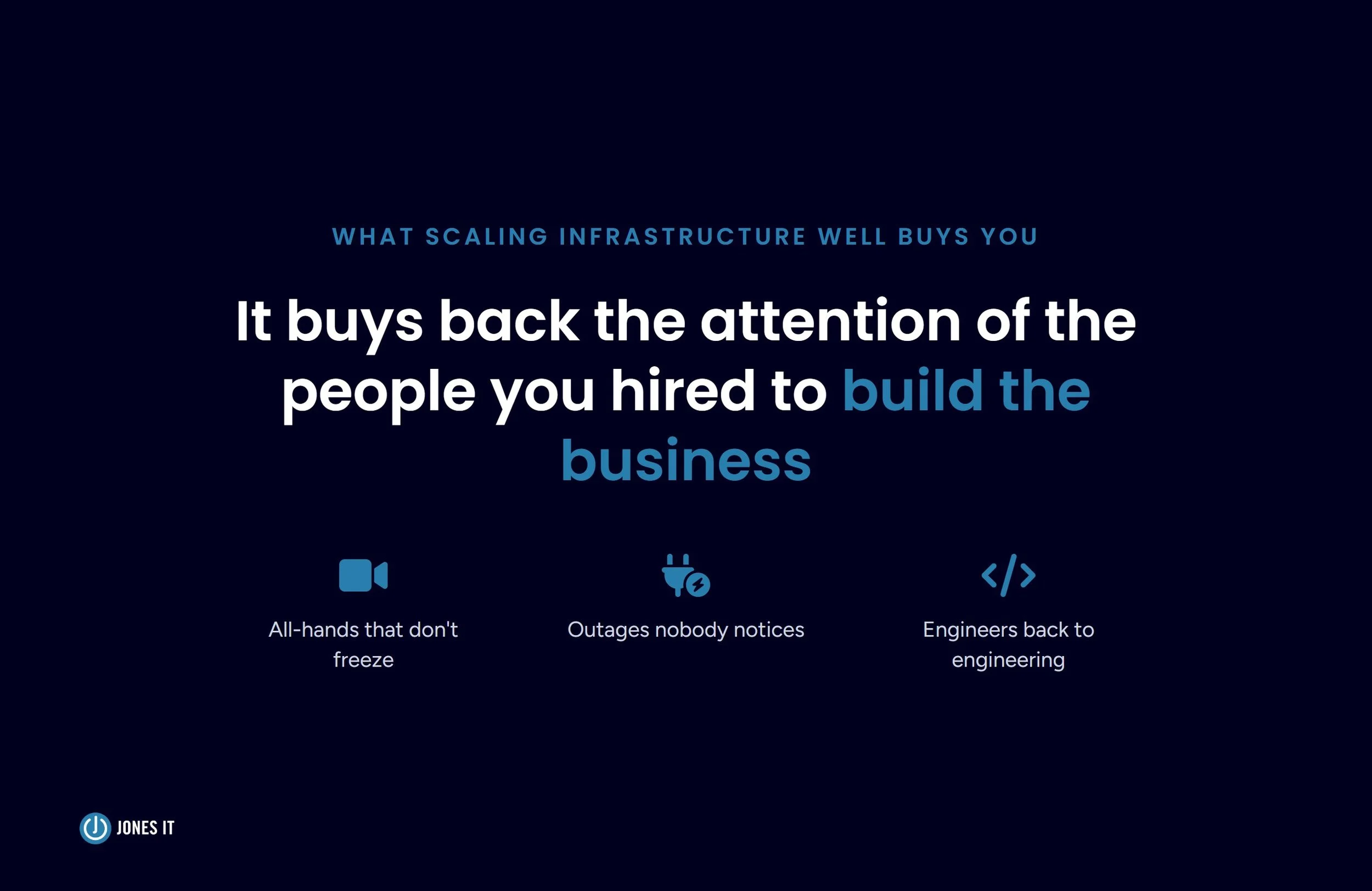
The Mission Bay company is past all of this now. The all-hands does not freeze. The VPN does not have a forbidden hour. Most telling, the backend engineer who used to spend his afternoons rebooting access points went back to writing backend code, which is the thing the company was actually paying him to do and the thing the round was actually raised to fund. That is what scaling infrastructure well buys you. Not a faster network, although you get that too. It buys back the attention of the people you hired to build the business.
Here is the part I want founders to hear most. The work we did was not exotic. There was no heroics in it, no clever trick. It was a set of unglamorous decisions made a little before they were forced, instead of a little after. That timing is the entire difference between scaling and rebuilding. The companies that grow smoothly are not the ones with the best gear. They are the ones who made these calls while they still had the room to make them calmly.
If your own version of the frozen all-hands has not happened yet, that is the best possible time to look at this. And if it just did, that is fine too; it is the reason most people call us. Reach out to Jones IT, and we will give you an honest read on where your setup is going to strain as you grow, and a plan that fits your team and your runway.


About The Author

Sarang JoshiCTO at Jones IT
Sarang Joshi leads and mentors the engineering team at Jones IT. With a Master's in Computer Engineering from San Jose State and over a decade of hands-on experience, he's the person we call when the toughest infrastructure problems show up. Cisco, Meraki, AWS, Azure, you name it, Sarang has probably debugged it at 2 am and still made it to standup.
Learn how IT support for VC firms works best as a shared baseline. Protect your portfolio companies without adding a central help desk operational burden.