
They came to us six weeks before their go-live date. A digital health startup, Series A funded, with a platform that collected and processed protected health information. Their previous MSP had handled the basics well enough: devices were set up, onboarding ran smoothly, and the helpdesk was responsive. But when their privacy officer sat down to map out their HIPAA Security Rule controls, a pattern emerged. The IT environment was not built with PHI in mind. Encryption was inconsistent. Audit logging was incomplete. And when she asked the MSP to sign a Business Associate Agreement, they came back a week later with a document that showed they did not fully understand what they were agreeing to.
Six weeks is not a lot of runway to rebuild an IT foundation while simultaneously preparing for launch. We have seen this situation enough times to know: it is not the MSP's fault for being generalists. It is a mismatch problem. Healthcare startups have specific requirements that most IT providers were not built to meet. Knowing what those requirements look like, before you sign with an MSP, saves a lot of pain.
Here is what HIPAA-compliant IT support for healthcare startups needs to look like.
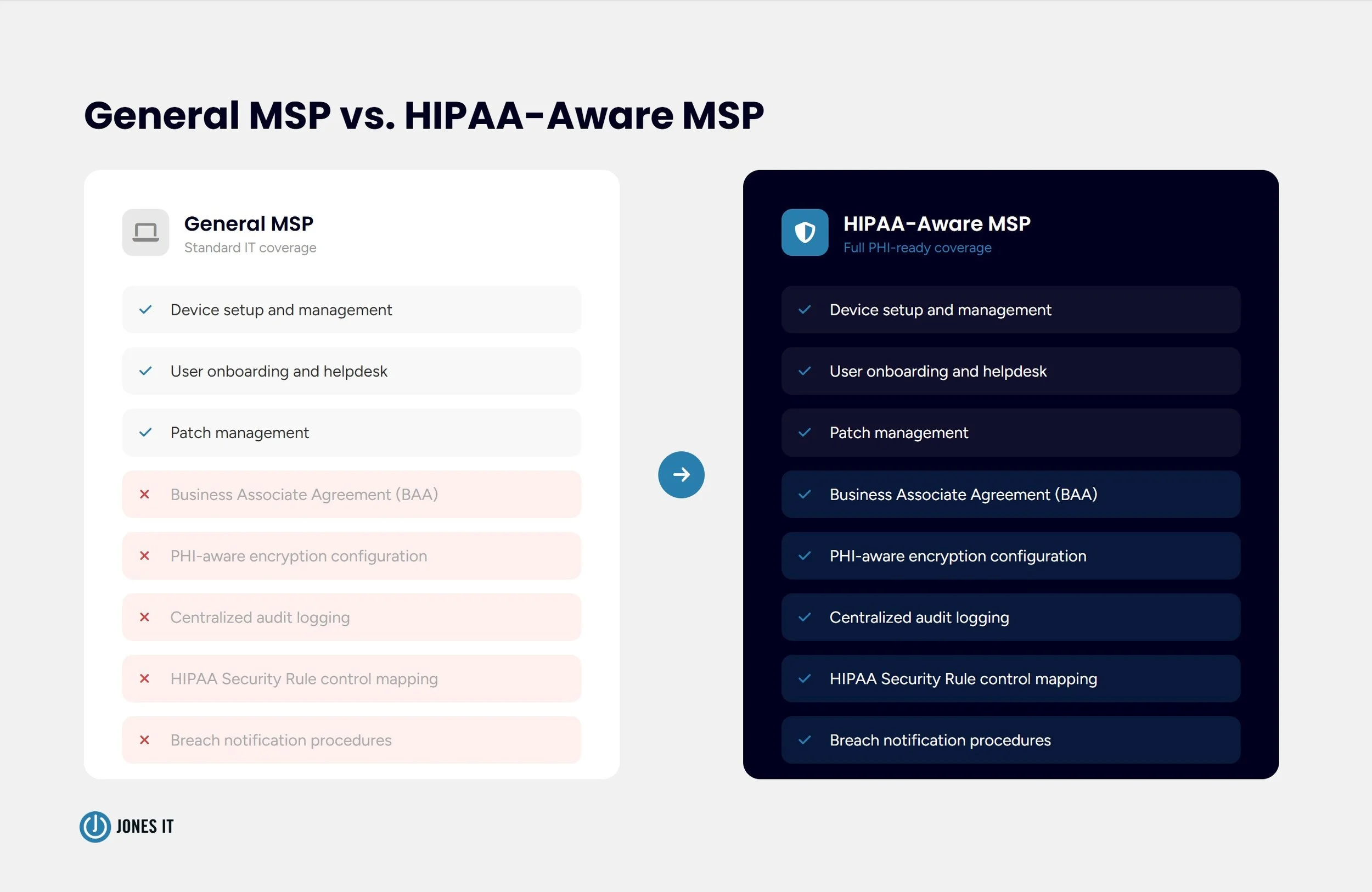
What Healthcare Startups Need From IT That General MSPs Miss
The gap is not dramatic in most cases. General MSPs are competent at what they do: device management, user provisioning, patch cycles, and helpdesk support. For a SaaS startup or a professional services firm, that coverage is more than enough. But healthcare startups handle PHI, and PHI changes the math entirely.
HIPAA’s Security Rule does not tell you what specific technology to use. It specifies categories of safeguards (administrative, physical, and technical) and requires covered entities and their business associates to implement them. The flexibility sounds nice in theory. In practice, it means that unless your MSP understands which of their configurations count as HIPAA controls and which do not, you will end up with an IT environment that looks fine on the surface and fails an audit underneath. Before diving into the specific IT controls your MSP should manage, it helps to understand the regulatory foundation. If you're new to these requirements, check out our guide on what HIPAA compliance entails and how to get started.
I have seen this play out in several ways. An MSP deploys endpoint encryption on company-owned laptops but leaves mobile devices unmanaged. Another configures access controls but never documents them, so there is no audit trail when HHS asks for evidence. A third does not know that their remote monitoring tools require a BAA because those tools touch systems where PHI lives. Each of these is a manageable problem when caught early, but during a breach investigation or an OCR audit, they are something else entirely.
What healthcare startups need is an MSP that treats HIPAA compliance as part of the IT architecture from day one, not a layer added after the fact when the compliance team raises the alarm.
Business Associate Agreements: The Baseline Your MSP Must Clear
The Business Associate Agreement is the first test. If your MSP touches any system where PHI lives, or provides services that give them access to PHI, they are a business associate under HIPAA. That means a signed BAA is legally required before they do any work in your environment.
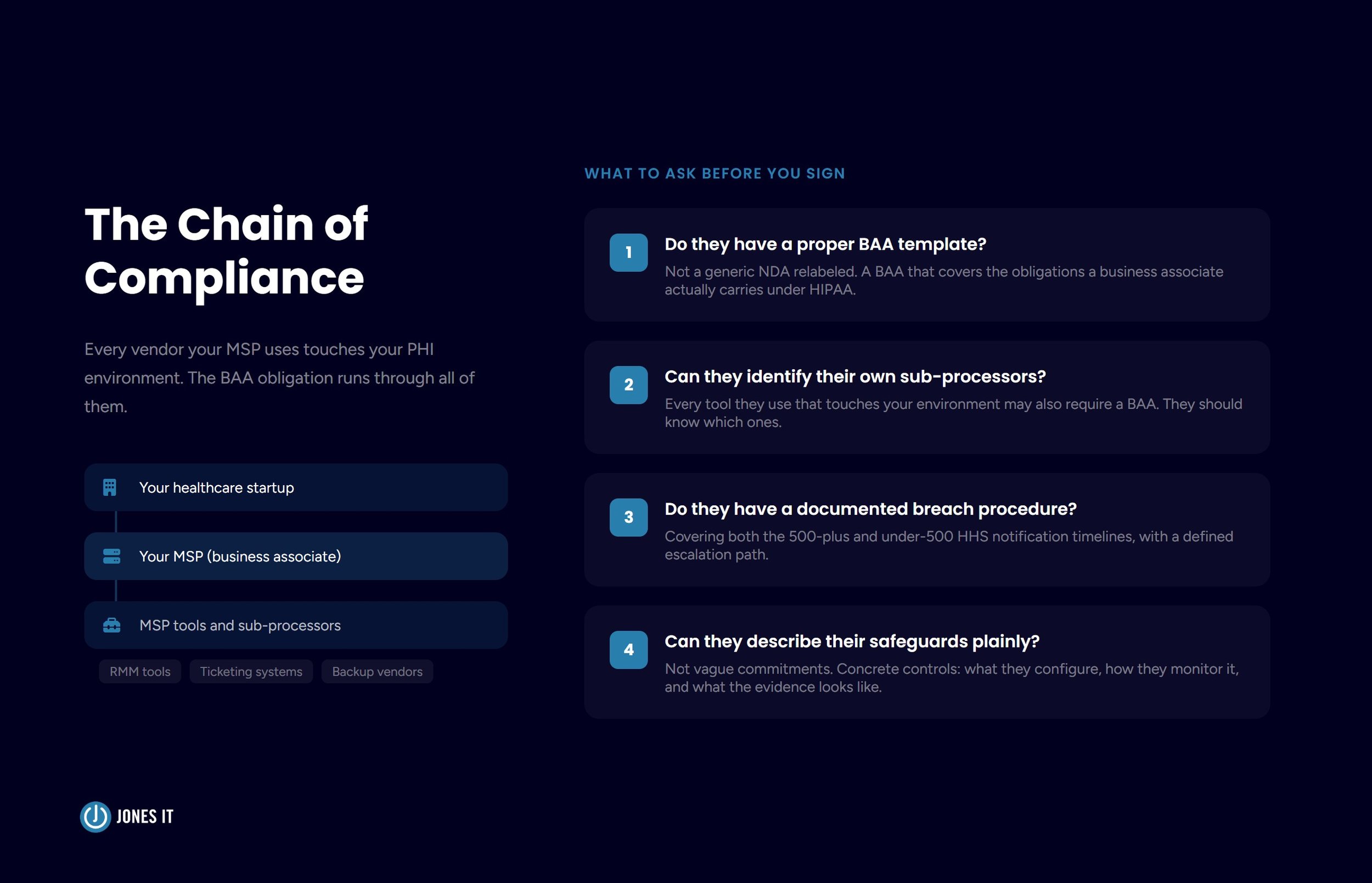
A lot of MSPs will sign a BAA, but few understand what it obligates them to do. The BAA is more than paperwork. It binds the MSP to the same HIPAA Security Rule requirements that apply to you as a covered entity. It requires them to report breaches, to implement safeguards, and to ensure that any subcontractors they use (like their remote monitoring tools, their ticketing system, their backup vendor) also have BAAs in place. The chain of compliance runs through them.
When we evaluate whether an MSP is HIPAA-aware in practice, the BAA conversation is revealing. Here is what to listen for:
Do they have a template BAA, or do they send you a generic NDA and call it close enough?
Can they identify which of their own tools and sub-processors would require their own BAAs?
Do they have a documented breach notification procedure covering both tiers: notifying HHS within 60 days of discovery for breaches affecting 500 or more individuals, and within 60 days of the end of the calendar year for smaller breaches? (See HHS.gov for current requirements)
Can they describe what “safeguards” they implement, in plain terms?
An MSP that hesitates on any of these is telling you something important. The BAA is the foundation and everything above it depends on their understanding of what they signed.
The startup that came to us in that six-week scramble had a signed BAA with their previous provider. But when we reviewed it, the document had been modified in ways that removed several of the standard obligations. Whether that happened intentionally or through carelessness, we could not say. Either way, it was not enforceable as written. Starting over with a clean BAA and a provider who understood its implications was the first thing we did.
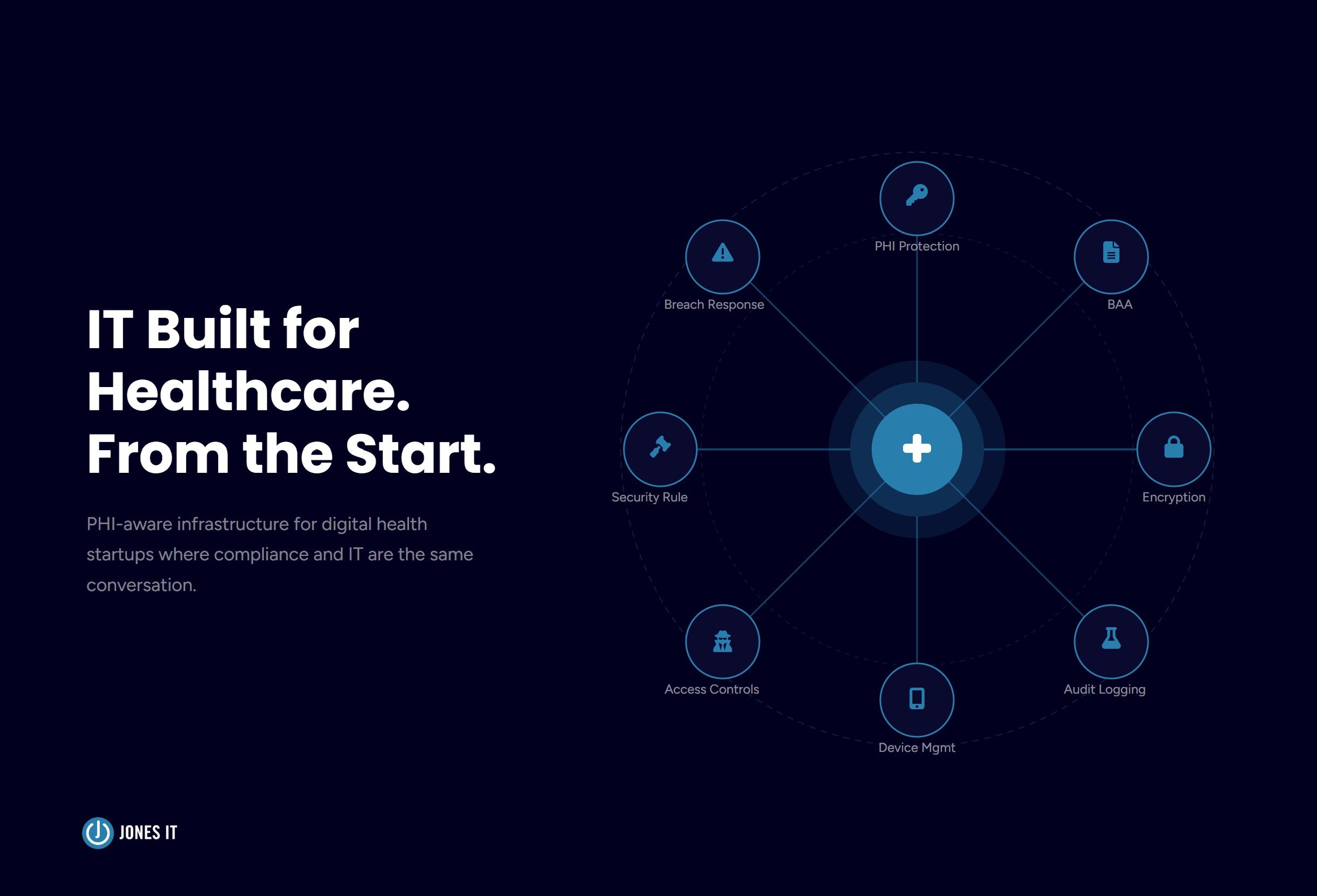
PHI Security Controls: Encryption, Access, and Audit Logging
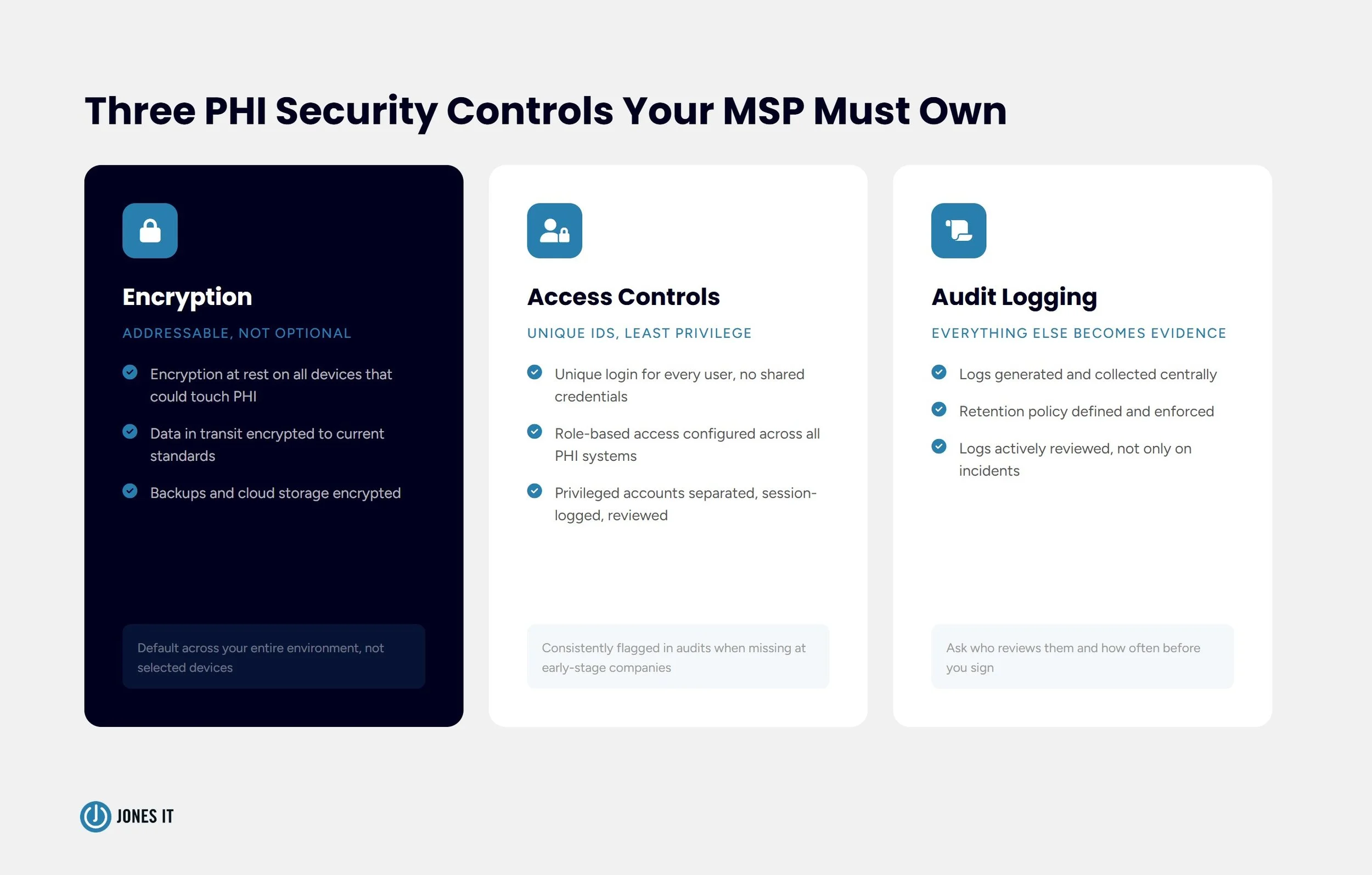
Once the BAA is in place, the technical work begins. HIPAA’s Security Rule groups its requirements into technical safeguards, and three of them show up in almost every audit finding when they are missing or misconfigured.
Encryption
HIPAA classifies encryption as an “addressable” implementation specification. That phrase is one of the most misunderstood in the regulation. Addressable does not mean optional. It means you must implement it, or document why it is not reasonable and appropriate for your situation, and implement an equivalent alternative. For a healthcare startup storing or transmitting PHI, however, there is rarely a valid 'equivalent' alternative. Encryption is the answer.
Your MSP should be enforcing encryption at rest on all devices that could touch PHI, encrypting data in transit using current standards, and ensuring that any backup systems or cloud storage used for PHI are encrypted. If they are not doing this by default across your environment, ask why.
Access Controls
Access controls under HIPAA mean that each user has a unique identifier, that access to PHI is limited to what that user’s role requires, and that the system can produce an audit trail of who accessed what and when. Role-based access control is the standard implementation. Your MSP should be configuring this across your cloud applications, your internal systems, and any shared drives or storage that hold patient data. This is a critical layer of your security posture. For a deeper look at why this is so vital, especially as you scale, see our article on Identity and Access Management for small businesses.
Privileged access deserves specific attention. The engineers and administrators in your IT environment who have elevated permissions need additional controls like separate admin accounts, session logging, and periodic reviews of what those accounts can access. This is an area where healthcare startups at the early stage often have the least visibility, and it is consistently flagged in audits.
Audit Logging
Audit logging is the control that turns everything else into evidence. Without it, you cannot demonstrate that your access controls are working, you cannot reconstruct the timeline of a potential breach, and you cannot answer an HHS investigator’s questions about what happened in your environment. Logs need to be generated, retained, and reviewed. An MSP that deploys your systems without configuring centralized logging is leaving a significant gap.
We recommend healthcare startups ask their MSP to walk through, concretely, how audit logs are collected, where they are stored, how long they are retained, and who reviews them. If the answer to that last question is “nobody unless something goes wrong,” that is a gap worth closing.
Device Management in Clinical and Remote Environments
Healthcare startups are rarely operating from a single office. Staff moves between clinical settings and remote work, devices travel with them, and every one of those devices that touches PHI is a potential exposure point.
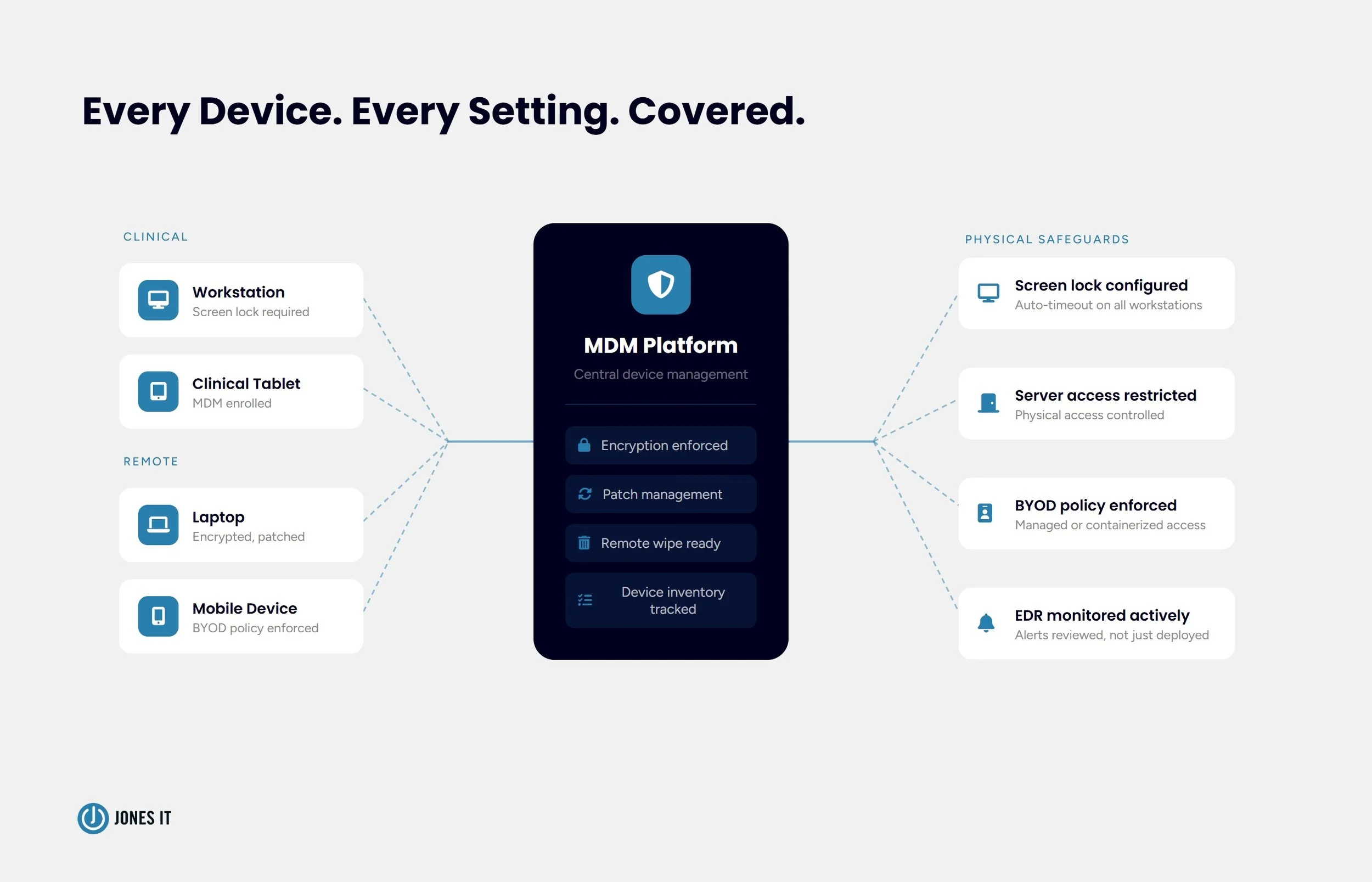
Mobile device management is the foundation. Every company-issued device should be enrolled in an MDM platform that enforces encryption, applies consistent security policies, and gives your IT team the ability to wipe a device remotely if it is lost or if an employee leaves. For healthcare startups, BYOD (bring your own device) policies require particular care. If employees are accessing PHI from personal devices, those devices need to be managed, or the access needs to be restricted to a secure, containerized environment.
The physical safeguards side of HIPAA is sometimes overlooked in conversations about IT, but it belongs here. Workstations that access PHI need screen locks. Automatic session timeouts should be configured. Access to servers or network equipment where PHI is stored needs to be physically restricted. Your MSP should be addressing these configurations, not leaving them to whoever sets up the office.
One thing I keep coming back to with healthcare clients is that the endpoint is where most incidents start. For example, a lost laptop, a compromised mobile device, a workstation left unlocked in a shared space. The technology to prevent these incidents is not complicated. What requires attention is making sure your MSP has deployed it consistently across every device in scope and that there is a process for maintaining that coverage as your team grows.
A few things to confirm with your MSP:
All devices accessing PHI are enrolled in MDM with encryption enforced.
Remote wipe capability is confirmed and tested.
Screen lock and automatic timeout are configured on all workstations.
BYOD policy is documented and technically enforced, or BYOD access to PHI is blocked.
Device inventory is maintained so nothing is unaccounted for.
How Jones IT Supports Healthcare Startups in the Bay Area
We work with healthcare startups across the Bay Area, from early-stage digital health companies building their first PHI-handling infrastructure to growth-stage platforms preparing for health system partnerships and HIPAA audits. We've worked with the likes of Hexagon Bio, Verge Genomics, Hey Jane, Ohalo, and Doctor On Demand to name a few. The common thread is treating HIPAA compliance and IT architecture as the same conversation, not two separate workstreams that talk to each other occasionally.
When we brought on that Series A team six weeks out from launch, the first thing we did was a full IT environment audit mapped against the HIPAA Security Rule safeguards. We identified the gaps, prioritized the ones with the highest exposure, and worked through remediation in parallel with their compliance team and legal counsel. They launched on schedule, with a clean BAA library, centralized audit logging, and an IT environment that has since held up through two rounds of investor due diligence without a single IT finding. We’ve successfully helped other organizations navigate similar timelines before and have achieved HIPAA certification ourselves. You can read more about our compliance journey in our case study on achieving HIPAA compliance in three months.
That is what the right MSP relationship looks like for a healthcare startup. Your IT provider should be a contributor to your compliance posture, not a question mark in it.
If you are a healthcare startup evaluating your IT setup, or if you are concerned that your current MSP is not HIPAA-aware, reach out to us. We are happy to walk through where you are and what a HIPAA-ready IT foundation looks like for your stage of growth.


Learn how to establish an AI tool approval process for startups with this 5-step workflow, vendor review checklist, and data loss prevention controls.