
Updated: June 12, 2026
A Series A SaaS founder called us on a Tuesday with a problem that had nothing to do with technology and everything to do with it. An enterprise customer, the one that would roughly double their annual revenue, had sent over a vendor security questionnaire and made the contract contingent on a SOC 2 report. The founder had ninety days to produce something the company had never built, while shipping product, closing the round, and hiring. That call is the moment most companies first feel the weight of security and compliance landing on them at once.
Managed security and compliance services combine cybersecurity threat management with regulatory compliance support, delivered by a managed IT service provider so that growing companies can meet standards like SOC 2, HIPAA, and PCI DSS without building an in-house security team. The two halves are related but distinct. Security keeps attackers out. Compliance proves to customers, auditors, and regulators that you are doing it. Most founders discover they need both on the same day, usually because a customer or an investor asked.
This is the page that maps how we approach security and compliance for startups and scaling tech companies, and where to go next for each piece. We have written dedicated guides for most of what follows, so think of this as the route map rather than the full territory.
What managed security and compliance services actually cover
Managed security and compliance services cover two jobs that companies often try to separate, but shouldn't. The first is cybersecurity threat management, the work of preventing, detecting, and responding to attacks on your network, devices, and data. The second is regulatory compliance, the work of meeting and proving adherence to standards your customers and regulators require.
Here is why we run them together. A control you put in place for SOC 2, such as enforced two-factor authentication or encrypted device storage, is also a genuine defense against the most common breach paths. Compliance done well is security made visible. Compliance done as a paperwork exercise, separate from how your systems actually run, gives you a certificate and a false sense of safety. We build the security first, then document it into compliance, rather than the reverse.
Working across many client networks and thousands of endpoints gives our security team visibility that a single in-house hire rarely has. We see the same attack patterns hitting fintech clients in the Financial District and biotech clients in Mission Bay, which means a vulnerability we spot at one company informs how we protect the next. That shared visibility is the practical advantage of bringing in an MSP rather than defending alone.
The compliance standards we help you meet
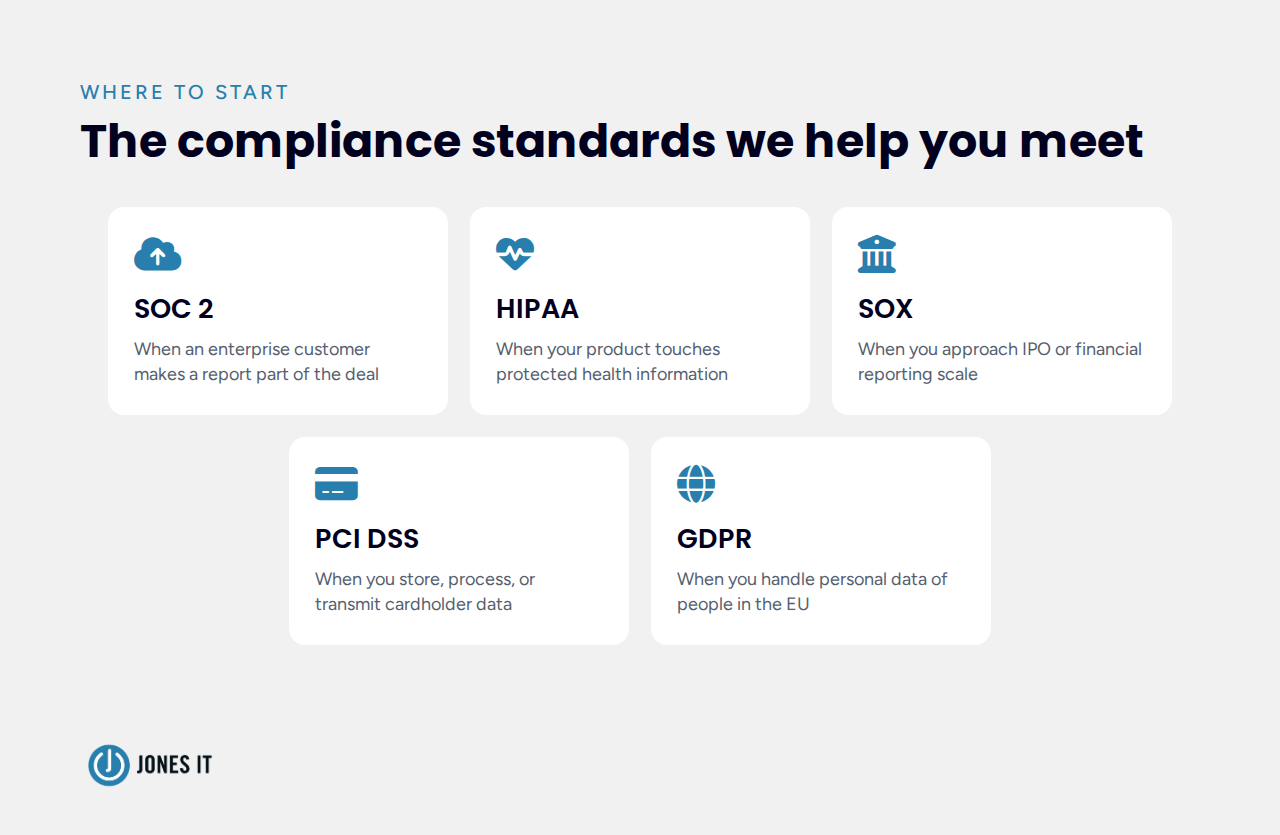
We help growing companies meet the compliance standards their customers and regulators actually ask for: SOC 2, HIPAA, SOX, PCI DSS, and GDPR. Each one applies to a different situation, and the trigger is almost always a specific business event rather than a general urge to be compliant. The sections below say what each standard is for and point you to the detailed guide.
SOC 2
SOC 2 is the standard most SaaS startups hit first, usually when an enterprise customer makes a report a condition of the deal. It evaluates how you handle data across criteria like security, availability, and confidentiality. Whether you need a Type 1 or a Type 2 report depends on the buyer and the timeline. For the full path, see our SOC 2 compliance timeline, the breakdown of Type 1 versus Type 2, and the security stack a SOC 2 audit expects.
HIPAA
HIPAA applies if you handle protected health information, which catches more companies than founders expect, including any SaaS or biotech product that touches patient data. It requires specific safeguards around how that data is stored, accessed, and transmitted. Our guide to HIPAA compliance and how to get started walks through the requirements and the risk assessment that anchors them.
SOX
SOX compliance becomes relevant as companies approach an IPO or financial scale, because it governs the integrity of financial reporting and the IT controls behind it. The work centers on access controls, change management, and audit trails for financial systems. See what finance and tech companies need to know about IT SOX compliance for the IT side of the requirement.
PCI DSS and GDPR
PCI DSS applies if you store, process, or transmit cardholder data, and GDPR applies if you handle the personal data of people in the EU. Both carry real penalties and both reward building the controls in early rather than retrofitting them.
How we manage cybersecurity threats
Cybersecurity threat management is the layer underneath compliance, the actual defense of your network, devices, and data against attack. We deliver it through a small set of services that work together rather than as a checklist of disconnected tools.
Network and endpoint protection. We monitor network infrastructure for vulnerabilities and secure the laptops, tablets, and phones your team works on, using antivirus, encryption, firewalls, and access control. With remote and hybrid work now the norm, the endpoint is where most attacks land.
Managed detection and response. We watch for security incidents and respond to them in real time, which shortens the window between a breach starting and it being contained. Detection without fast response is just an alarm nobody answers.
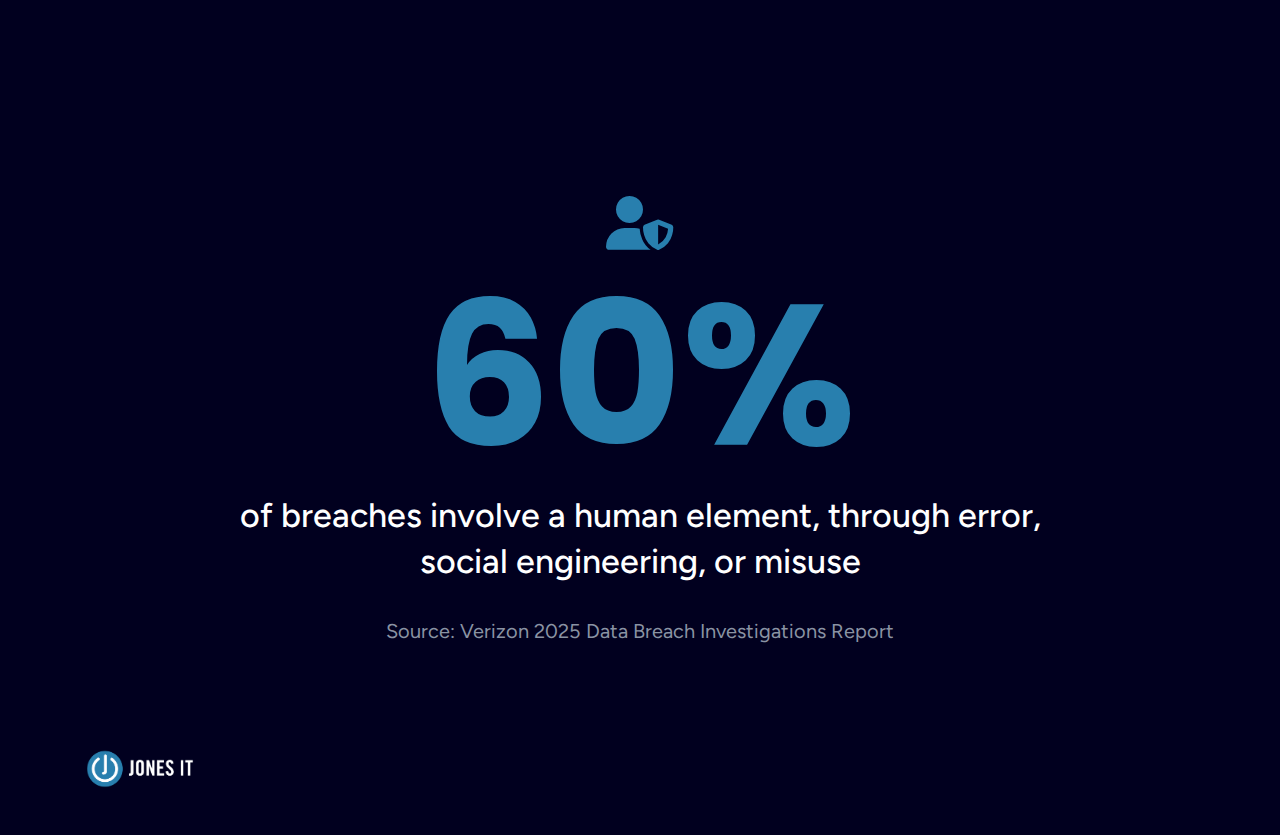
Security awareness training. Attackers target people first. Verizon's 2025 Data Breach Investigations Report found that around 60% of breaches involve a human element, through error, social engineering, or misuse. We run security awareness training so employees can recognize phishing and social engineering before they click.
Backup and recovery. A tested backup and recovery strategy is what lets you refuse a ransomware demand and recover from a fire, flood, or failed system without losing the business. The plan matters less than whether you have actually tested restoring from it.
Incident response planning. When something does go wrong, an incident response plan determines whether the next few hours are controlled or chaotic. We help you build and rehearse one before you need it.
Each of these is a defense in its own right, and each also produces the evidence that compliance audits ask for. That overlap is the point. You are not doing security work and compliance work twice.
Where security risk assessment fits in
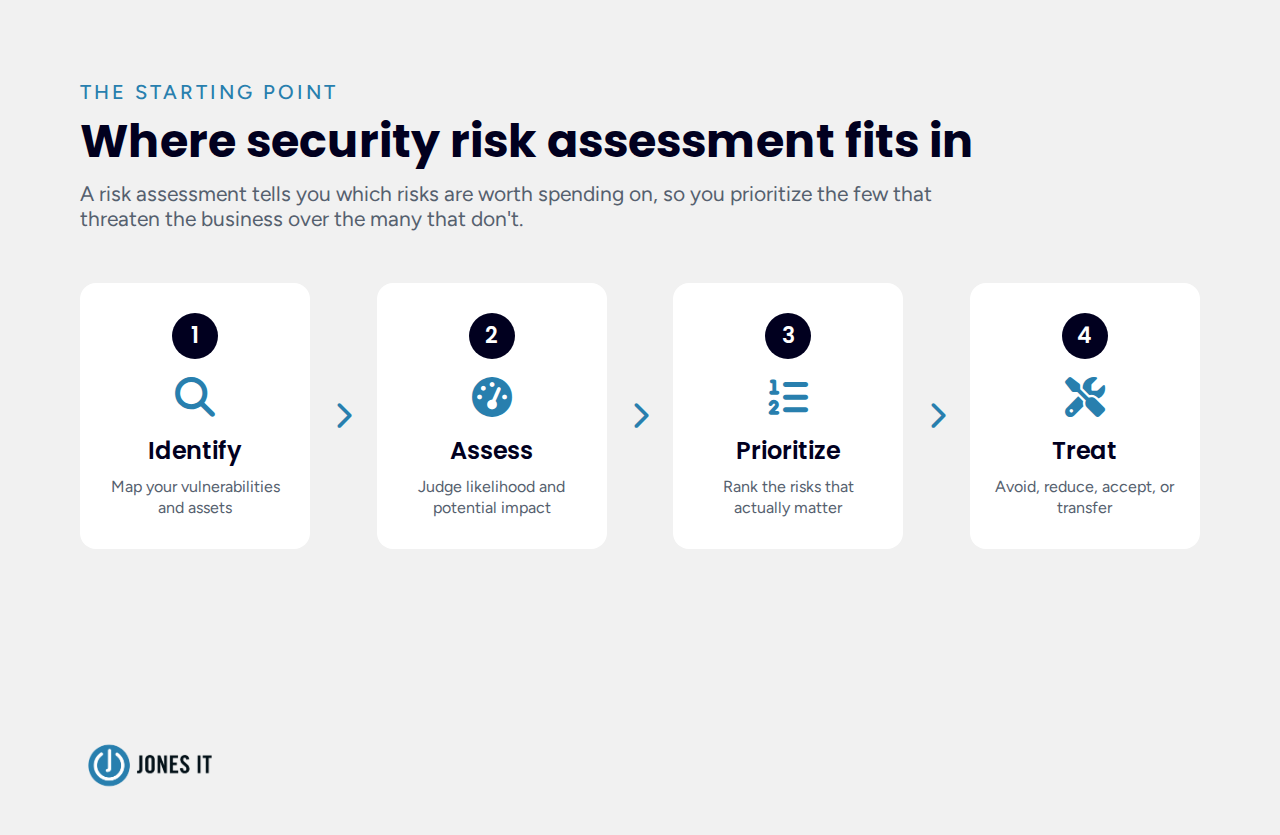
A security risk assessment is the starting point for both security and compliance, because it tells you which risks are worth spending on. It identifies your vulnerabilities, judges how likely each is to be exploited, and weighs the impact if it is, so you can prioritize the few risks that actually threaten the business over the many that don't. External threats only become real when they meet an internal weakness, which is why the assessment looks inward as much as outward.
Once risks are ranked, you treat them: avoid the activity, reduce the risk with controls, accept it when mitigation costs more than the exposure, or transfer it through insurance or outsourcing. We run this process with clients rather than handing over a report, because the judgment calls about what to accept and what to fix are business decisions, not just technical ones. For the full method, see our guide on how to perform a cybersecurity risk assessment.
Keeping your security posture current as you grow
Your security posture is the overall strength of your defenses at a given moment, and it decays if you leave it alone. The controls that protected a fifteen-person startup do not cover a hundred-person company with three offices, a dozen SaaS tools, and a regulated customer base. Posture has to be reassessed as the company changes, not set once and filed away.
We review posture on a regular cadence and adjust it as your technology, team, and threat landscape shift. The goal is to move from reacting to incidents toward anticipating them, which is the difference between a security program that scales with the company and one the company outgrows. Our guide on how to improve security posture as your organization grows goes deeper on the scaling problem.
When to bring in an MSP for security and compliance
The right time to bring in an MSP for security and compliance is usually marked by a specific event, not a calendar date. A few signals tend to show up together, and any one of them is worth taking seriously.
You receive your first enterprise security questionnaire and realize you cannot answer half of it.
A customer or investor makes a SOC 2, HIPAA, or other compliance report a condition of moving forward.
You sign your first regulated customer, in healthcare, finance, or payments, and inherit their requirements.
An auditor asks for evidence, such as access logs or security configurations, that nobody has been collecting.
Your team has grown past the point where one person can track who has access to what.
If any of these sound familiar, the work has already arrived whether or not the team is ready for it. Bringing in an MSP at that point is about doing it once, correctly, instead of scrambling under a deadline set by someone else. The founder from the start of this page made the call with ninety days left and got the report. It would have been a calmer ninety days with the foundations already in place.
Conclusion
Security and compliance stop being optional the moment a customer, investor, or regulator asks you to prove them, and for growing companies that moment arrives sooner than expected. Maintaining a strong security posture is manageable for a small team, but the requirements compound quickly as the business scales, adds regulated customers, and accumulates the systems and access that have to be governed.
Partnering with a managed IT service provider like Jones IT takes that load off your team while keeping security and compliance aligned with how you actually grow. We combine the threat management, the compliance work, and the risk judgment into one program, so you are not assembling it from parts under pressure. If you are facing a questionnaire, an audit, or a deadline you did not set, get better cybersecurity and compliance with a team that has done it for hundreds of growing companies.


About The Author

Hari SubediMarketing Manager at Jones IT
Hari is an online marketing professional with a focus on content marketing. He writes on topics related to IT, Security, and Small Business. He is also the founder and managing director of Girivar Kft., a business services company located in Budapest, Hungary.

Learn how to establish an AI tool approval process for startups with this 5-step workflow, vendor review checklist, and data loss prevention controls.