
Updated: May 28, 2026
Switching to a new managed IT service provider is hard, especially if you’ve been with the same one for years. The process can be time-consuming and stressful, which is exactly why so many businesses knowingly suffer through poor service longer than they should. The inconvenience of switching, however, is a small price to pay for the long-term health of your business.
Knowing the signs that your managed IT service provider is underperforming is the first step toward finding a partner that actually helps your business grow. Whether you like it or not, you have to eat that frog.
If you often wonder whether you’re really getting what you pay for, it might be time to break off the partnership and switch MSPs. How do you know it’s the right time to move on? If you’re going to invest time and money into such a big change, it has to be necessary. To help you with your decision, here are the telltale signs that indicate it’s time to change your managed IT service provider.
Telltale Signs That It’s Time to Change Your Managed IT Service Provider
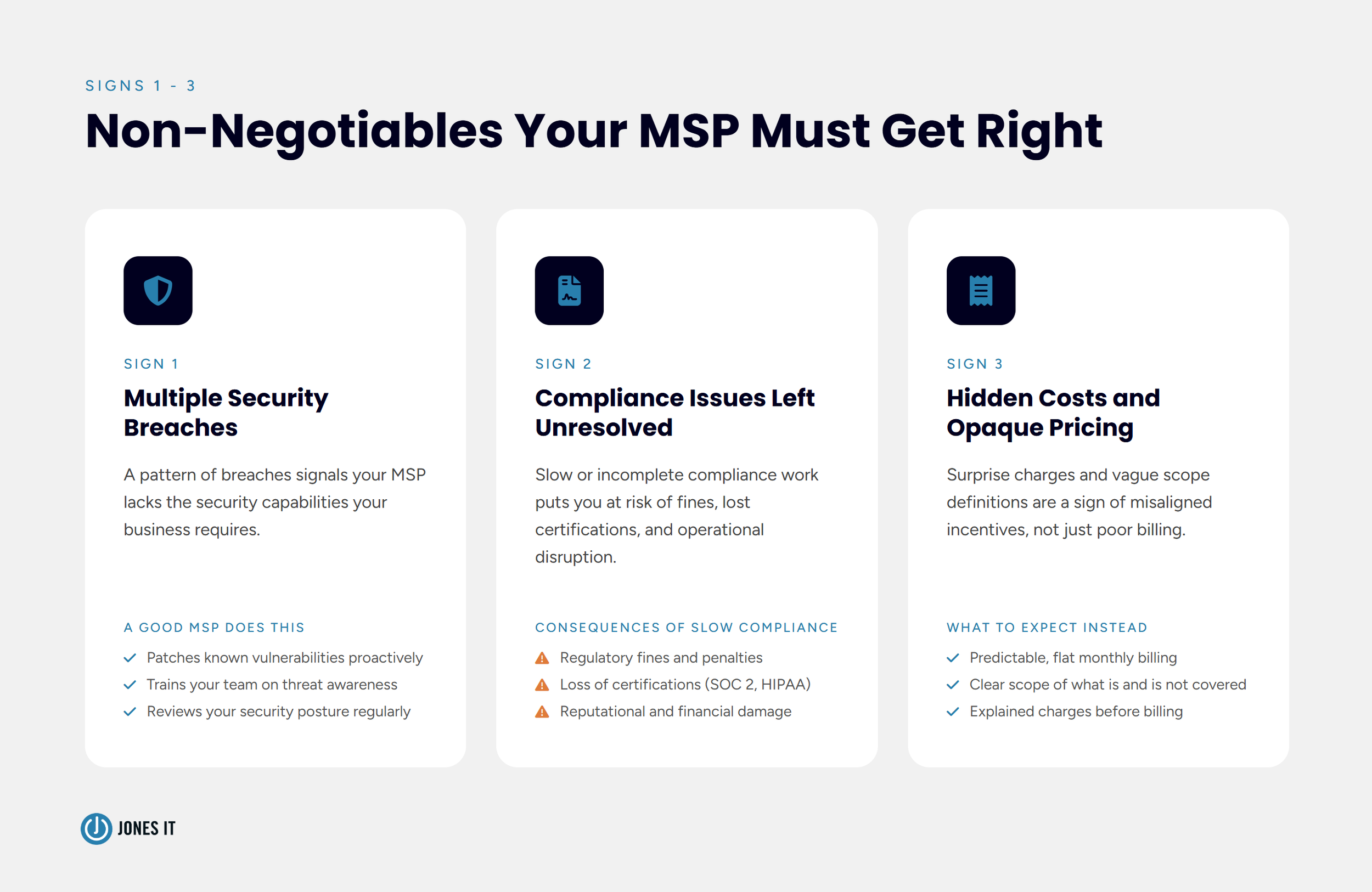
1. You Have Experienced Multiple Security Breaches
Repeated security breaches are a clear indicator that your managed IT service provider lacks the capabilities your business needs. Even a small or apparently minor security failure can have a disastrous impact on your organization, so a pattern of breaches should never be tolerated.
Of course, there are novel and sophisticated cyberattacks that cannot be completely prevented. But adequate safeguards must be in place to mitigate the damage, and your MSP should be driving that work proactively.
Many businesses treat security as a one-time project: roll out the measures, then move on. That thinking gets reinforced when no incidents occur for a while, creating a false sense of security. A good managed IT service provider actively pushes back against that complacency. Your MSP should be guiding your organization toward better security practices, educating your team about the critical role of security, and keeping you informed about emerging threats.
If your organization suffers more than one breach in a short period, it’s time to conduct a thorough review of your cybersecurity and compliance posture and your MSP’s role in it. If that review reveals a persistent pattern of failures and insufficient action from your provider, it’s time to switch. A security-conscious managed IT service provider consistently works to:
Weed out common cybersecurity bad habits,
Implement security best practices and standards,
Keep you updated with the latest developments in security,
Identify and fix known vulnerabilities before they are exploited, and
Educate your employees about security threats and preventive measures.
2. Your MSP Fails To Promptly Address Compliance Issues
Compliance failures can have serious repercussions on a business, and a managed IT service provider that drags its feet on compliance issues is putting you at risk. Strict compliance programs are especially critical for organizations in regulated industries, such as HIPAA in healthcare. Failure to address compliance issues in a timely manner can lead to loss of certifications, heavy regulatory fines, disruption in business operations, and significant financial and reputational damage.
If you’ve had multiple compliance issues linger unresolved, or if your MSP struggles to keep pace with your compliance requirements, it’s probably time to move on. The right managed IT service provider treats compliance as an ongoing program, not a checkbox.
3. There Is A Lack Of Transparency In Pricing And Services
When you sign up with a managed IT service provider, a predictable monthly cost is one of the most important things you’re looking for in the partnership. The role of your MSP is not just to fix IT issues but also to help you prioritize, plan, and budget for IT spending. Regular surprises in your invoice are not a feature of a healthy MSP relationship.
Lack of transparency is the most common reason for discrepancies in your monthly IT support bill. Complicated pricing structures or gray areas in the scope of services can lead to lengthy, unexplained time charges that send your costs soaring.
Organizations often struggle to fully understand the breadth of IT services they require, and they need their managed IT service provider to bring clarity by explicitly communicating what’s covered and what’s not. If your MSP isn’t fully transparent about the services they’re providing, or if they can’t explain lengthy charges, it’s time to move on.
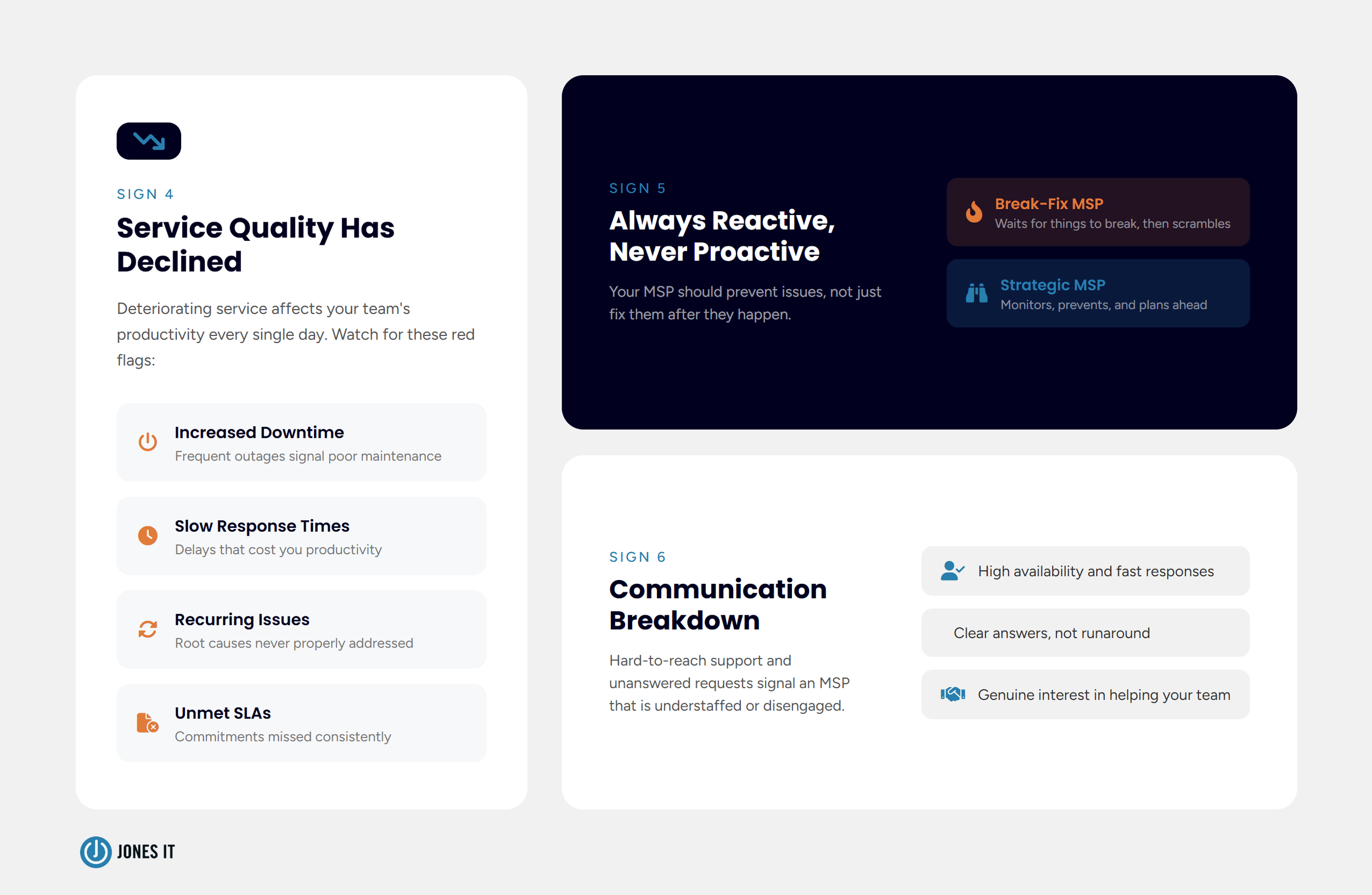
4. Their Service Quality Has Deteriorated
You hire a managed IT service provider for their expertise, and that expertise should reflect in both their technical capabilities and the quality of their customer service. High-quality service requires the right combination of people, processes, and technology. A deficiency in any of these areas compromises the whole service experience.
Here are the signs of poor service quality to watch for:
Increased Downtime
Frequent and extended periods of downtime are typically caused by inadequate maintenance, poor management, poor security, or other technical issues. If your downtime is on the rise, it is a clear indicator of deteriorating service quality.
Slow Response Time
Frequent and long delays in addressing support requests suggest that your managed IT service provider either lacks the efficiency or the capacity to handle your requirements. Slow response that negatively impacts your business operations is a significant red flag.
Recurring Issues
Persistent problems that keep resurfacing indicate a lack of expertise or a failure in your MSP’s problem-solving processes. When an IT issue recurs, it means the root cause was never properly addressed.
Unmet Service Level Agreements (SLA)
Failure to meet SLAs is the most evident indicator of a decline in service quality. SLAs define the agreed level of service, and if your managed IT service provider consistently falls short of these commitments, that’s a direct breach of your agreement.
5. Your Managed IT Provider Is Reactive, Not Proactive
Constantly firefighting IT issues means you are playing catch-up, and your efficiency suffers as a result. A good managed IT service provider helps you transition from a reactive to a proactive approach. That means not just fixing IT issues as they arise, but actively preventing similar issues from reoccurring.
You can’t completely do away with reactive or “break-fix” IT support because every piece of technology will break down eventually. However, your MSP must actively work to stop preventable issues from coming back. Your managed IT service provider should have a robust troubleshooting methodology that identifies root causes and suggests ways to prevent recurrence.
If your MSP is always busy solving the same IT problems, that is not a good sign for your business.
6. Your MSP Doesn’t Communicate Frequently
Are your employees having trouble reaching your support provider? Are they struggling to get updates on the status of their requests? These are clear signs of a communication breakdown, and they have a direct impact on your team’s productivity and morale.
Lack of communication can stem from a variety of reasons: your support provider is too busy to respond, your request has gone unnoticed, or the issue is outside their area of expertise. None of these is acceptable. Even when an IT issue falls outside their scope, your managed IT service provider must let you know immediately. For issues within their scope, they should see each one through to resolution, with no finger-pointing or blame-shifting.
The hallmark of a good MSP is high availability, the ability to provide clear answers, actionable information, and a genuine interest in helping. If any of these are missing, you are not getting the service you deserve.
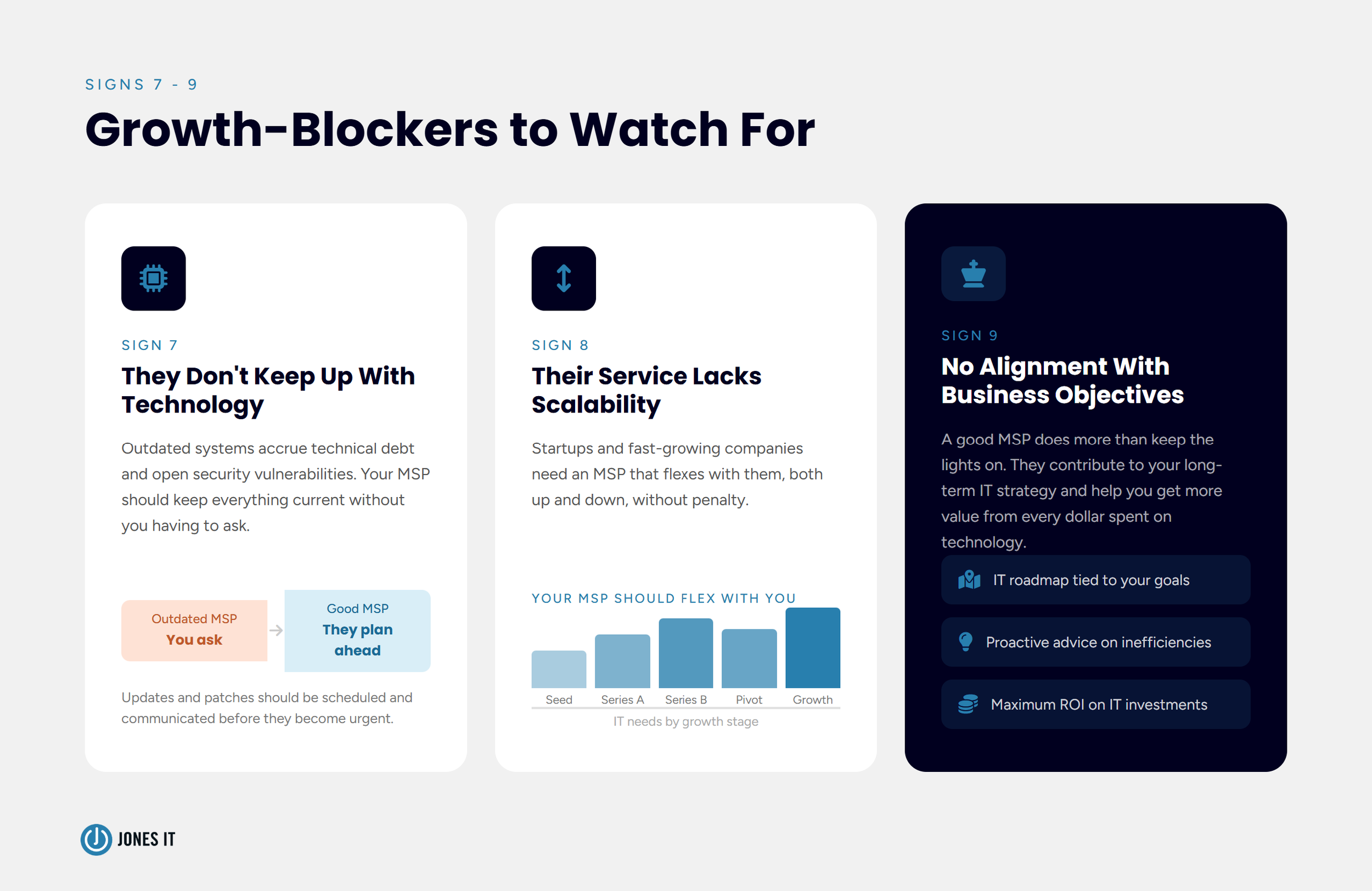
7. They Don’t Keep Up With Technology
Outdated technology accrues technical debt, and failure to keep systems current results in performance issues and security vulnerabilities. A good managed IT service provider ensures that all of your systems remain up-to-date and optimized. All updates and patch rollouts should be planned and communicated in advance so they do not disrupt operations.
If your systems are not updated in a timely manner, if you have to ask for software updates, or if rollouts happen without any advance notice, it’s time to find a new IT partner.
8. Their Service Lacks Scalability
The IT needs of most organizations, especially startups and high-growth companies, fluctuate significantly. Your managed IT service provider should have the flexibility to adjust their services to your changing needs. While scaling up is typically easy, scaling down is often not, and many MSPs with long-term, inflexible contracts make that even harder.
If your MSP does not offer a flexible contract or the ability to scale services both up and down, you should switch to a provider that does. There are always options, and you should not have to work with an MSP that cannot grow or shrink with you.
9. The IT Service Is Not Aligned With Your Business Objectives
A managed IT service provider should do more than address your immediate IT needs. Your MSP should also provide strategic guidance, contributing to your long-term IT roadmap and ensuring that IT initiatives deliver the functionality needed to achieve your business objectives. Your provider should also be working to deliver maximum economic value on all IT services, projects, and initiatives.
This is, in fact, what separates good managed IT service providers from mediocre ones. The best MSPs guide clients on everything from overall IT strategy to industry best practices and security, within the context of your IT systems, business goals, and industry. That kind of strategic IT consulting is especially valuable for business owners who are not deeply technical, as well as for those looking for an experienced outside perspective.
If your managed IT service provider is not giving you timely advice on IT strategy, identifying inefficiencies in your systems, or offering solutions to improve efficiency and productivity, it may be time to find a new IT partner.
If you have decided to change your managed IT service provider, here are a couple of resources that will help you select your next MSP:
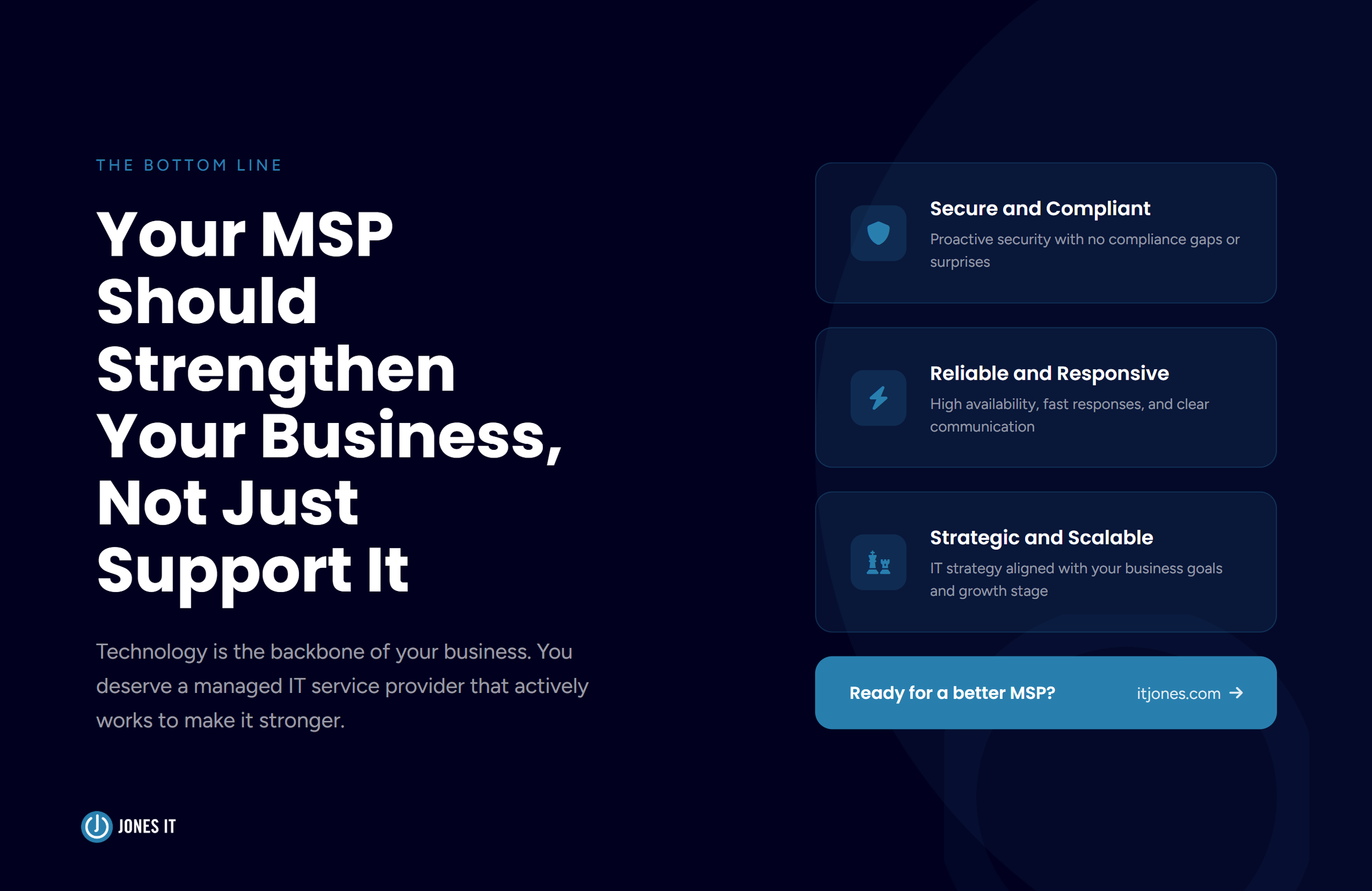
Conclusion
Technology is the backbone of any business, and it is never worth staying in a partnership with a managed IT service provider that is not actively working to maintain and strengthen that backbone. Changing your MSP is a significant decision, but sometimes an unavoidable one. Transitioning from one IT services provider to another can be stressful, but if you choose the right MSP, it can be smooth and efficient.
Before making such a big decision, it is worth having an open conversation with your current IT service provider. Apart from absolute dealbreakers like security and compliance failures, if a little leniency helps get things back on track, it’s absolutely worth trying. Everyone makes mistakes.
However, if issues persist and your MSP does not raise its standards to meet your expectations, it’s time to find a new managed IT service provider that is more capable and attentive to your requirements.



About The Author

Hari SubediMarketing Manager at Jones IT
Hari is an online marketing professional with a focus on content marketing. He writes on topics related to IT, Security, and Small Business. He is also the founder and managing director of Girivar Kft., a business services company located in Budapest, Hungary.

Learn how to hand off Level 1 support to a co-managed IT help desk without losing control or dip in quality, and free up your team for strategic IT projects.