
"We're Not A Traditional MSP": What That Claim Should Mean For You
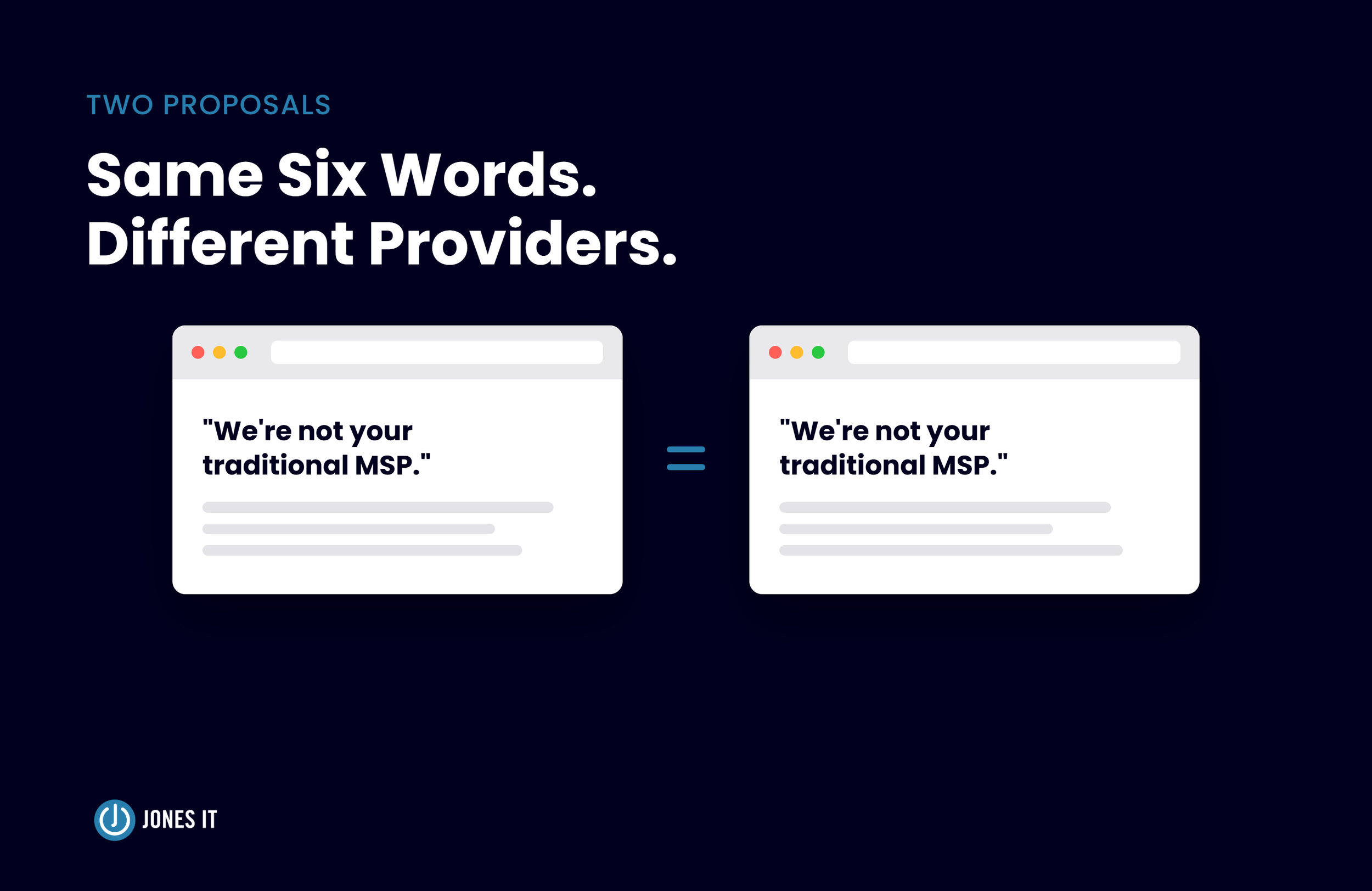
This spring, I sat in on a sales call with a Bay Area Series B fintech founder who already had two managed IT proposals open in separate browser tabs. Both homepages used almost the same six words near the top: “we're not your traditional MSP”. These days, that claim shows up everywhere in MSP marketing because it's easy to make and hard to verify, and it’s almost always used without definition.
In this case, both providers were very much traditional MSPs. They used that claim to describe a service that, once you got past the homepage and into the actual proposal, looked exactly like the model they claimed to have left behind: a three-year term, a support queue with no stated response times, and a pitch built entirely around uptime numbers nobody could verify.
The founder asked me: “if every MSP says the same thing, how do you tell which ones actually mean it?”
I don't think that question is hard to answer. I do think it's one almost nobody asks out loud, which is why the phrase keeps working as a differentiator even after it's stopped differentiating anything. It shows up across enough MSP websites at this point that it reads less like a claim and more like punctuation, something a provider adds because every competitor already added it. Search for the phrase yourself and you'll find it on regional shops with five employees and on national providers with a hundred, used to describe service models that have almost nothing in common with each other.
The phrase isn't meaningless on its own, but the reader is left doing the work the provider skipped: defining what the claim is supposed to prove. That's the real job of evaluating a managed service provider before you sign anything, figuring out what the pitch is promising before you're locked into a contract that doesn't deliver it.
What "Traditional" and "Modern" Actually Mean, and Why the Claim Rarely Says Which One
Search around for how the industry defines this split and most of what comes back is written by MSPs selling tooling. A traditional MSP gets defined by break-fix, on-premise, ticket-based support. A modern MSP gets defined by whichever cloud stack the provider happens to sell, usually some mix of Microsoft 365 automation, AI-assisted monitoring, and self-service dashboards. That's a real distinction, and it matters if your business already runs entirely in the cloud. That version of modern is also something a provider can claim the day they buy a license, and a license doesn't say much about how the relationship runs once you're a client.
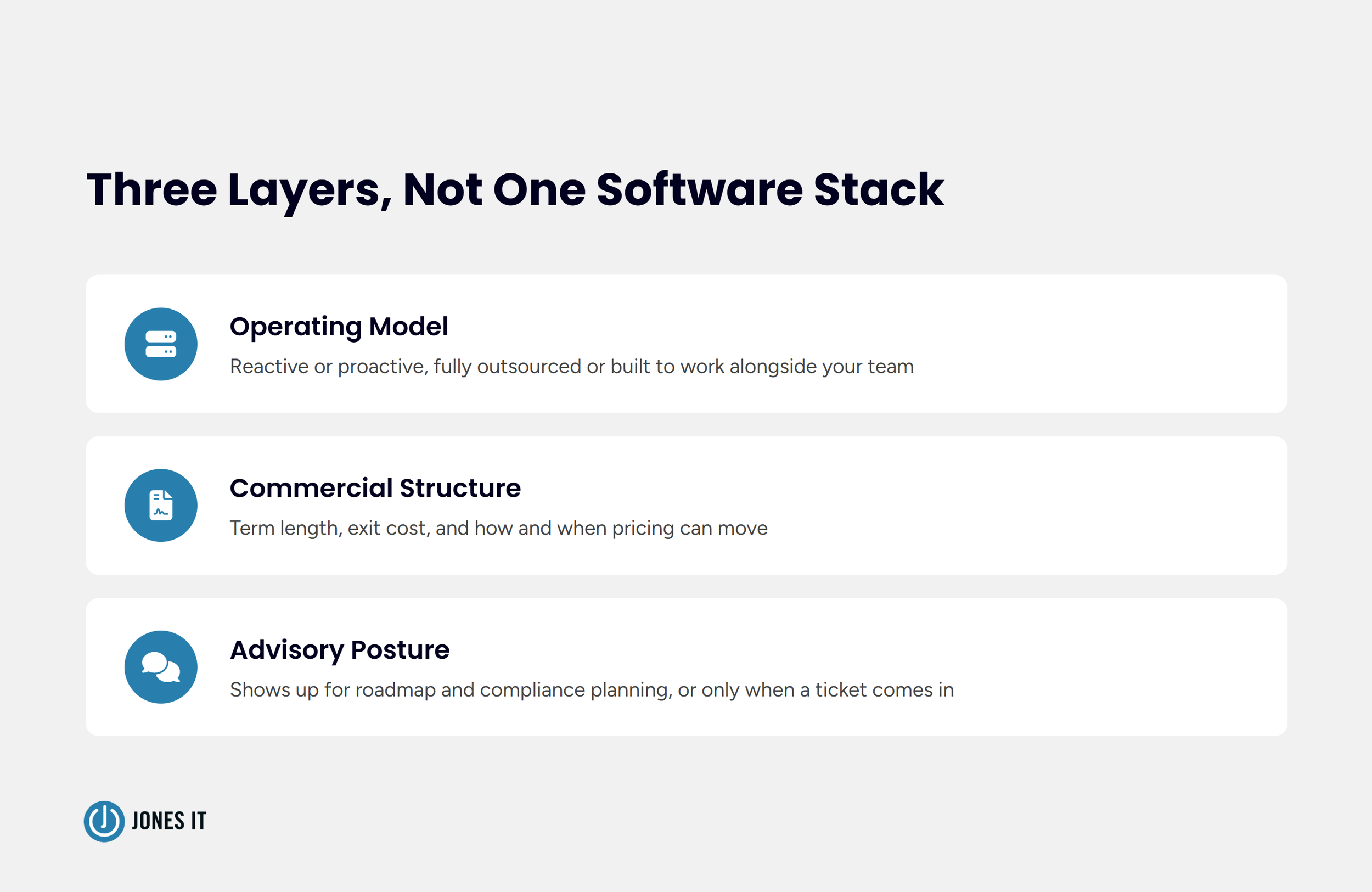
We, however, think about the split across three layers, only one of which has much to do with software.
The first is the operating model: whether the provider waits for something to break or proactively monitors systems before issues arise, and whether the relationship is fully outsourced or built to work alongside a team you already have.
The second is commercial structure: how long you're locked in, what it costs to leave, how pricing can move, and whether any of that is disclosed before you sign.
The third is advisory posture: whether the provider shows up to talk about your roadmap and your compliance obligations, or only shows up when a ticket comes in.
A provider can score well on the first layer and still run the second one exactly like the traditional model it claims to have replaced. We've seen it happen with providers who do offer proactive monitoring and a modern tool stack, then sell that upgrade wrapped in a three year contract with no disclosed exit terms, because the commercial layer was never part of the pitch they were building. That's the layer most homepages skip, and it's the one that determines what the next twelve months look like.
The advisory layer is the one founders notice last, usually because it only becomes visible in its absence. A provider that shows up quarterly with a written roadmap and a point of view on your compliance timeline is doing something a break-fix shop was never built to do. A provider that only calls when a ticket needs escalating hasn't changed the relationship, no matter what cloud tools sit underneath it.
Where the Claim Should Show Up in the Contract, Not Just the Homepage
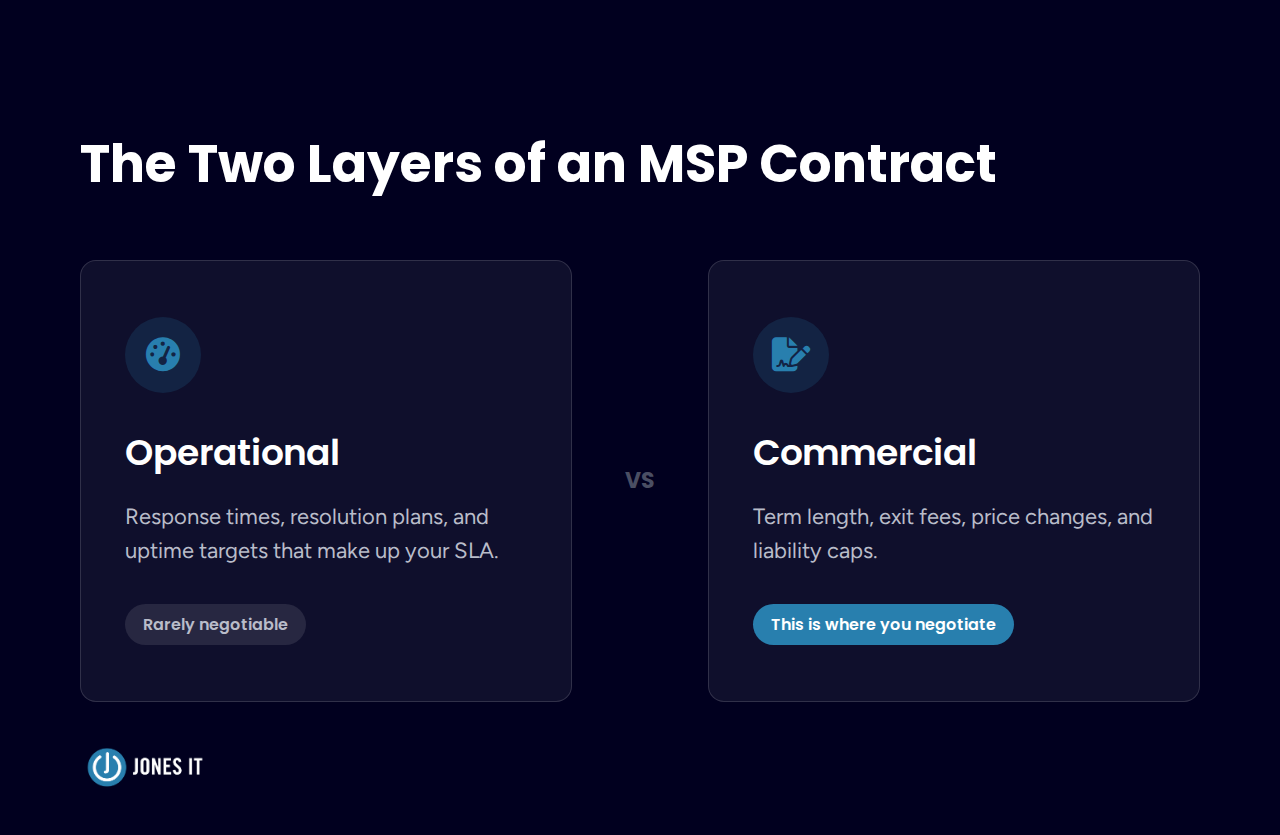
If a provider tells you they've moved past the traditional model, the commercial terms in the contract are where that claim gets tested. We've written about this in more depth in our guide to managed IT services SLAs, but a few terms carry more weight than the rest when you're specifically testing a "not traditional" claim.
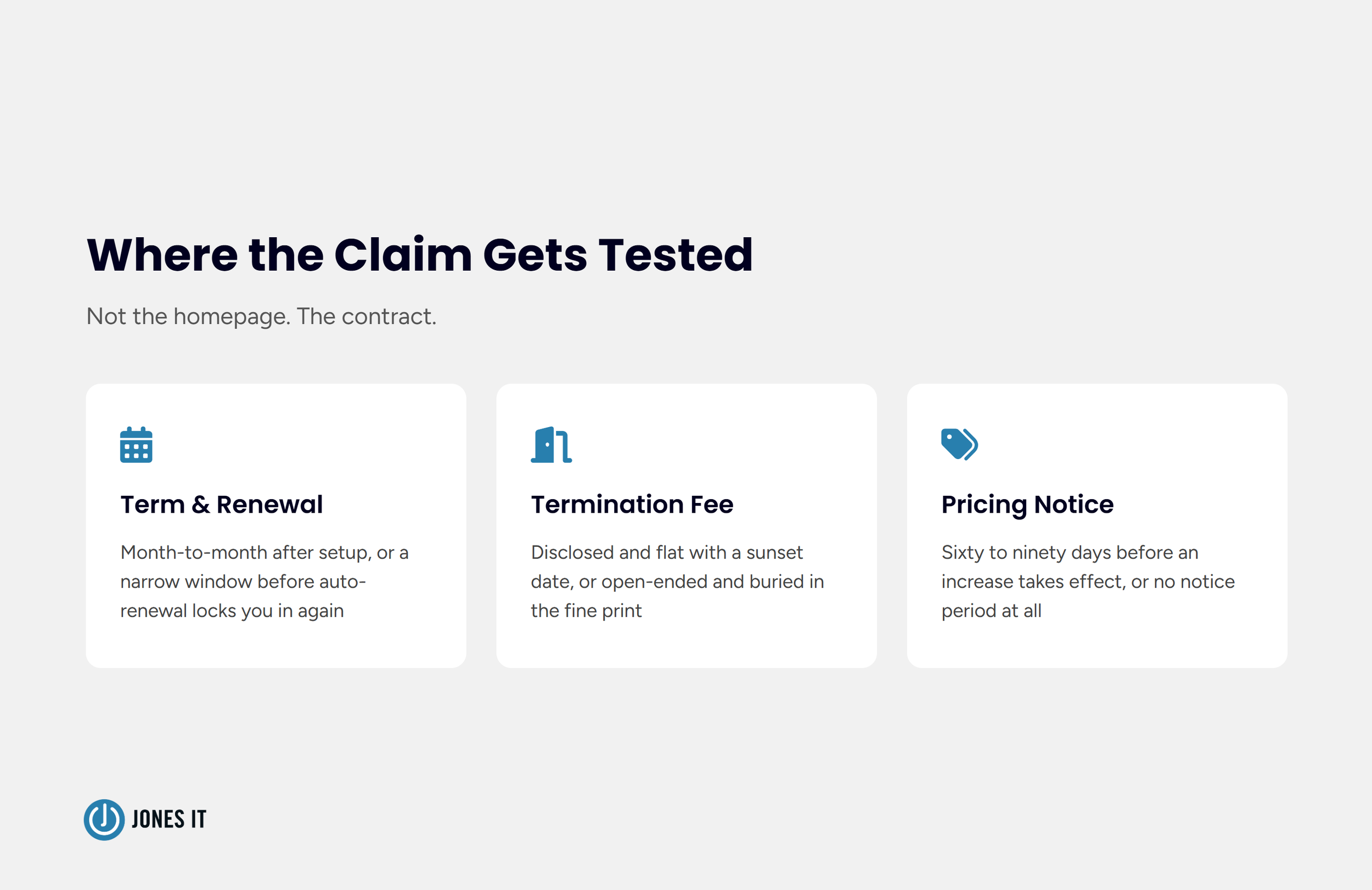
Term length and renewal structure come first. A traditional MSP contract tends to lock you into a multi-year term with automatic renewal and a narrow cancellation window, sometimes as little as thirty days. A provider that has rebuilt its commercial model around flexibility structures the contract closer to month-to-month after an initial period, or at minimum gives you sixty to ninety days of renewal notice instead of thirty.
Early termination fees come next. These aren't inherently a red flag. Onboarding a new client costs a provider real time and money, and a fee that protects that investment during the first six months to a year is reasonable. What separates a traditional fee structure from a modern one is disclosure and proportion: is the number stated clearly before you sign, is it flat rather than an open-ended calculation of remaining contract value, and does it sunset once the relationship is established.
Pricing transparency is the third piece. Ask how much notice you get before a price increase takes effect, and whether the provider commits to holding pricing steady during the initial term. Sixty to ninety days of notice gives you room to budget or push back. Anything shorter puts the provider in control of a line item that should be yours.
None of these terms show up on a homepage. They show up in a document most founders skim on their way to a signature, which is exactly why they're the most honest test of whether a provider's claim is real.
Four Questions for Evaluating a Managed Service Provider's Claim
Once you've read the contract, a short set of direct questions during the sales process will tell you more than another review of their homepage copy. We'd ask a prospective provider these four, in this order.
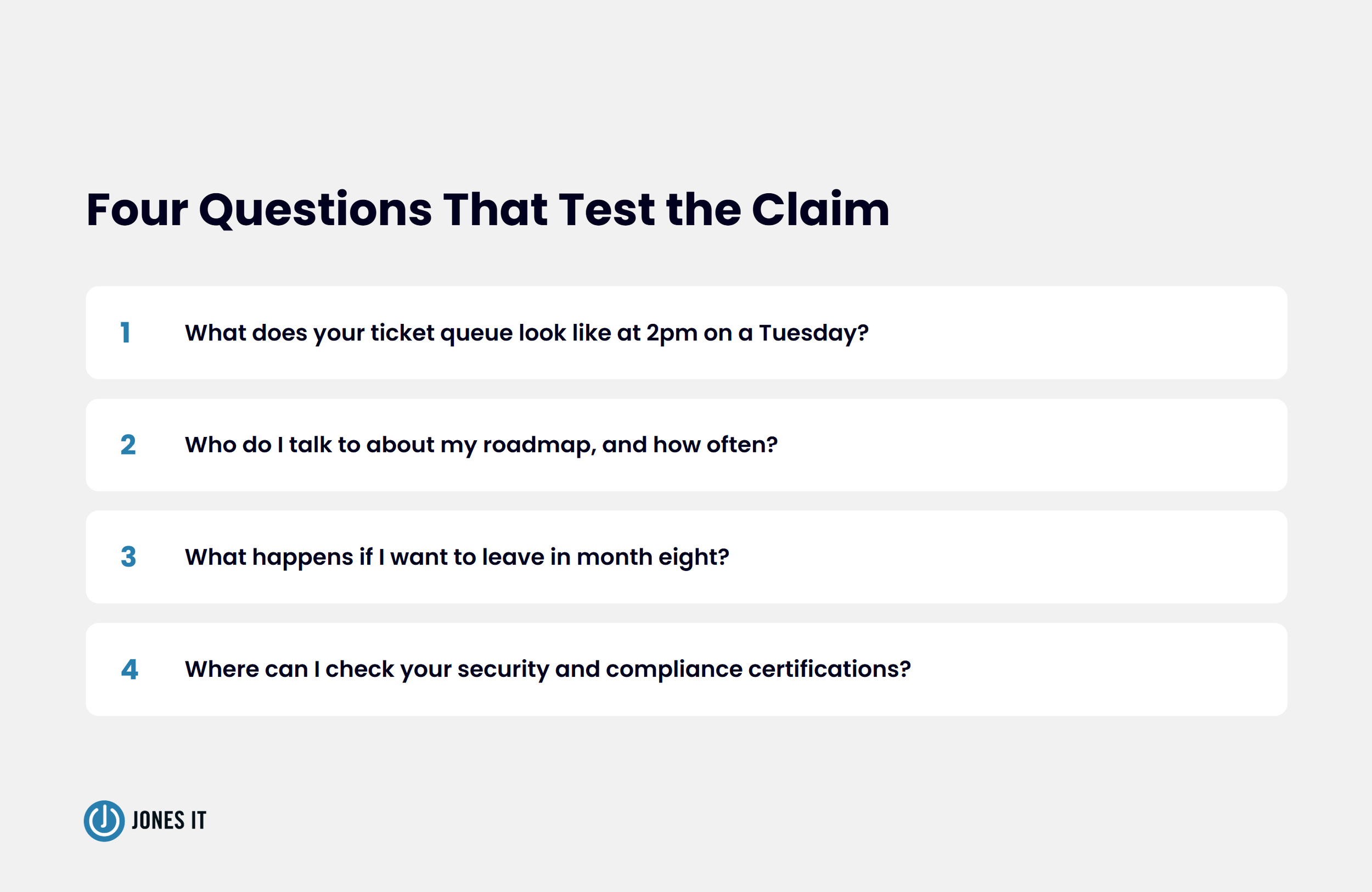
What does your ticket queue look like at 2pm on a Tuesday? The question gets past the marketed response time and into how the provider staffs and prioritizes day to day. A provider that answers with specifics, like priority tiers and named escalation paths, has clearly thought about this. A provider that repeats the number from their sales deck hasn't.
Who do I talk to about my roadmap, and how often? A traditional MSP shows up when something breaks. A provider that has rebuilt the advisory layer can name a specific cadence, usually quarterly, and a specific person, not just "your dedicated team."
What happens if I want to leave in month eight? This is the termination fee question asked directly rather than left buried in a document. The answer tells you whether the provider is comfortable being tested on the claim made in their own marketing.
Where can I check your security and compliance certifications? Not a badge pasted on the homepage. A live trust center hosting current SOC 2, HIPAA, or ISO 27001 reports that a prospective client can request access to before signing anything. A provider maintaining one has put its compliance posture somewhere you can verify it, rather than asking you to take a logo at face value.
None of these questions require technical expertise to ask. They require treating the claim as something to verify rather than something to accept. If the answers to the above questions don't hold up, that's the answer, not whatever the homepage says.
What This Looks Like in Practice
We structure our own commercial and operational terms to pass this exact test; not because we're immune to marketing speak, but because we got tired of seeing founders burned by fine-print traps. Our plans run month-to-month once the setup period ends, and pricing moves to the lowest available rate automatically based on monthly usage rather than locking you into a tier you might outgrow or never fill. We disclose our termination terms before a client signs, not after they try to leave, because a fee nobody saw coming is the exact stereotype this whole conversation is about.
The same test applies to compliance. Our SOC 2 and ISO 27001 reports sit in a trust center that a prospective client can request access to before signing anything, rather than a certification we mention on a call and never produce.
The advisory layer works the same way. Clients who want a fully outsourced relationship get one, and clients who already have an internal IT lead but need the day-to-day ticket volume handled get a co-managed arrangement instead, with the internal team keeping admin access and roadmap decisions. That flexibility is the operating model layer doing what it's supposed to do: adjusting to how a business wants to work, rather than asking the business to adjust to a fixed service tier.
There's a limit to how far one company's example can carry this argument, and I'll admit that upfront. We think our terms hold up under the test just described, but you shouldn't take that on faith any more than you'd take a competitor's homepage on faith. Run the same four questions on us that you'd run on anyone else.
Before You Sign: A Practical Checklist
Confirm the following before you take a "not your traditional MSP" claim at face value:
The initial term length and whether renewal is automatic or converts to month-to-month.
The termination fee, whether it's disclosed, flat, and capped to the initial term.
The price increase notice period, ideally sixty to ninety days.
Whether the provider can name a specific advisory cadence and a specific point of contact.
Whether the provider will show you a real compliance report, not just a badge on the website.
Whether the answers from the sales process match what's written in the contract.
If you're still building your shortlist rather than testing a specific claim, our guide to vendor evaluation and selection and our evaluation questions for startups cover that groundwork first.
Testing the Claim Instead of Repeating It
The founder from the story above picked the provider whose answers held up under these questions, not the one with the better homepage copy. That's usually how it goes once the claim gets read as a testable statement instead of a marketing statement. Most providers making it are describing something real, even if they haven't said which part. A few are using six words that cost nothing to write and mean less the more often they're repeated.
If you’re evaluating MSP proposals right now and want a neutral set of eyes on the fine print, send them over. We're happy to help you spot red flags and test their claims; no pressure, just peer-to-peer advice from someone who knows what to look for.
Frequently Asked Questions (FAQ)
Q: What does "not a traditional MSP" actually mean?
A: While many providers use the phrase as marketing jargon, a genuinely modern MSP differs across three key areas: an operating model focused on proactive monitoring and co-management, commercial terms with transparent pricing and flexible contract lengths, and a dedicated advisory posture providing regular strategic roadmaps.
Q: What key contract terms should I look for when evaluating an MSP?
A: Focus on initial term length (preferring month-to-month or 60-90 day renewal notices over multi-year auto-renewals), clearly disclosed and flat early termination fees that sunset over time, and a price increase notice period of at least 60 to 90 days.
Q: What questions should I ask during an MSP evaluation call?
A: Ask direct questions about day-to-day operations and business practices:
What does your ticket queue look like at 2pm on a Tuesday?
Who do I talk to about my roadmap, and how often?
What happens if I want to leave in month eight?
Where can I check your security and compliance certifications?
Q: How can I verify an MSP's security and compliance claims?
A: Request access to a live trust center hosting current third-party audit reports (such as SOC 2, HIPAA, or ISO 27001) before signing, rather than relying on website logos or unverified promises.


About The Author

Evan JonesFounder and CEO of Jones IT
With over two decades of IT experience in San Francisco, Evan guides Jones IT's long-term strategy, finances, and culture, with a vision of building the city's highest-rated IT services firm. Outside of work, you'll find him on the golf course or running Bay Area Warriors, his non-profit connecting Bay Area kids to college through basketball.
Discover what "not a traditional MSP" really means. Evaluate managed IT services with our guide to contract terms, pricing, and 4 essential questions.