
Managed IT Services Contract Negotiation: The Terms Worth Pushing Back On
A Series A SaaS company in the East Bay called me this spring, already annoyed before we'd even discussed working together. They were switching IT providers after a rough year of missed tickets and inconsistent support, and when they told their outgoing MSP they were leaving, the provider pointed to a clause buried in section three of the managed IT services contract they'd signed fourteen months earlier: a flat $6,000 fee for terminating early. Nobody on the founding team remembered negotiating it, because nobody had. They signed during the same week they closed their Series A, reviewing five vendor contracts in six days, and the IT agreement got the least attention of any of them.
I bring this up because it's a familiar pattern, not because the fee itself was unusual. Early termination fees are common in this industry and often reasonable. What stood out was that nobody at the company knew the fee existed until they were already trying to leave.
Founders run into this same pattern in managed IT services contracts. They spend real time evaluating a provider's technical capability, their SOC 2 posture, their response times, and then treat the actual contract as a formality to sign quickly so the real work can start. That evaluation work matters, and if you're still in that stage, our Managed IT Service Evaluation: What to Ask Before You Sign covers what to ask before you get anywhere near contract language. But it isn't the only place value gets won or lost at the negotiating table. A managed IT services contract carries commercial terms sitting right next to the technical ones, and those commercial terms are often the ones nobody reads closely until something goes wrong.
The Two Layers of an MSP Contract, and Which One You Can Actually Move
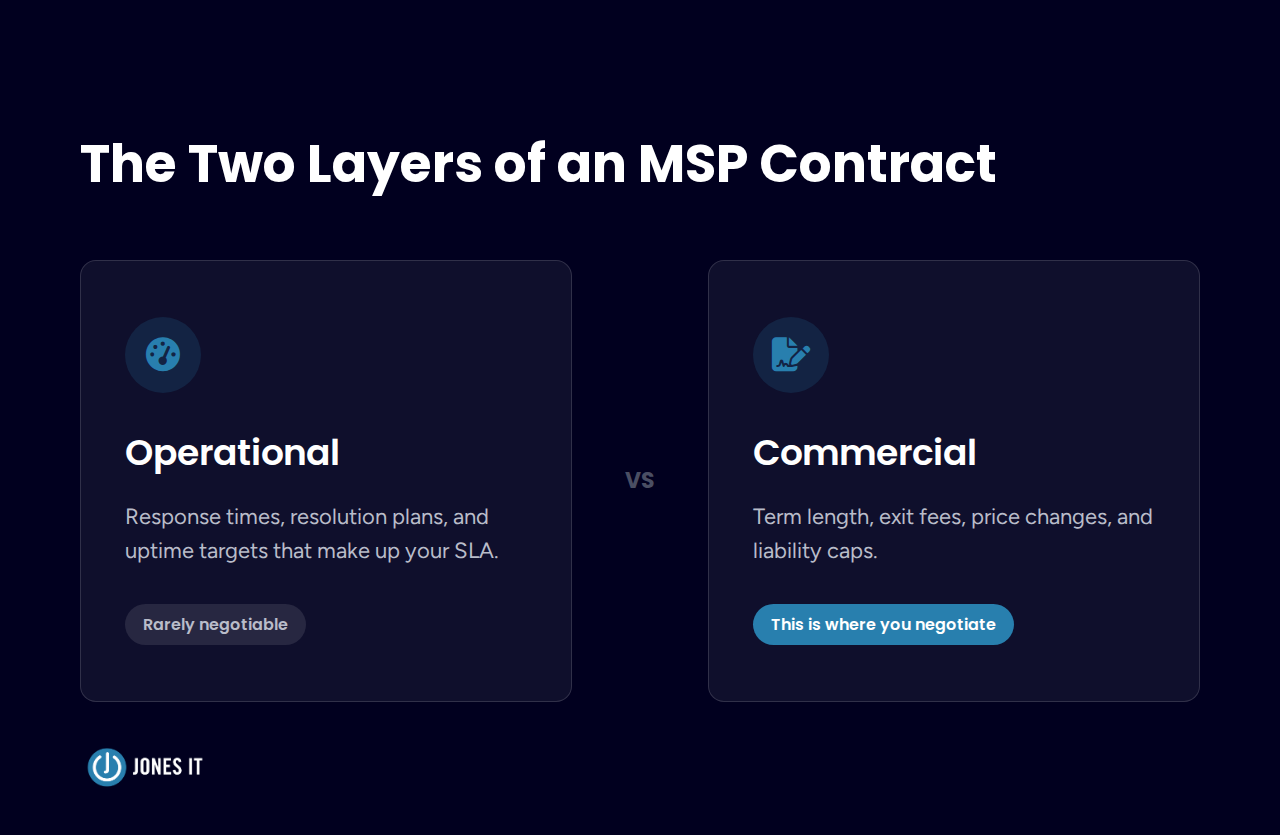
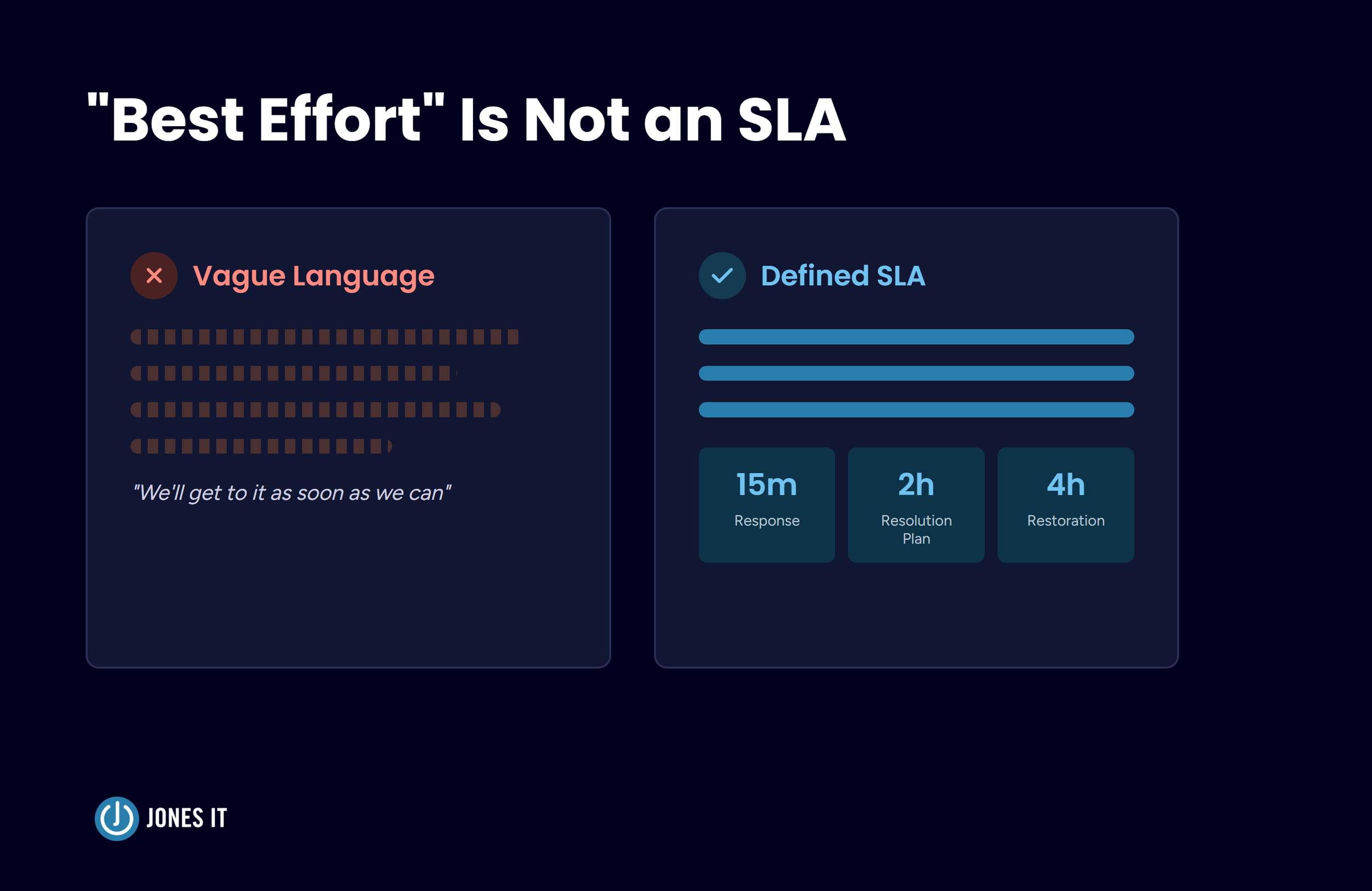
Every managed IT services contract carries two different kinds of commitments, and they behave differently once you start negotiating. The first is operational, which includes response times, resolution plans, uptime targets, and the specific security and backup commitments that make up your service level agreement. Those numbers reflect how a provider actually runs their operations center, so pushing hard on them usually means asking the provider to change how they deliver service across their entire client base. We wrote a full breakdown of what to look for in that layer in our Guide to Managed IT Services SLA, since it deserves its own treatment.
The second layer is commercial. It covers how long you're locked in, what it costs to leave early, how pricing can change, what happens with hours you don't use, and what the provider can charge you outside the monthly fee. This layer protects positions rather than describing operations, and it moves far more easily in a negotiation than most founders expect. A provider confident in their service delivery usually has real room to work with you here, because none of it touches how their technicians actually do their jobs.
Contract Term Length and Auto-Renewal Notice
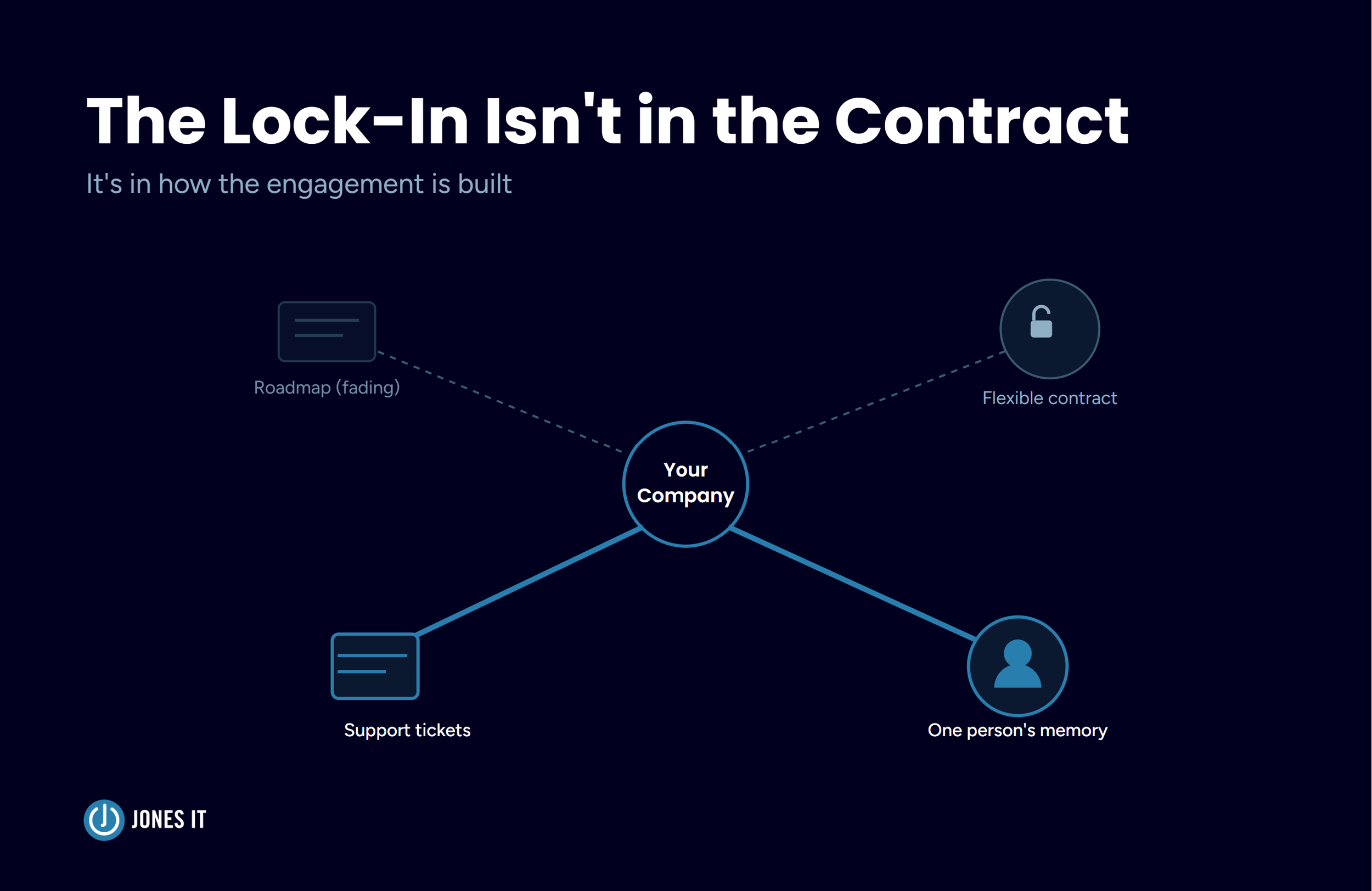
Start with how long you're actually committing to and what happens when that period ends. Most managed IT services contracts open with an initial term, 1-3 years is common, followed by either automatic renewal into another full term or a rolling month-to-month arrangement.
The difference matters more than it looks. A contract that auto-renews into another full year gives you a narrow window, sometimes as little as 30 days, to give notice before you're locked in again. Miss it, and you're committed through another cycle regardless of how the relationship is going. A contract that shifts to month-to-month after the initial term gives you the flexibility to leave with standard notice once you've gotten past the setup period, without requiring you to remember an exact cancellation date a year in advance.
Ask for the second structure. If a provider insists on multi-year renewal terms, negotiate a longer notice window instead, 60 or 90 days rather than 30, so a missed calendar reminder doesn't cost you another year.
Takeaway: Opt for month-to-month terms after the initial period and negotiate a 60–90 day notice window to avoid being locked into an unwanted annual renewal.
Early Termination Fees and Exit Conditions
Early termination fees are the clause from the story above, and they deserve real attention precisely because they're easy to skip past during a sales process. They exist for a real reason: onboarding a new client takes time and resources on the provider's side, migrating credentials, documenting an environment, and setting up monitoring, and a provider walking away from that investment six weeks in deserves some protection. Structured well, this generally follows the same logic as liquidated damages: a pre-agreed number standing in for real but hard-to-prove costs, rather than a punishment for leaving.
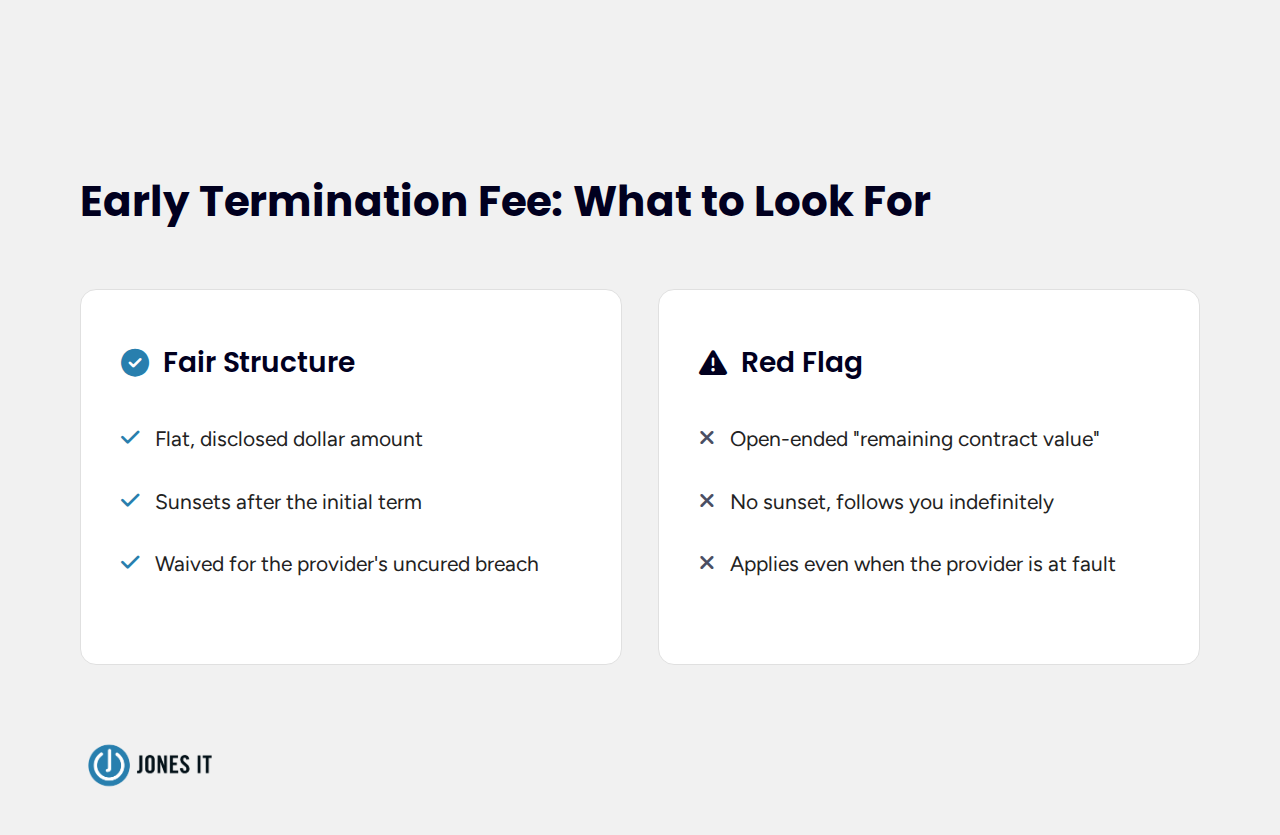
What you're negotiating isn't whether the fee exists. It's whether it's disclosed clearly, whether it's a flat and predictable number rather than an open-ended calculation of “remaining contract value,” and whether it sunsets after the initial term rather than following you indefinitely. A flat fee in the low thousands that only applies during the first six months to a year, and that's waived when the provider is the one in uncured breach, is a fair structure. An open-ended fee with no sunset, or one that applies even when the provider is the reason you're leaving, is not.
Get the number in writing before you sign, not after you've already decided to leave. And if you're already the one leaving, our guide on how to switch to a new managed IT services provider walks through that process end to end.
Takeaway: Ensure termination fees are flat, predictable numbers that sunset after the initial term and are waived if the provider is in breach.
Price Increase Notice Periods
Pricing that can change without meaningful warning is a budgeting risk, and it's a particularly sharp one for a company that raises capital in discrete rounds and plans spend against a specific runway. Ask how much written notice you get before a price increase takes effect, and whether increases are barred entirely during the initial term.
Ninety days is a reasonable standard to ask for. It gives you time to budget around the change, push back if the increase seems steep relative to what you're getting, or start evaluating alternatives if you decide it's not worth staying. Sixty days is workable. Anything shorter effectively means the provider sets your IT budget for you with little recourse.
Takeaway: Demand at least 60–90 days' written notice for any price increase and prohibit hikes during your initial term.
Monthly Minimum Hours and Rollover
Many managed IT contracts are structured around a monthly minimum number of support hours, ten hours is a common baseline for a small team, with additional hours billed as needed. That minimum isn't only a floor on your bill. It gives a provider a predictable number to staff against, and predictable staffing is part of what makes fast response times possible in the first place. A provider guessing at your hours month to month either carries slack capacity and prices it into every client's rate, or runs lean and lets your tickets wait longer during a busy stretch.
Two questions matter here that founders rarely ask upfront. Do unused hours roll over to the next month, and does a heavier month reduce the minimum owed in a lighter one? In most standard agreements, the answer to both is no. You pay the minimum every month regardless of usage, and going over in one month doesn't buy you credit in another.
Tiered hourly pricing softens that in practice. The more hours you use in a given month, the lower your per-hour rate drops, commonly ranging from around $300 an hour at the base tier down to $150 an hour at the highest tier. A heavy month costs more in total, but not proportionally more, since your later hours in that month are priced well below your first ten. That's worth knowing before you assume no rollover means no flexibility. If your usage runs consistently uneven rather than occasionally spiky, ask exactly where the tier breakpoints sit, since that's what determines how fairly an active month gets priced.
Takeaway: Clarify whether unused hours roll over or if usage fluctuates to ensure you aren't paying for support you don't use.
Liability Caps and Damage Exclusions
Every contract in this category includes a limitation of liability section, and it deserves more attention than founders typically give it. This clause caps the total amount you can recover if something goes seriously wrong, usually expressed as a multiple of fees paid over a trailing period, and it typically excludes both parties from claiming lost profits or other indirect damages.
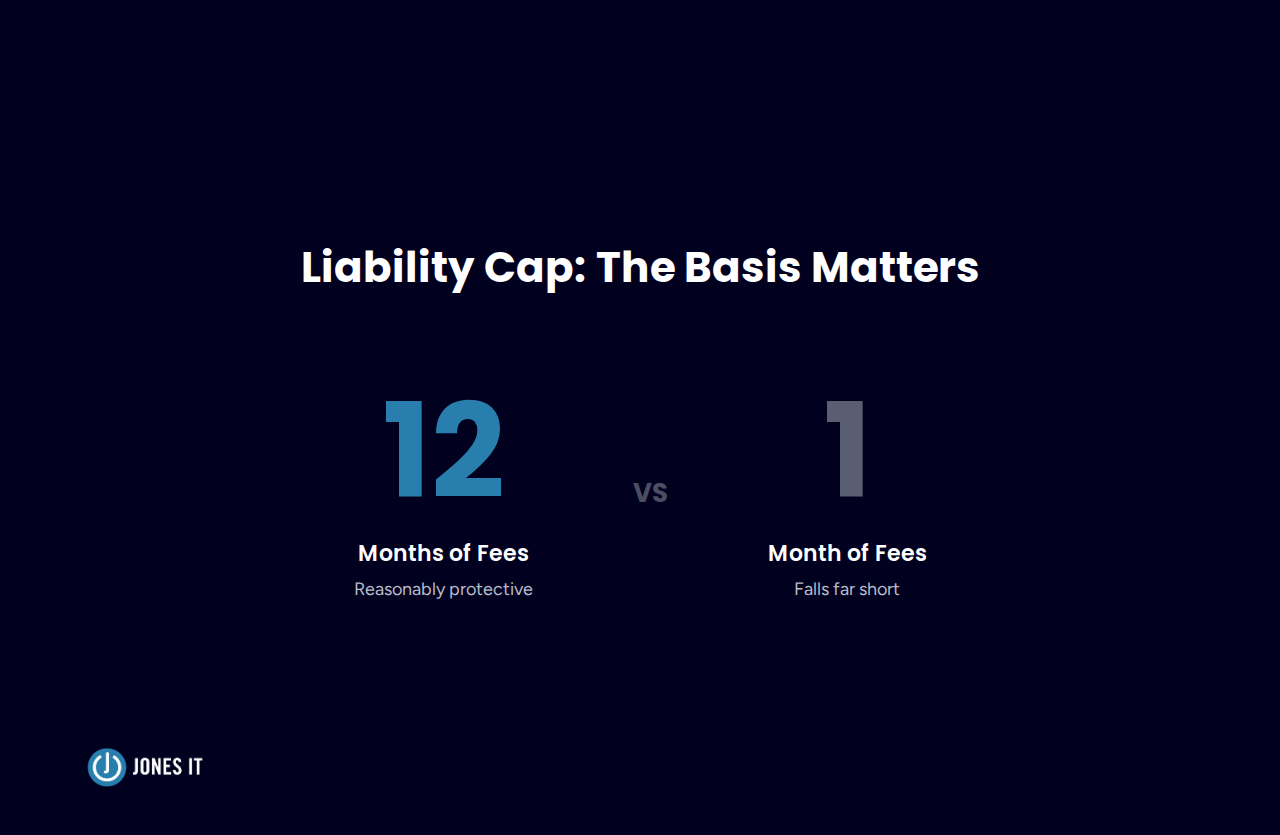
A cap set at twelve months of fees paid is a standard, protective threshold. A cap set at a single month's fees is far less so, and worth pushing back on, particularly if the provider will have access to sensitive systems or regulated data. The mutual exclusion of consequential damages, meaning neither side can go after the other for lost profits or downstream business harm, is standard practice and rarely worth fighting over on its own. The cap amount is where the real negotiation lives.
Takeaway: Target a liability cap of at least 12 months of fees; a single-month cap offers inadequate protection for your sensitive data.
Purchase Markup and Procurement Access
If your provider buys hardware or software on your behalf, most contracts include a markup, commonly in the 10 to 15 percent range, charged as a service fee on top of the item's cost. That's a normal way for a provider to get paid for procurement work, but it should be disclosed as a specific percentage rather than left vague.
Some providers will waive that markup entirely if you give them direct access to your own payment method, a company card or a procurement portal, so they're purchasing on your account instead of theirs. If your monthly purchase volume is high enough for the markup to add up, it's worth asking whether that option exists.
Takeaway: Define markup percentages clearly, and negotiate waiving them by providing direct access to your own procurement accounts.
A Practical IT Contract Negotiation Checklist
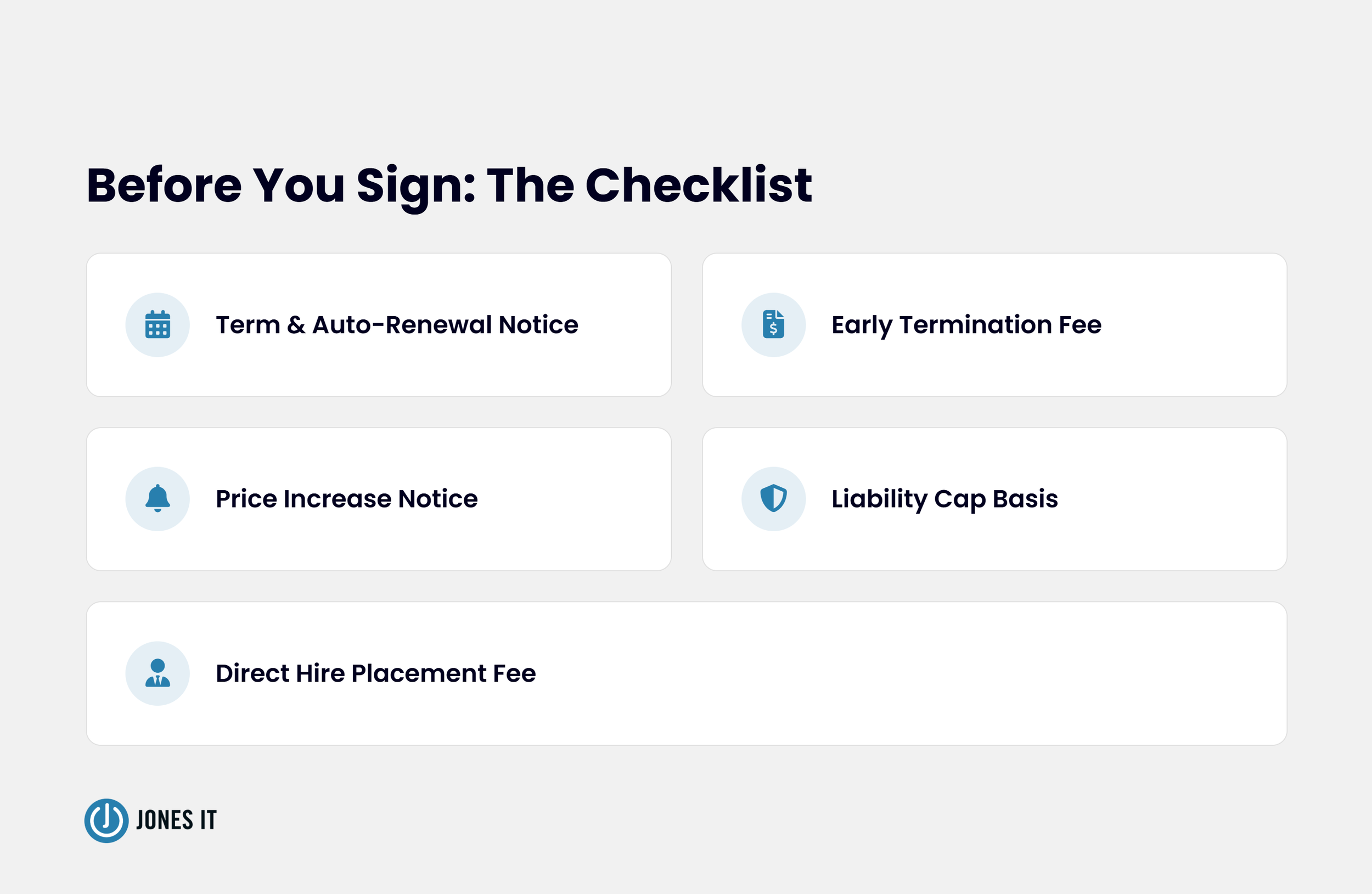
Before you sign a managed IT services contract, confirm the following:
The initial term length, and whether renewal is automatic for another full term or converts to month-to-month.
The auto-renewal notice window, ideally 60 to 90 days rather than 30.
The early termination fee, and whether it's flat, disclosed, capped to the initial term, and waived for the provider's uncured breach.
The price increase notice period, ideally 60 to 90 days, with no increases during the initial term.
Whether unused monthly hours roll over, and whether overages in one month offset another.
The liability cap basis, and whether it's proportionate to the risk of the engagement.
Whether hardware or software purchases carry a markup, and whether procurement access can waive it.
Which of these terms live in the master agreement versus the SLA, so you know which document you're actually negotiating.
None of this replaces a contract attorney. Get one to review the final language, especially anything involving liability, indemnification, or data ownership, before you sign. What the checklist above does is ensure you're asking the right questions before that review even starts, instead of finding out what you agreed to the day you try to leave.
Building a Contract That Doesn't Surprise You Later
The company from the story above ended up paying the fee. Six thousand dollars wasn't worth fighting over given everything else on their plate that quarter, and the provider wasn't wrong to enforce a term that was, technically, in the contract they signed. What frustrated them wasn't the number. It was realizing they'd had leverage to negotiate that clause fourteen months earlier and never used it, because nobody thought to ask.
We build our own client agreements with these terms spelled out clearly for exactly that reason: a flat termination fee that sunsets after the initial term and real notice before any price change. If you're reviewing a contract right now and can't tell what you'd owe to leave, that's worth resolving before you sign anything else.




About The Author

Evan JonesFounder and CEO of Jones IT
With over two decades of IT experience in San Francisco, Evan guides Jones IT's long-term strategy, finances, and culture, with a vision of building the city's highest-rated IT services firm. Outside of work, you'll find him on the golf course or running Bay Area Warriors, his non-profit connecting Bay Area kids to college through basketball.
Most managed IT contract terms are fixed, but exit fees, term lengths, and liability caps are negotiable. Learn what to push back on before signing.