
Fast-Ramp IT Transitions for Launches, Moves, and Cutovers: When the Deadline Doesn't Move
Six weeks. That's how long a Mission Bay healthcare startup had between the moment they told us about their new office and the day their lease clock started running, whether they'd moved in or not. They weren't unhappy with their current IT provider. Nothing was broken. They were opening a second location, onboarding eighteen new hires in the same month, and demoing a new patient portal to their board, all while their existing setup wasn't built to support any of it at the pace they needed. When a business is faced with an immovable deadline, urgent MSP onboarding isn't just about speed; it's about structure. That's the shape of a deadline-driven IT transition; not “our IT is failing us,” but “we have a date, and it isn't moving.”
We asked the founder what would happen if the office wasn't ready on schedule. She didn't hesitate. The lease started accruing rent that day; regardless, the new hires had already given notice at their old jobs, and the board demo had been on the calendar for two months. There was no version of this where the date moved to accommodate IT. IT had to accommodate the date.
A deadline-driven IT transition is a different problem than the one most IT transition advice is written for. It's not about finding the right long-term partner, weighing feature sets, or negotiating contract terms at a comfortable pace. It's about building a working environment against a deadline that someone else set, for reasons that have nothing to do with technology.
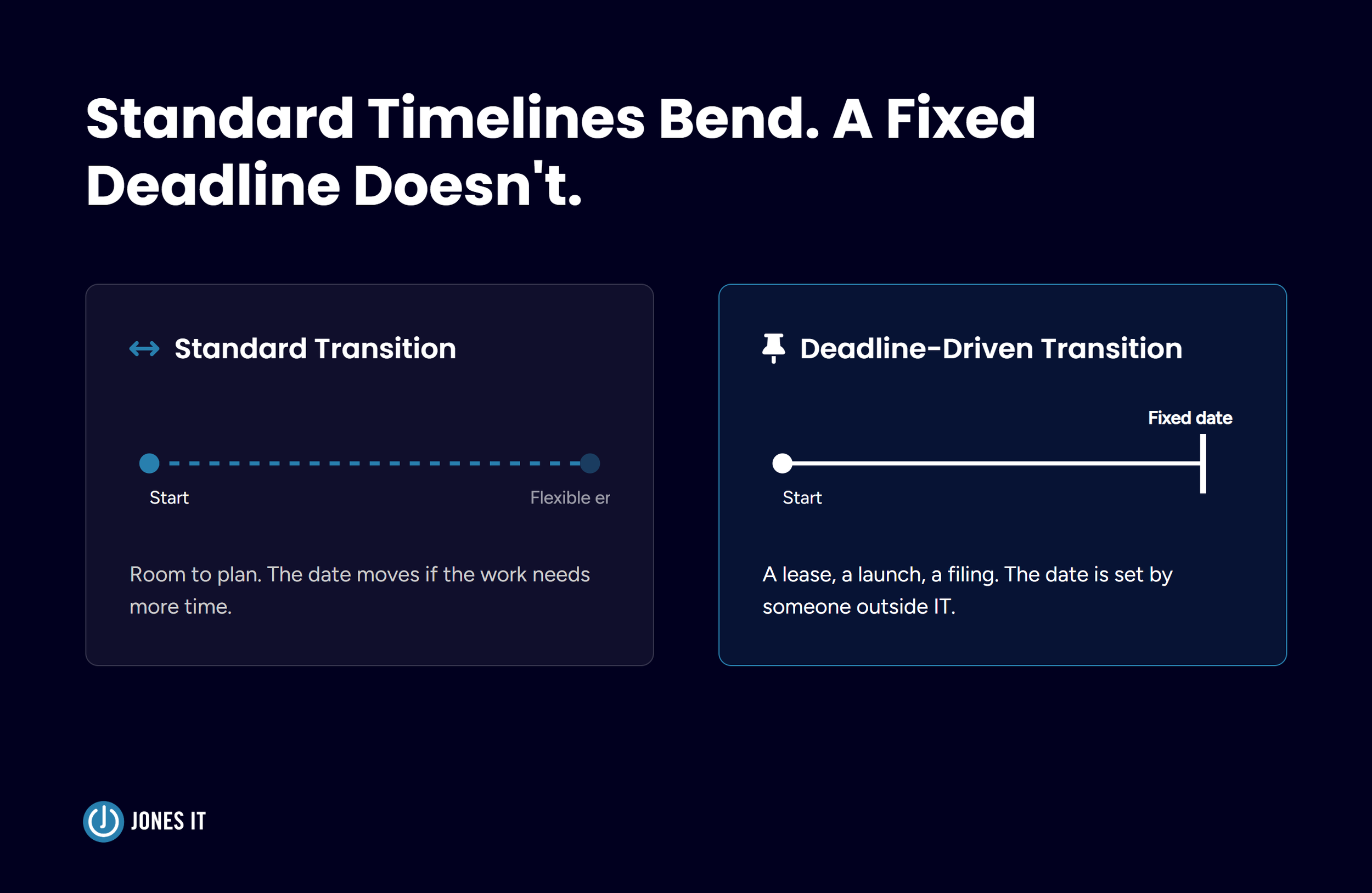
Why Standard IT Transition Timelines Don't Work on a Fixed Deadline
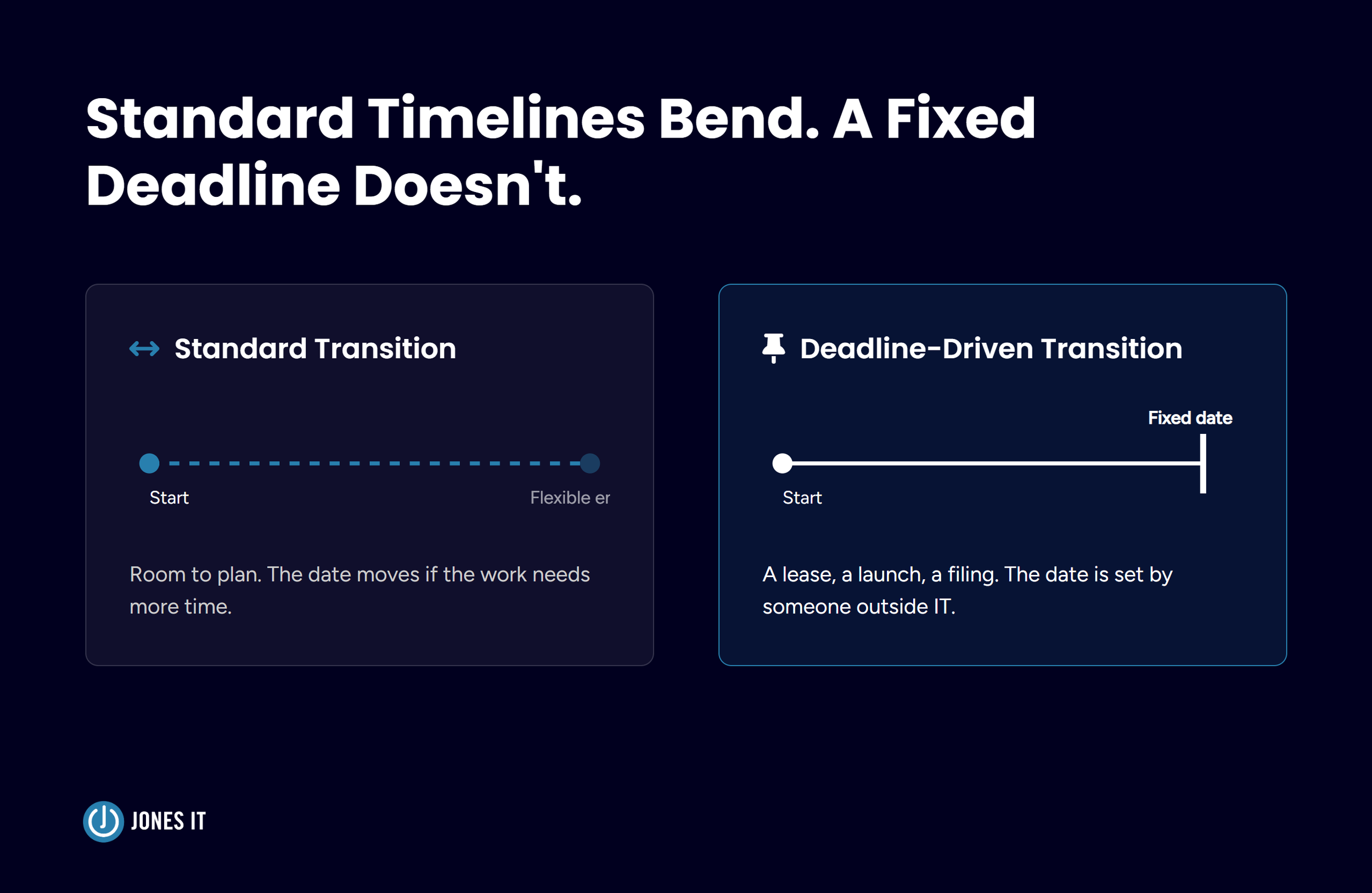
A deadline-driven IT transition is an IT provider changeover built around a fixed external date, like a launch, a move, a compliance filing, or an acquisition close, rather than around the provider's preferred pace. Most guidance on switching IT providers assumes you have room to plan. Start vetting new vendors four to six months before your contract renews. Take your time on discovery. Run a slow, careful handoff so nothing breaks. That advice is sound when the trigger is dissatisfaction with a current provider, or a company simply outgrowing its setup.
This kind of transition doesn't get that luxury. The date is set by something outside IT entirely, and the technology has to be ready regardless of how much internal debate happens about vendor selection. We built our onboarding model around this exact situation, because the standard model breaks down the moment the calendar becomes non-negotiable.
The distinction that matters here is that a good IT transition and a fast one aren't the same skill. A provider who does careful, unhurried onboarding well may still be the wrong choice for a compressed timeline. Not because they're bad at their job, but because their process was never built to run under compression.
We've seen this play out in office moves, product launches, acquisition cutovers, and vendor switches tied to a compliance filing date. The details change, but the shape is consistent. Someone in the business made a commitment with a hard date attached, a lease, a launch announcement, a regulatory deadline, or a closing date, before IT was consulted about feasibility. By the time we're brought in, the date is fixed, and everything else has to bend around it. That's not a flaw in how the business operates. Launches get announced before every technical dependency is mapped. Leases get signed before a network buildout plan exists. Compliance deadlines don't wait for a leisurely vendor search. Our job is to build a transition plan that treats the date as the one non-negotiable input, rather than trying to talk the business into a more comfortable timeline that isn't actually available to them.
Kickoff for a Deadline-Driven IT Transition: What Happens Before Day One Ends
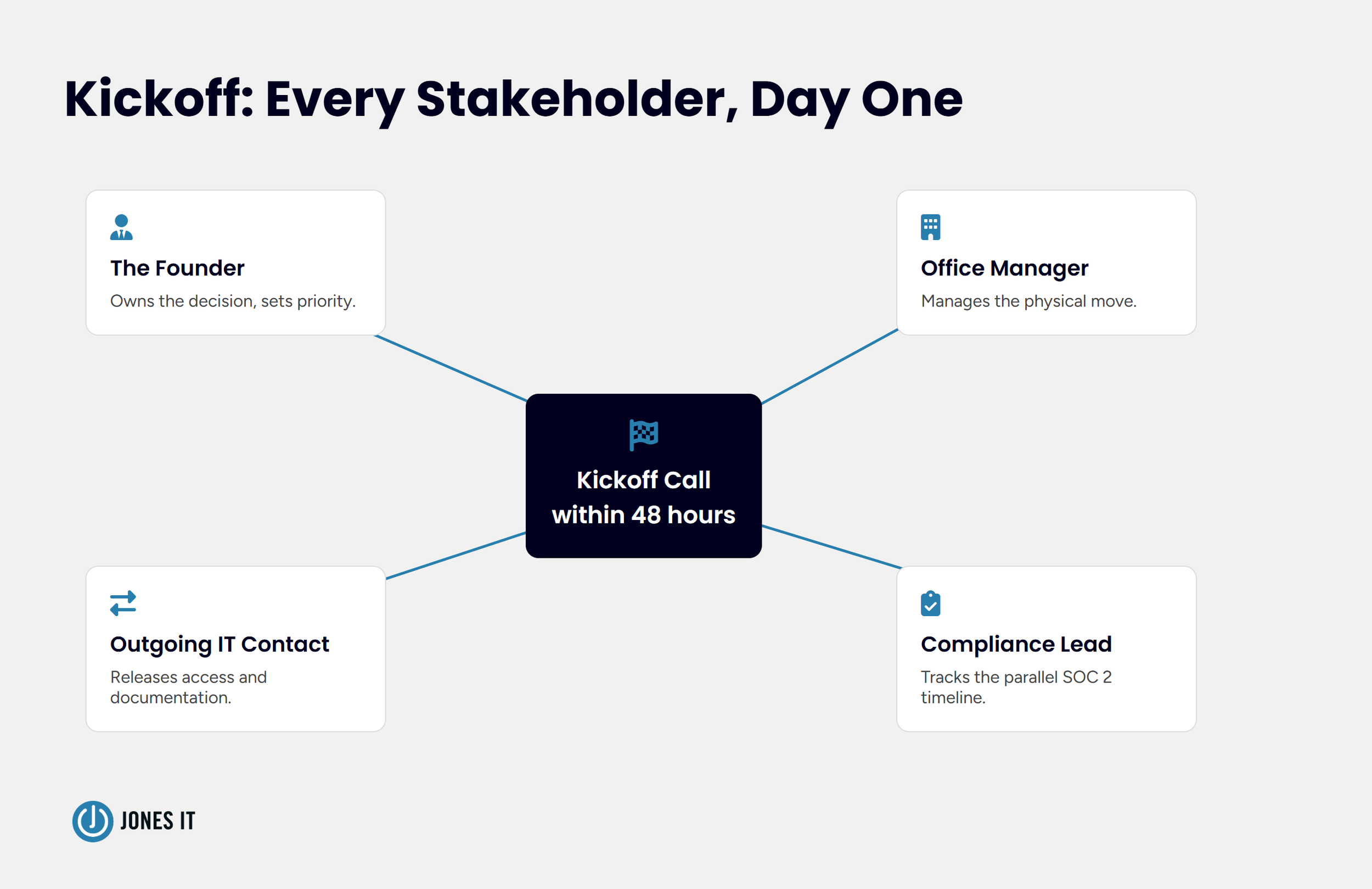
For the healthcare startup, we scheduled the kickoff call within 24 hours of the signed agreement. Not because we like to move fast for its own sake, but because kickoff is where a compressed timeline either gets protected or gets quietly eroded.
Kickoff for a deadline-driven IT transition has to name the actual immovable date, and what happens if it's missed, before anyone touches a router or a switch. A lease start with a rent liability attached is a different kind of deadline than a soft internal target, and the plan has to reflect that difference. It also has to name who holds the authority to make decisions without waiting for a follow-up meeting, and which existing access, documentation, or vendor relationships need to be released, and by when.
We spent the first day building a stakeholder map: the founder, the office manager handling the physical move, the outgoing IT contact, and the compliance lead tracking a SOC 2 timeline running in parallel. Getting all four in the same room, even briefly, kept a six-week runway from quietly becoming a five-week one.
The stakeholder map matters more than it sounds like it should. On a normal transition timeline, a missed connection between the office manager and the outgoing IT contact costs a few days of back-and-forth email. On a six-week timeline, the same miscommunication costs a full week, because there's no slack left to absorb it. We treat kickoff as the moment to surface every dependency that could stall the plan later. For example, lease terms that restrict when contractors can access the building, an outgoing provider who is slow to respond to access requests, or a compliance deadline that requires specific documentation before a cutover can happen. Every one of these risks gets identified on day one, not discovered on day twenty.
A successful IT transition project management approach requires identifying dependencies on day one, not day twenty.
Discovery on a Compressed Timeline: What Gets Prioritized First
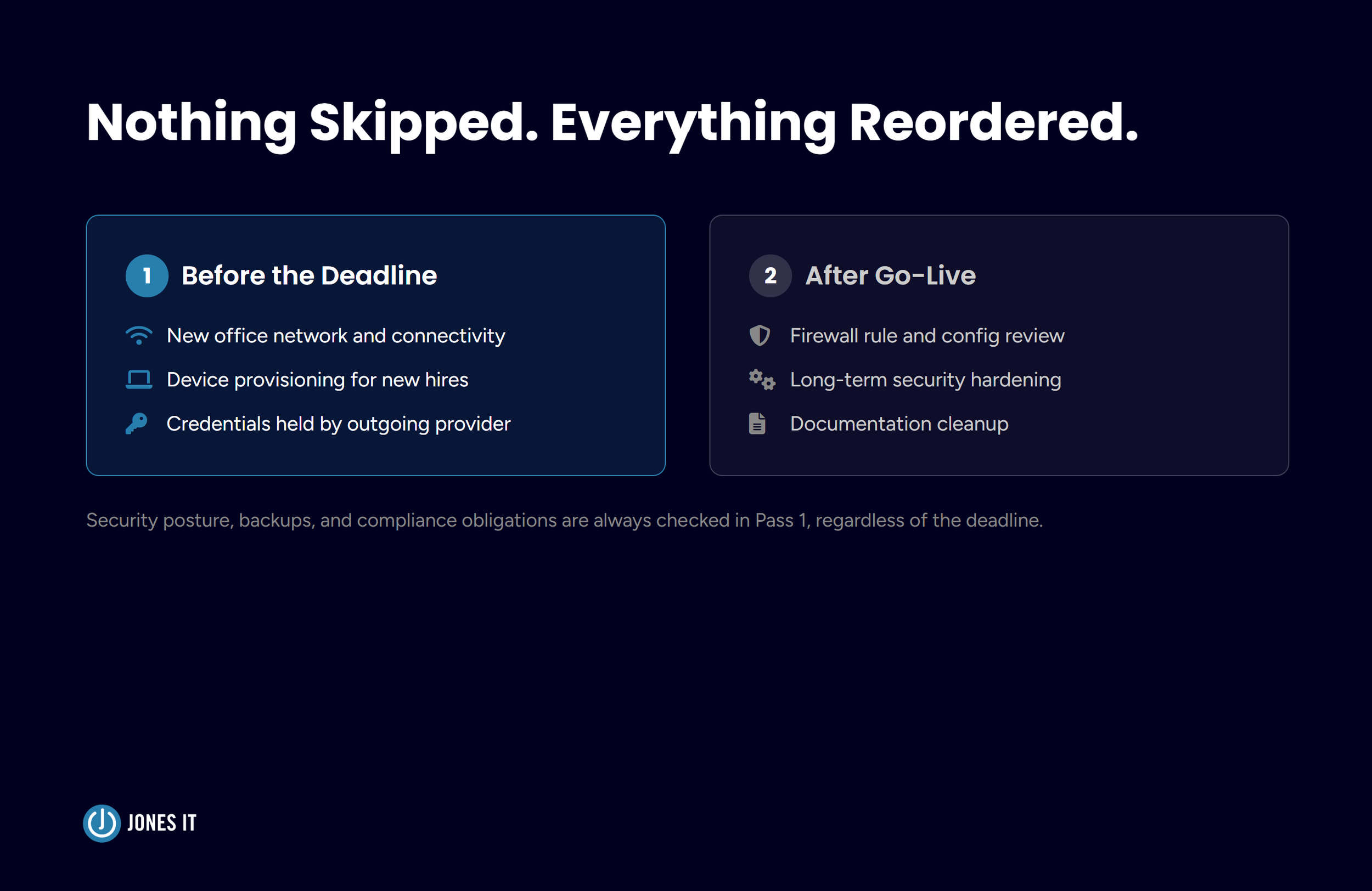
Discovery under normal conditions is thorough by design, including a full inventory of hardware, software, licenses, cloud services, and security controls, gathered before any changes are made. Under a fixed deadline, thoroughness has to be sequenced differently. Nothing gets skipped; it just gets reordered.
The first pass covers only what blocks the deadline: network and connectivity for the new office, device provisioning for incoming hires, and any credential or access dependency held by the outgoing provider. The deeper audit, legacy configuration review, long-term security hardening, and documentation cleanup move to a second pass that happens after the date is met, not before.
This prioritized approach creates a clear IT project cutover strategy that ensures security and compliance are maintained even under a compressed timeline.
I'll admit something here that might sound uncomfortable coming from someone who manages systems for a living: a discovery checklist followed in the exact same order every time, regardless of context, isn't a sign of good process. It's a sign of a process that hasn't had to survive a real deadline yet.
For the healthcare startup, that meant the new office's network buildout, and the eighteen incoming laptops got resourced first. Reviewing three years of accumulated firewall rule changes from the outgoing provider got scheduled for week seven, after the lease had already started, and rent was no longer the driving concern.
Deferring part of discovery carries a real risk, and we don't pretend otherwise. It means operating for a period with an incomplete picture of the environment. We manage that risk by drawing a hard line between what gets deferred and what doesn't. Anything touching security posture, backup integrity, or compliance obligations gets checked in the first pass, regardless of whether it blocks the deadline directly. What gets deferred is configuration cleanup and long-term optimization, not the items that would leave the business exposed. A compressed timeline changes the order of the work, but it doesn't lower the bar for what has to be checked before going live.
Stabilization: The First 30 Days of a Fast IT Provider Transition
Meeting the deadline isn't the finish line. It's the point where the real work of a fast IT provider transition actually starts, because everything deferred during discovery is still sitting there, waiting.
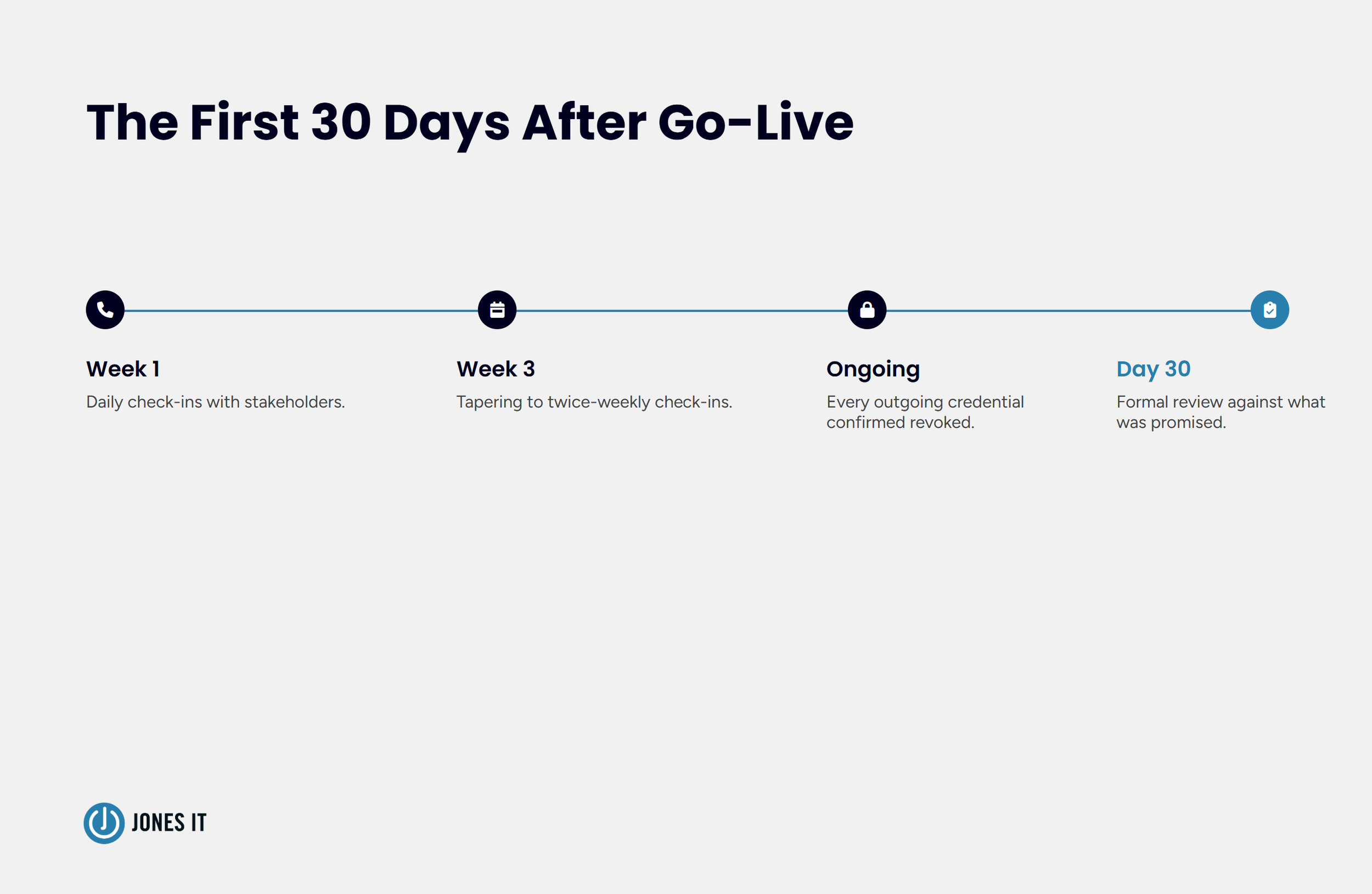
The first 30 days after go-live follow a different rhythm than the six weeks before it. The posture shifts from “get this working” to “make sure it stays working.” Daily check-ins run for the first week, tapering to twice-weekly by week three. The deferred discovery items get closed out in order of risk, not in the order they were noticed. Every credential and access point the outgoing provider held gets confirmed as revoked, not just reported as revoked. And a formal 30-day review brings back the same stakeholders from kickoff, comparing what was promised against what actually happened.
For the healthcare startup, the 30-day mark landed the same week as their patient portal demo. The network held, the new hires had working equipment on day one in the new space, and the compliance lead had what she needed for the SOC 2 timeline running alongside all of it. None of that happened because we moved faster than everyone else. It happened because we treated the deadline as the one constant and built everything else around it.
Thirty days after go-live is also when we finish closing out everything that got deferred during discovery. The firewall rule review that got pushed to week seven happens on schedule, not whenever it's convenient. We track deferred items the same way we track anything else in the transition plan: with an owner and a date. A deferred item without a deadline of its own has a way of turning into a permanent gap, and permanent gaps are exactly what a deadline-driven IT transition can't afford to accumulate, even after the original crisis has passed.
What to Ask Before an Urgent Managed IT Transition
If you're facing an urgent managed IT transition of your own, tied to a launch, a move, a cutover, or a deadline someone else set, the questions worth asking a prospective provider look different from a standard MSP evaluation.
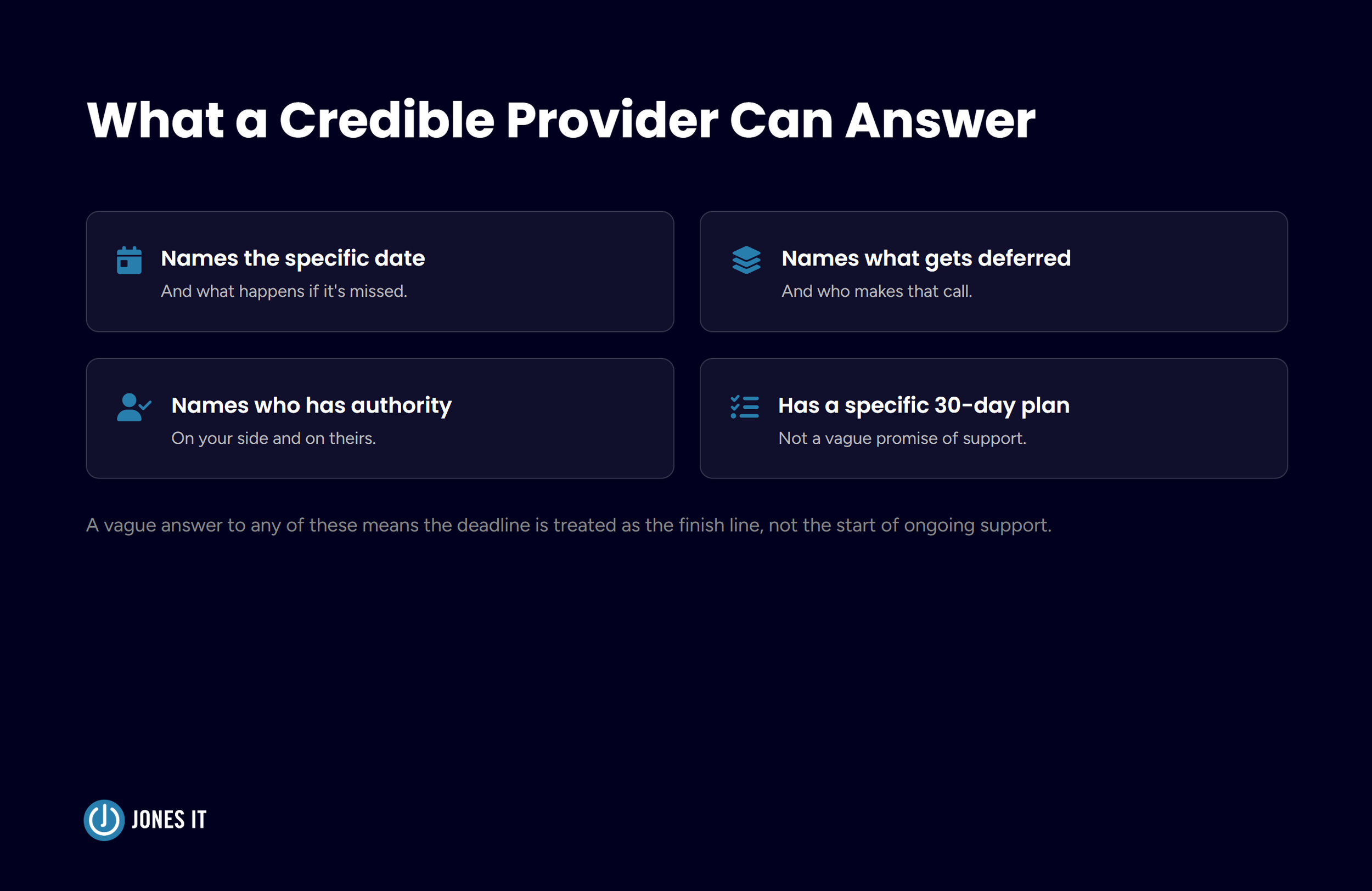
A credible provider can name the specific date and explain what happens if it's missed. One who treats every timeline the same way hasn't planned for yours specifically. Ask what gets deferred to the second phase, and who makes that call. An answer of “nothing gets deferred” isn't thoroughness; it's a sign the provider hasn't done this under real pressure. Ask who holds decision-making authority on your side and on theirs, since compressed timelines don't survive a decision that has to wait for someone's return from vacation. And ask what the 30-day stabilization plan looks like, specifically. A vague answer usually means the provider treats the deadline as the finish line rather than the starting point of ongoing support.
It's also worth asking directly what happens if the outgoing provider is slow to cooperate. A deadline-driven IT transition doesn't have the buffer to wait out an unresponsive incumbent. A provider with real experience in this kind of transition should have a documented fallback, credential recovery without cooperation, a plan for rebuilding access from scratch, rather than a hope that the handoff goes smoothly. If a prospective provider hasn't thought through what happens when the handoff doesn't run like clockwork, that's worth knowing before the date arrives, not after.
Bringing the Deadline In On Time
A launch date doesn't wait for a leisurely onboarding process. Neither does a lease, a compliance filing, or an acquisition close. If your IT transition is tied to one of these, the deadline is the one thing that isn't up for negotiation, and the plan has to start there.
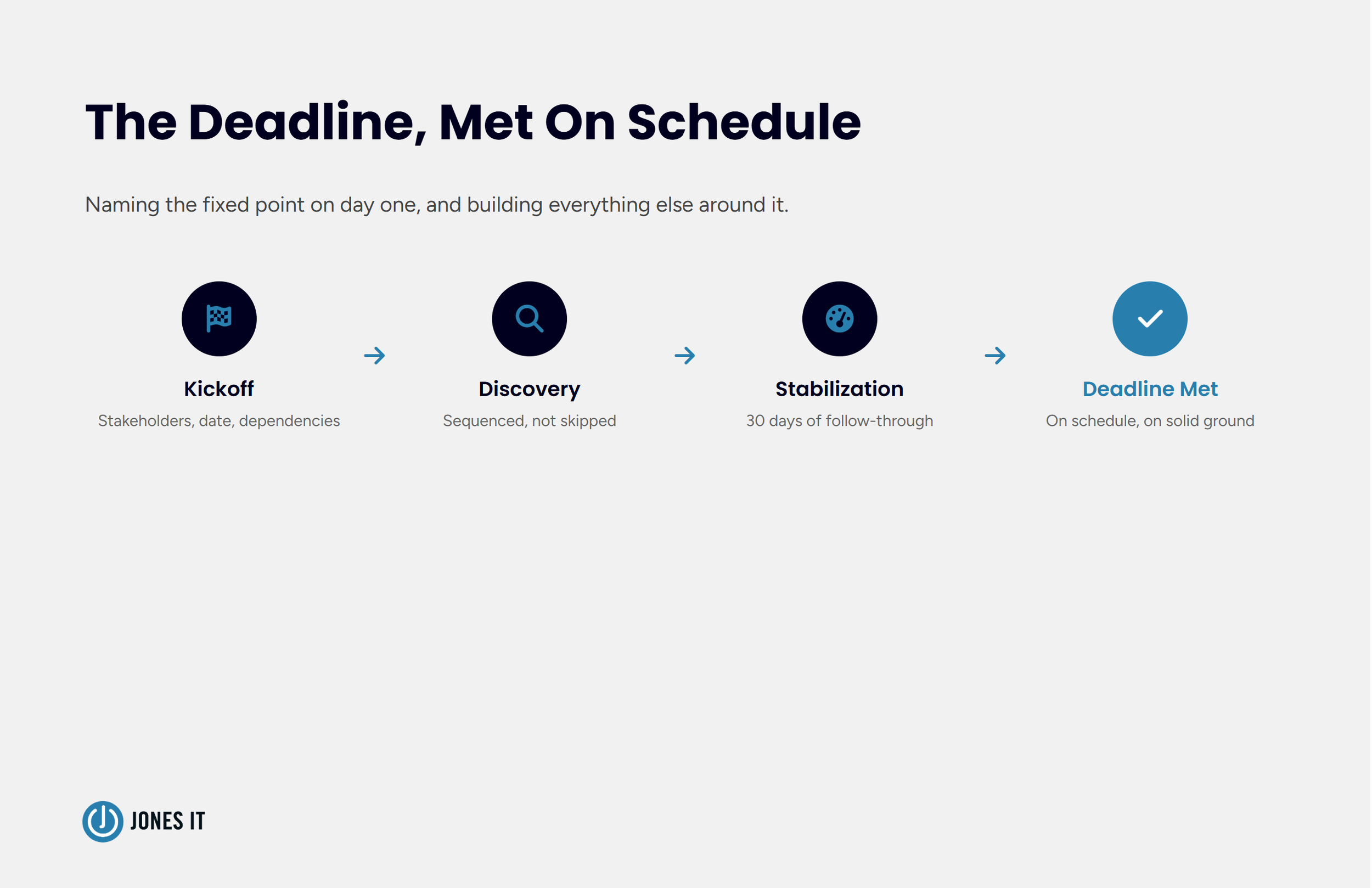
The healthcare startup's board demo went ahead as scheduled. The new hires started in a working office instead of a half-finished one. None of that was luck. It was the result of naming the deadline as the fixed point on day one and building kickoff, discovery, and stabilization around it, rather than around a generic onboarding template that assumed nobody was in a hurry.
We've run this playbook for companies across the Bay Area facing exactly this kind of timeline. If your trigger is dissatisfaction with a current provider rather than a fixed date, that's a related but different playbook; see How To Switch To A New Managed IT Services Provider.
If you have a fixed date on the calendar and IT that isn't ready for it, reach out to us, and we'll walk you through what a deadline-driven IT transition looks like for your specific situation.



About The Author

Michael LeMayIT Systems Engineering Manager at Jones IT
Michael LeMay has spent over seven years at Jones IT, growing from consultant to team lead. Before getting into IT, he spent nearly seven years as an F-16 and C-17 jet engine mechanic in the United States Air Force. He brings that same precision and discipline to troubleshooting complex systems today.
Mac vs. PC for startups isn't a company-wide choice; it’s a per-role one. Use this framework to match hardware to software needs and efficiently manage a mixed fleet.