
An IT provider is underperforming when it consistently fails to meet response time benchmarks, resolve recurring issues at the root, or align its services with your company’s current scale and security requirements. Although most businesses recognize this eventually, they miss the important question of why it’s happening, and that distinction matters more than most people realize when deciding what to do about it.
When Your IT Provider Was the Right Fit (And Then Wasn't)
Picture a fintech startup in SoMa that signed on with a local MSP when they had 11 employees and two racks of hardware. The provider was responsive, personal, and priced right. Three years later, the company is at 55 people, handling PCI-scoped cardholder data, staring down a SOC 2 Type II audit, and building on AWS. The MSP is still calling back within the hour, and the tickets are getting closed, but nothing is getting better. There’s no technology roadmap. Cloud architecture questions get vague answers. Security training for new hires has never happened.
This is one of the most common IT partnership problems we see, and it’s genuinely hard to name at first. Nothing has “failed.” Your provider hasn’t dropped the ball on something obvious. The relationship just quietly stopped serving you. It’s easy to mistake that feeling for vendor underperformance when the real issue is outgrowth.
Other times, the problem really is underperformance, when tickets pile up, the same issues cycle through month after month, and security gaps never get patched. That’s a different situation with a different fix.
Knowing which one you’re dealing with is the starting point for everything that follows.
Two Reasons Managed IT Providers Underperform
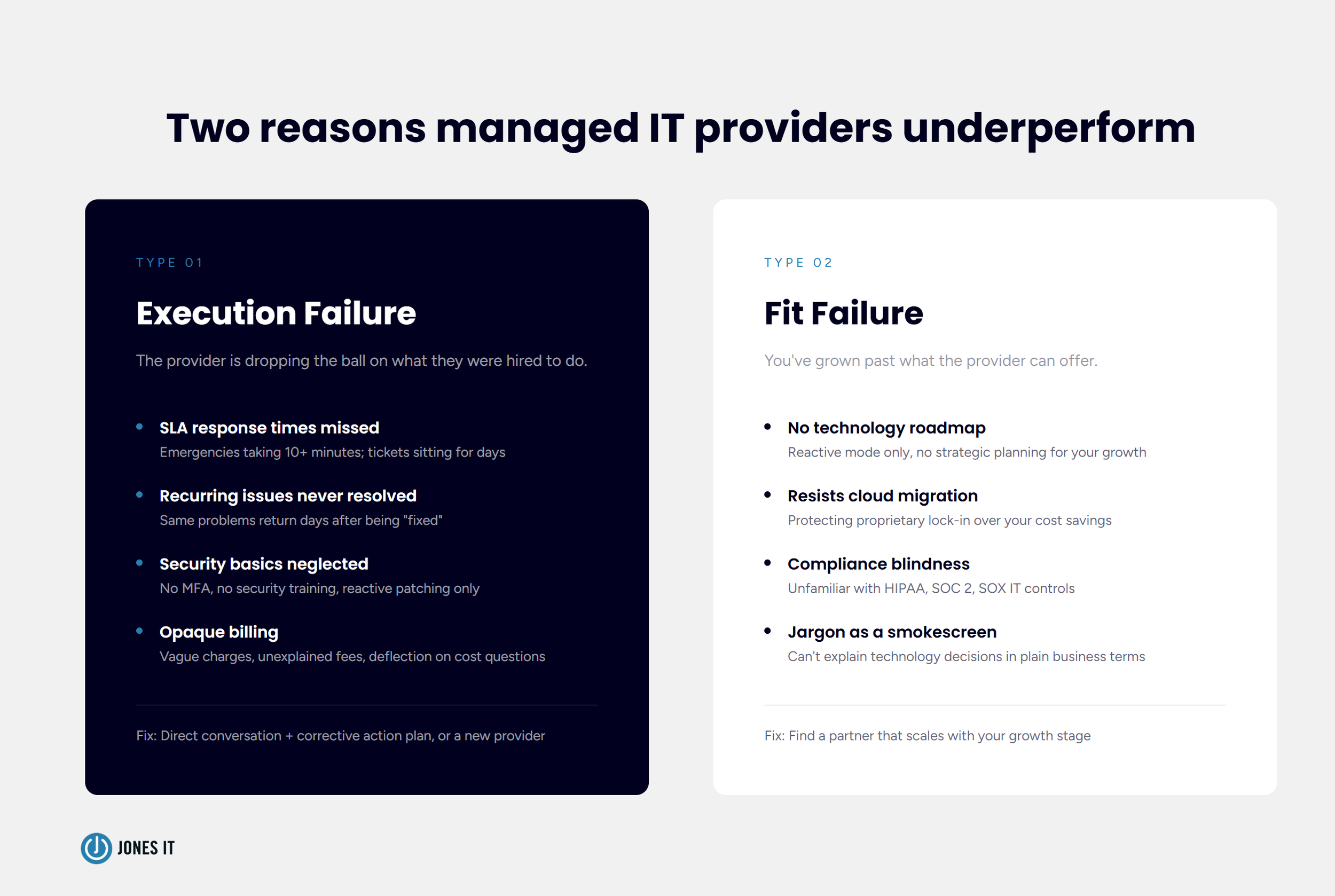
When an IT partnership stops working, the cause is almost always one of two things: execution failure or fit failure. They look similar from the outside but have different roots.
Execution failure means the provider is dropping the ball on what they were hired to do. Response times slip past SLA (Service Level Agreement) benchmarks. The same glitches come back days after a fix. Security basics go unaddressed. This is a performance problem, and it requires a direct conversation, a corrective action plan, and often a provider change.
Fit failure means the provider is probably doing the job they were hired to do, but you’ve grown past what that job covers. A provider built for 15-person companies with simple network needs cannot easily become a strategic IT partner for a 60-person SaaS company navigating SOC 2 compliance and multi-cloud infrastructure. The skills, processes, and tooling are different. This isn’t about blame, but about alignment.
Most advice on this topic conflates the two. The result is companies having corrective-action conversations with a provider when what they actually need is a different one, or switching providers when a direct conversation would have resolved things. Getting the diagnosis right saves time and money on either side of the decision.
Signs Your IT Provider Is Failing on Execution
Execution failures tend to show up in ways that are measurable, even if they accumulate slowly. Here are the patterns worth watching for.
1. Response times that consistently miss benchmarks
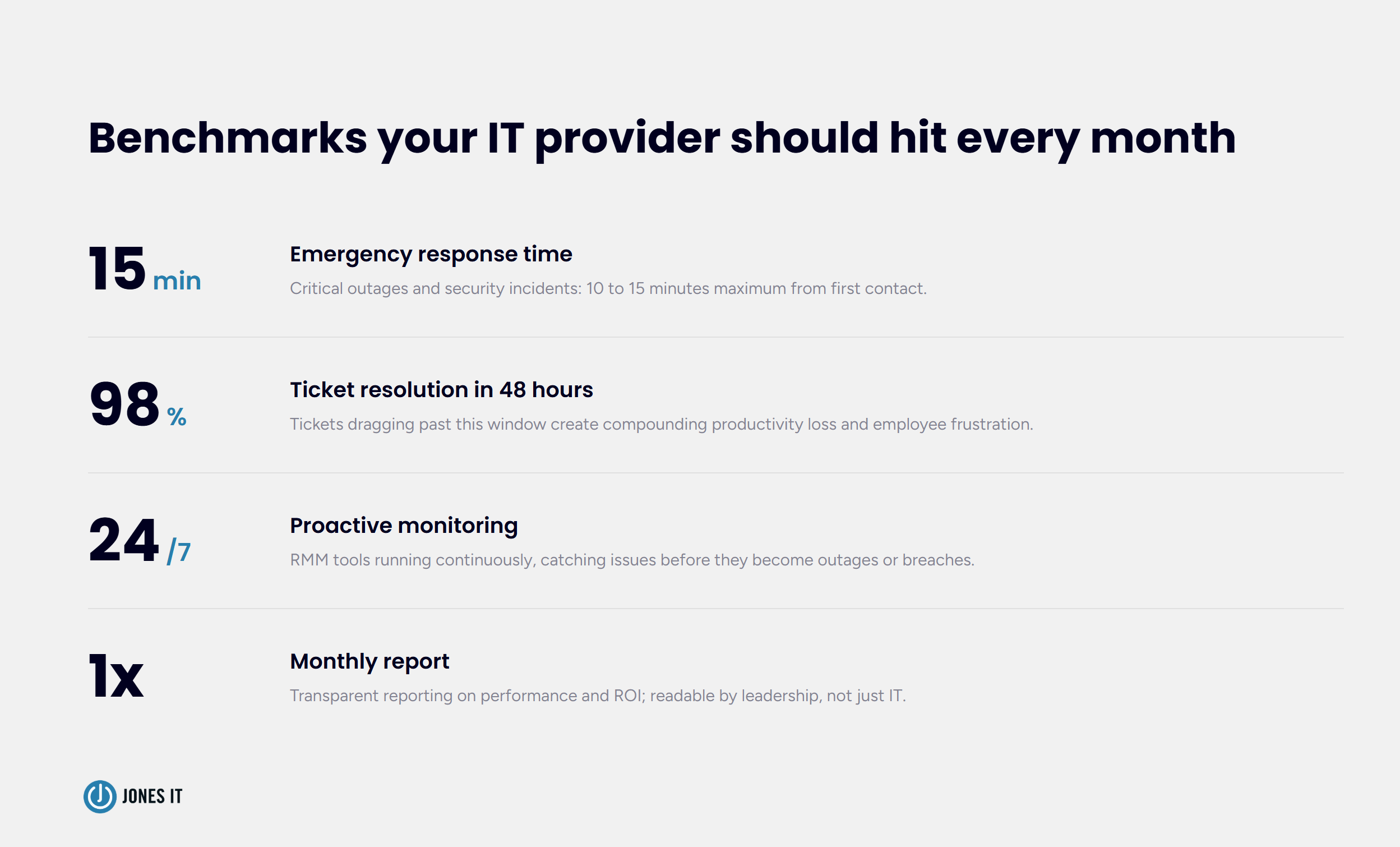
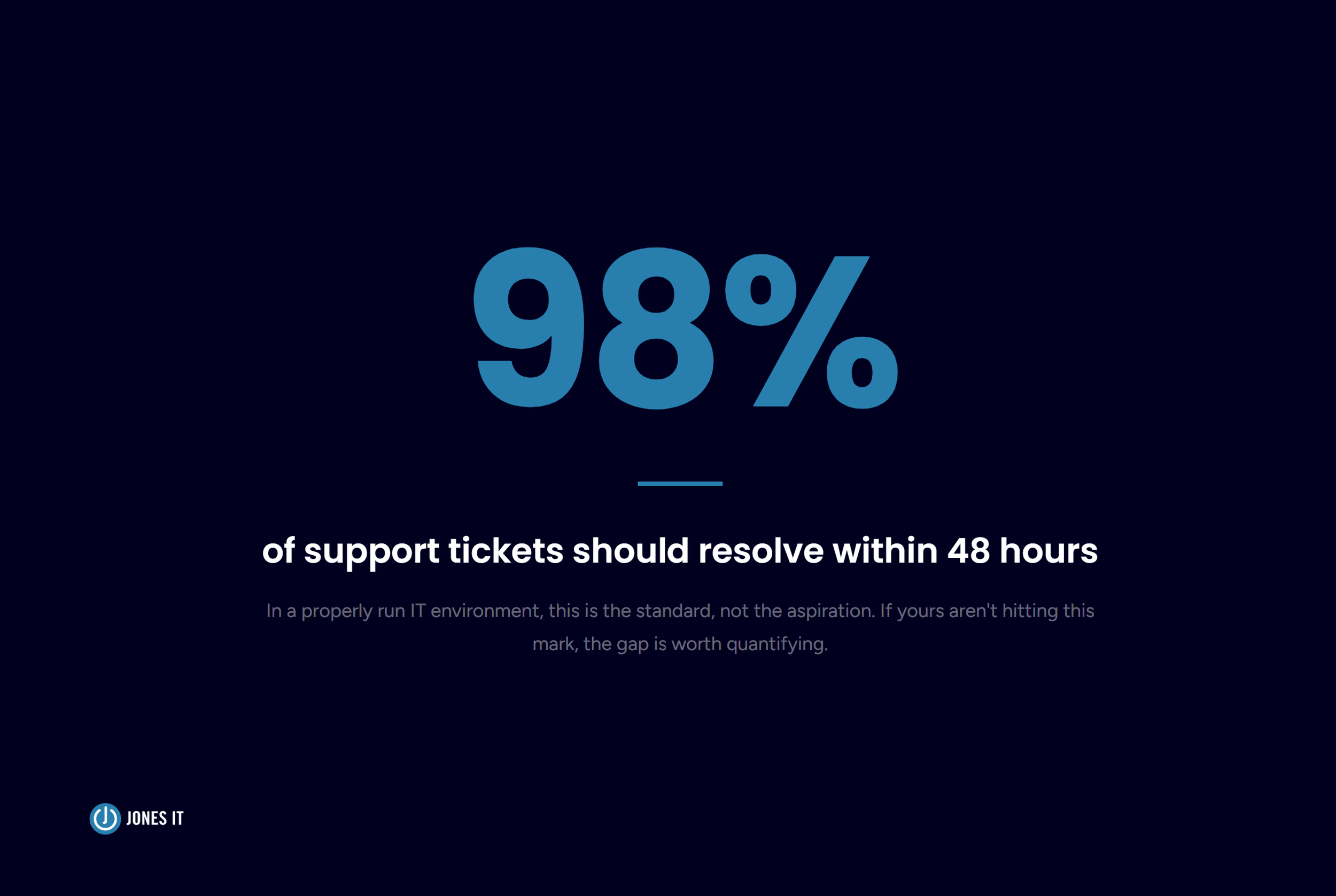
A healthy managed IT partnership has specific response benchmarks, such as emergency issues addressed within 10 to 15 minutes, and non-urgent tickets resolved within a few hours. When emergency responses routinely stretch past 15 minutes, or tickets sit for days without movement, that’s not an occasional bad week. It reflects inadequate staffing, helpdesk mismanagement, or a provider stretched too thin across too many clients. In a properly run environment, 98% of support tickets should resolve within 48 hours. If yours aren’t, the gap is worth quantifying before you have a harder conversation.
2. Recurring issues that never actually get fixed
A ticket closed is not a problem solved. When the same issues come back days or weeks after being “fixed,” the underlying cause was never addressed. This pattern, sometimes called reactive or break-fix behavior, is a strong signal that your provider is applying band-aids rather than doing root-cause analysis. It creates a slow drain on productivity and employee morale that rarely appears in any single incident report but compounds steadily over time.
3. Security basics left unaddressed
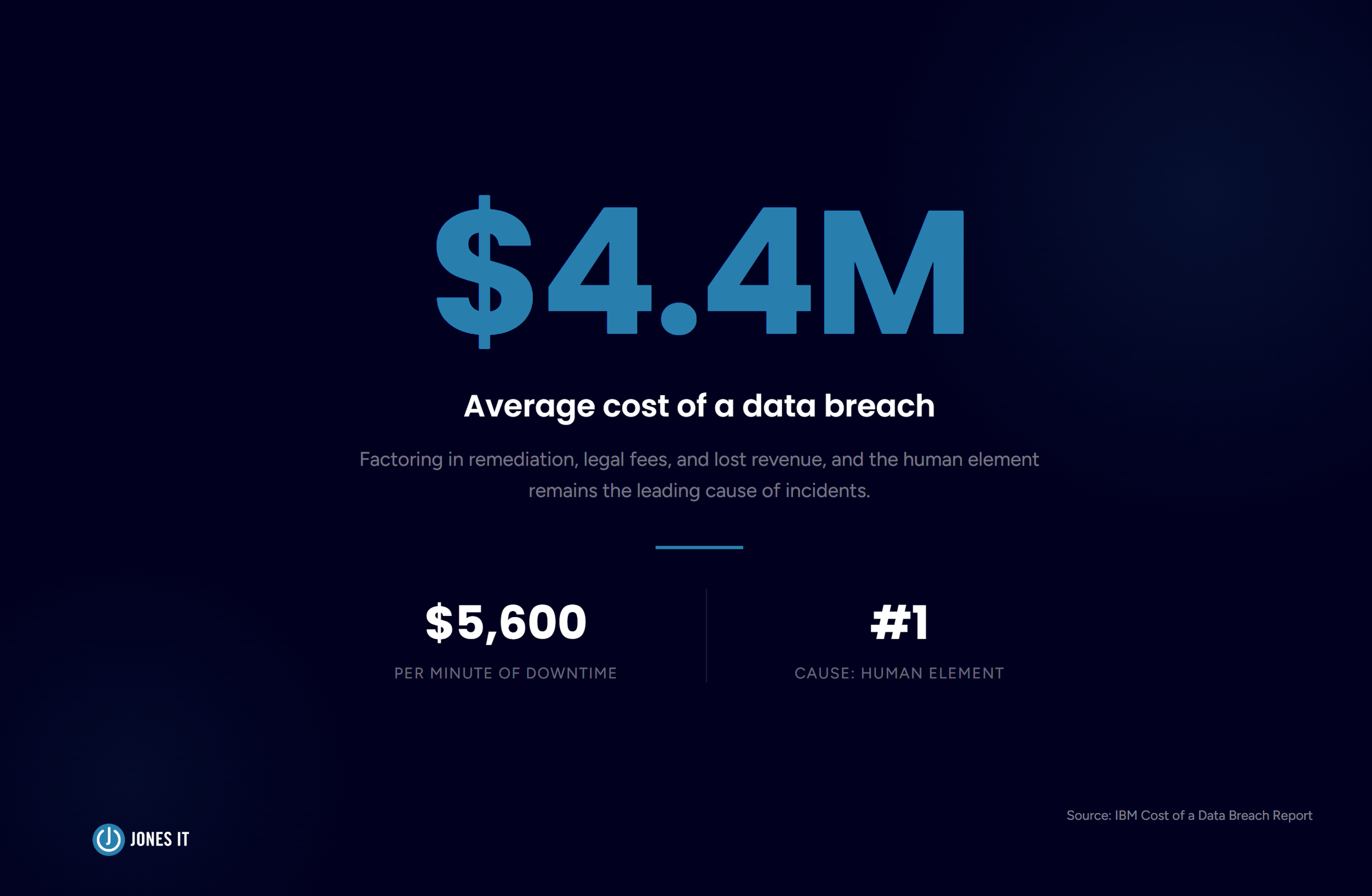
A proactive IT provider doesn’t wait for a breach before implementing multi-factor authentication, endpoint protection, or managed detection and response tools. If your provider has never run a phishing simulation, never conducted security awareness training for new hires, or can’t speak fluently to frameworks like NIST or the compliance requirements specific to your industry, that’s a concrete execution gap. The average cost of a data breach now sits at $4.4 million according to IBM’s annual Cost of a Data Breach report, and the human element remains the leading cause of incidents. Security training, therefore, isn’t optional.
4. Opaque billing and unexplained charges
A reliable managed IT provider can explain every line on your invoice in plain language. If your provider regularly includes vague “miscellaneous” fees, can’t account for hours billed, or uses technical jargon to deflect cost questions, that’s not just an accounting frustration; rather, it signals a governance problem that tends to get worse as the relationship continues.
Signs You've Outgrown Your IT Provider
Outgrowth signs are subtler since the provider isn’t failing on the basics. They’re just no longer equipped for where you are.
1. No technology roadmap
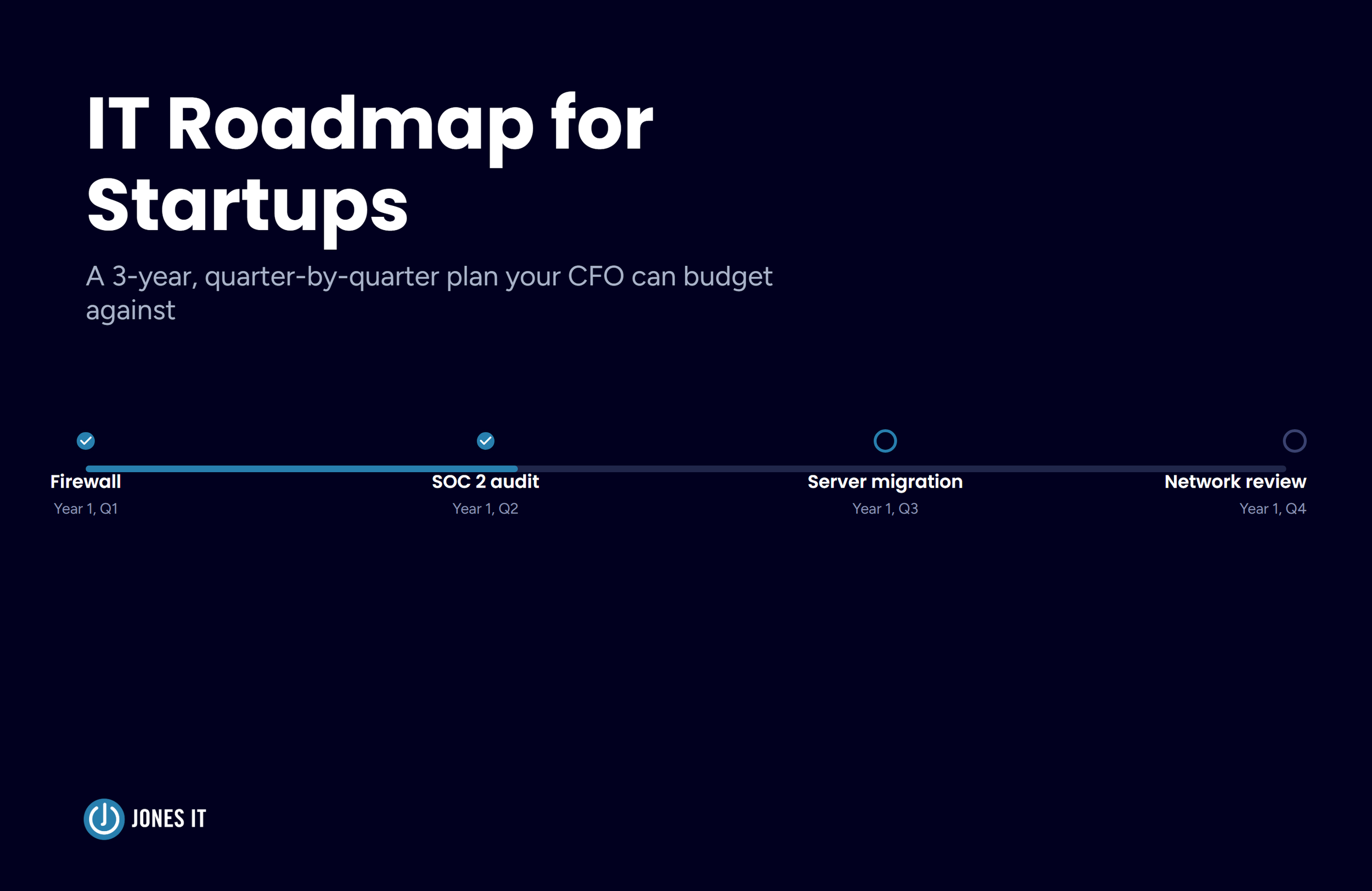
A strategic IT partner brings a technology roadmap to the relationship. They understand where your business is heading and help you plan infrastructure, security, and compliance accordingly. If your provider operates purely in reactive mode, treating each ticket as an isolated event with no view of the larger picture, they’re functioning as a help desk rather than a partner. That was probably fine at 15 people. At 50, it leaves real gaps.
2. Resistance to cloud migration or modern infrastructure
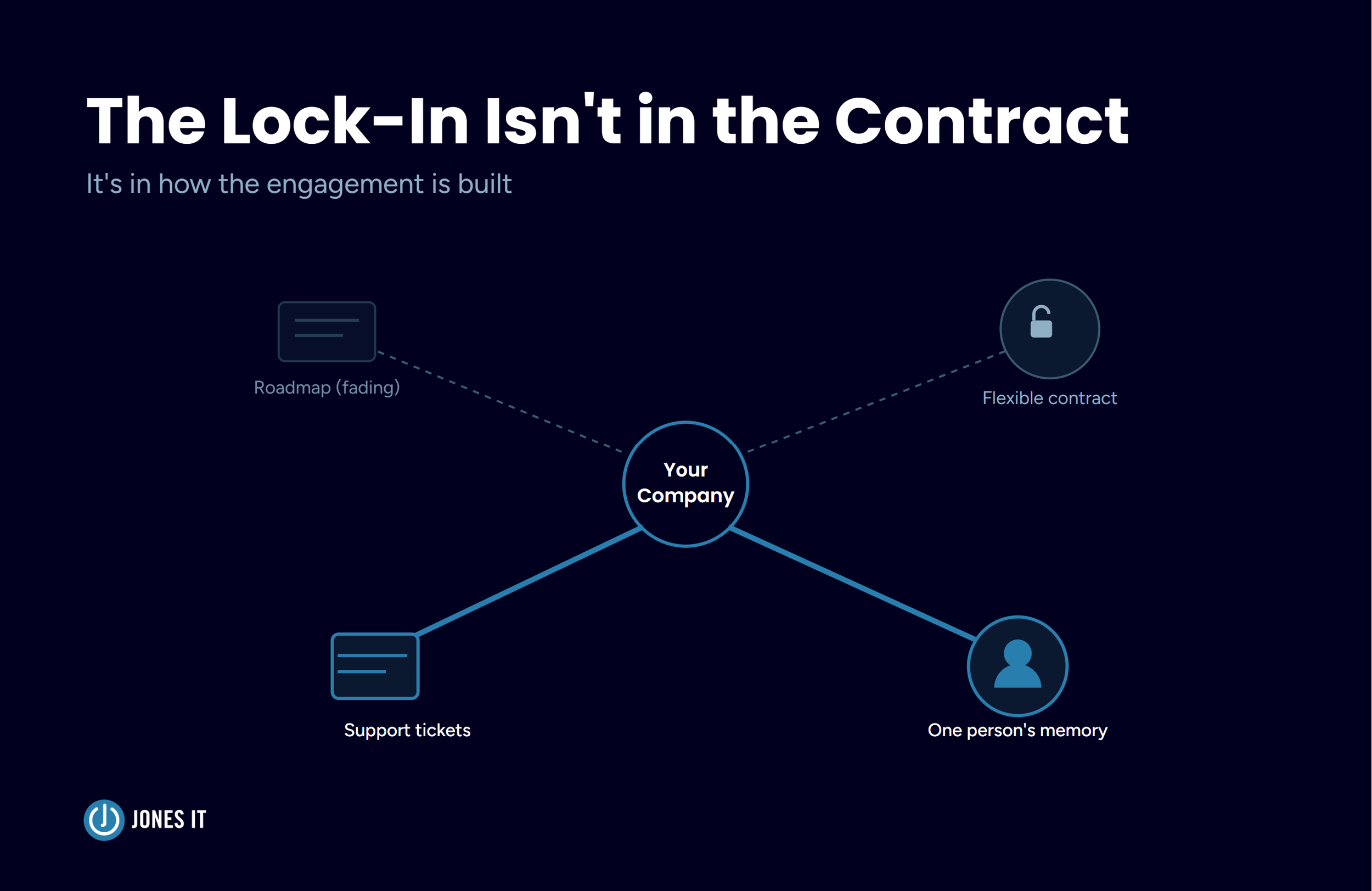
Public cloud costs on platforms like AWS and Azure have dropped roughly 40% over the past several years. A provider that resists migrating you off private or on-premise infrastructure may be protecting their own proprietary lock-in rather than optimizing your costs and scalability. If every conversation about cloud architecture ends with vague warnings or a push toward services the provider manages directly, that’s worth scrutinizing.
3. Compliance blindness
If your business operates under HIPAA, SOX IT controls, SOC 2, or any other compliance framework, your IT provider needs to understand those requirements well enough to build them into your infrastructure and processes. A provider who is unfamiliar with the frameworks that govern your industry isn’t just unhelpful on compliance, but a liability risk. Compliance failures carry real penalties, including regulatory fines, loss of certifications, and in some cases disruption to business operations.
4. Technical jargon used as a smokescreen
A capable IT provider can explain the “why” behind every technology decision in plain business terms. If your provider regularly deflects strategic questions with technical language that leaves you no clearer on the rationale, that’s a communication failure. It could mean they don’t actually have a strategy. It could also mean they don’t believe you need to understand one. Neither is acceptable.
How to Diagnose Which Problem You Have
A few straightforward questions help clarify the diagnosis.
First, are the issues measurable execution failures, or do they show up as strategic gaps? Missed SLAs, recurring incidents, and unexplained billing are execution problems. Absent roadmaps, compliance blindness, and technology resistance are fit problems.
Second, when you raise concerns, does your provider take ownership or deflect? Execution failures are sometimes fixable if the provider acknowledges them and makes concrete changes. A provider that consistently blames external tools or external circumstances is telling you something important about how they operate.
Third, has your company’s profile changed significantly since you started with your current provider? A jump from 15 to 60 employees, a compliance audit on the horizon, or a shift to cloud-first infrastructure all change what you need from an IT partner. If your needs have evolved substantially and your provider hasn’t evolved with them, that’s a fit problem regardless of how your ticket resolution numbers look.
Finally, is trust intact? Persistent security lapses, opaque billing, and refusal to take responsibility erode trust in ways that are very hard to rebuild. If the relationship has reached that point, the diagnosis is less important than the decision.
What to Do When Your IT Provider Is Underperforming
If the diagnosis points to execution failure and trust is still intact, start with a direct conversation. Document the specific issues, such as missed response times, recurring incidents with dates, or billing questions. Give your provider the opportunity to respond with a concrete corrective action plan. Not a general reassurance, but specific changes with timelines. If measurable improvement follows, you may not need to do anything else. If issues persist, the conversation has at least established a clear record.
If the diagnosis points to a fit failure, the conversation is different. It’s not about correcting poor performance. It’s about whether the provider has the capability to grow into what you need, or whether you’ve simply moved past what they offer. Some providers can expand their service scope meaningfully. Many cannot.
When switching providers becomes the right call, approach the transition carefully:
Audit for proprietary traps before you give notice. Identify any hardware, software licenses, or account credentials that the current provider owns or controls. Verify that you have administrative access to every system in your environment.
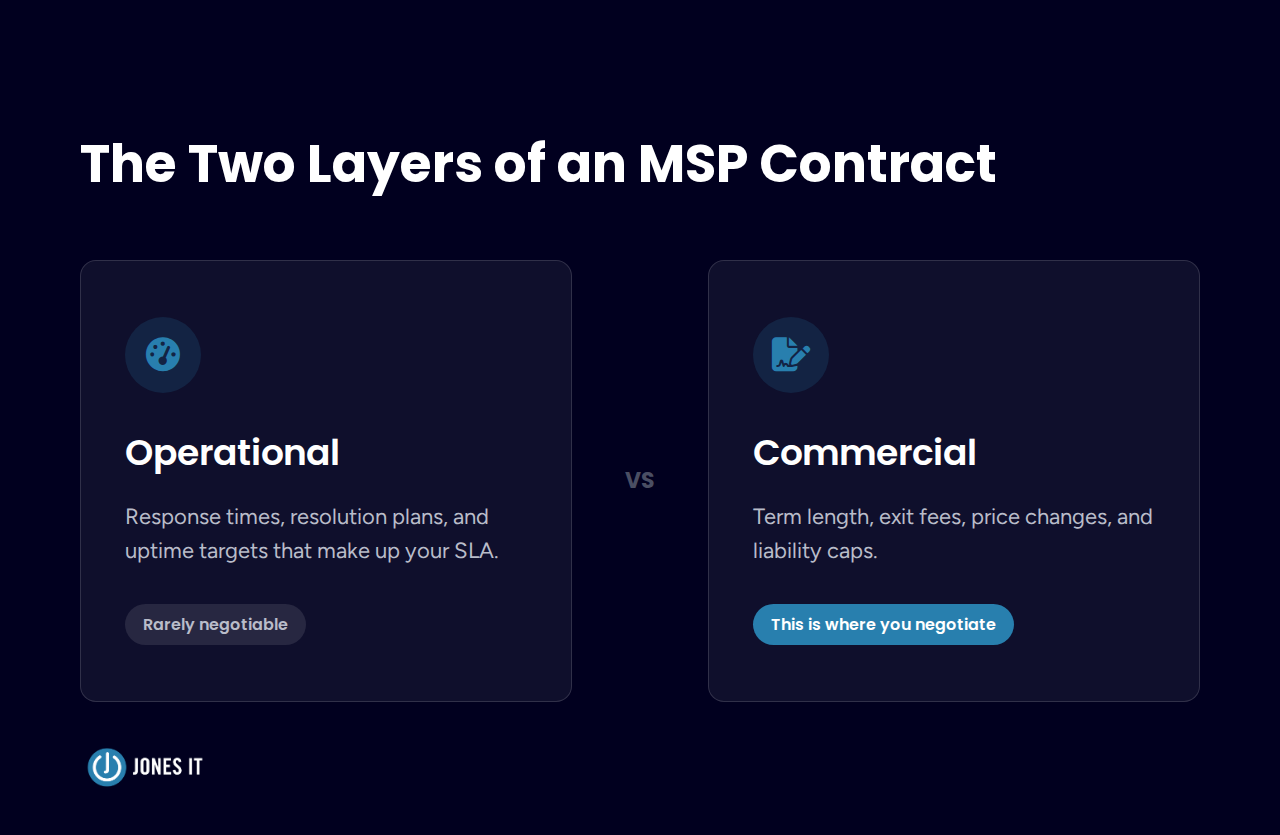
Review your contract for exit penalties or offboarding fees before initiating termination.
Bring the new provider in for an environment audit before notifying the current one. This gives the incoming team a clean picture of the environment and allows for comprehensive backups before any disruption.
Time the transition for an off-peak period. Switching IT providers during a product launch or fiscal close creates unnecessary risk.
For a detailed walkthrough of the transition process, our guide on how to switch to a new managed IT services provider covers the full sequence.
What a High-Performing Managed IT Provider Looks Like
A well-matched IT provider does more than keep the lights on. They bring a clear technology roadmap, communicate proactively rather than reactively, and speak to compliance and security in the same conversation as infrastructure. They provide transparent monthly reporting that makes the ROI of the relationship comprehensible to leadership, not just to the IT team. Their pricing is predictable, their contracts are flexible, and their response benchmarks are contractual commitments rather than aspirational targets.
Perhaps most importantly, a high-performing managed IT provider scales with you. The team supporting a 15-person startup doesn’t hand you off to a junior helpdesk when you reach 60 people. They expand what they’re doing with you. At Jones IT, each client works with a dedicated 6-to-8-person team rather than a rotating helpdesk, because continuity and context matter when infrastructure gets complex.
If you’re evaluating your current provider against these benchmarks, our Fully Managed IT Services in San Francisco page gives you a clear picture of what a proactive, full-scope IT partnership covers. And if you’re already at the point of making a change, we’re happy to walk through what a transition to Jones IT looks like for your specific environment.
Conclusion
IT provider underperformance is rarely as simple as “they’re bad at their job.” Sometimes the provider has stopped performing. Sometimes you’ve grown past what they can offer. Both situations are fixable, but they require different responses. The companies that handle this well are the ones that get specific about what’s actually happening before deciding what to do about it.
If your IT partnership feels off and you’re not sure why, we’re glad to help you think through it. Reach out to the Jones IT team for a no-pressure conversation about what a better-fit IT partner could look like for your business.
Explore Our Managed IT Services





About The Author

Evan JonesFounder and CEO of Jones IT
With over two decades of IT experience in San Francisco, Evan guides Jones IT's long-term strategy, finances, and culture, with a vision of building the city's highest-rated IT services firm. Outside of work, you'll find him on the golf course or running Bay Area Warriors, his non-profit connecting Bay Area kids to college through basketball.
Learn how to hand off Level 1 support to a co-managed IT help desk without losing control or dip in quality, and free up your team for strategic IT projects.