
A biotech startup in Redwood City contacted us two months after closing their Series C round. Their research database was still running on infrastructure configured three years earlier, when the team was a tenth of its current size. Access permissions had accumulated through three years of hiring without anyone auditing who still needed what, and their backups were replicated but not immutable, meaning a compromised account could quietly overwrite months of assay data before anyone noticed the change.
None of that risk looked like an emergency until the round closed. A press release brings attention founders don't always plan for, and this one drew a later-stage investor's security questionnaire before the ink was dry on the term sheet. Suddenly the company had weeks to answer questions nobody on the founding team had prepared for.
We rebuilt the access model around least privilege, implemented continuous monitoring, and migrated their backup architecture to an immutable, off-site configuration before their next board meeting. None of it was dramatic work. It was just overdue work, and the funding round is what made the overdue status impossible to ignore any longer.
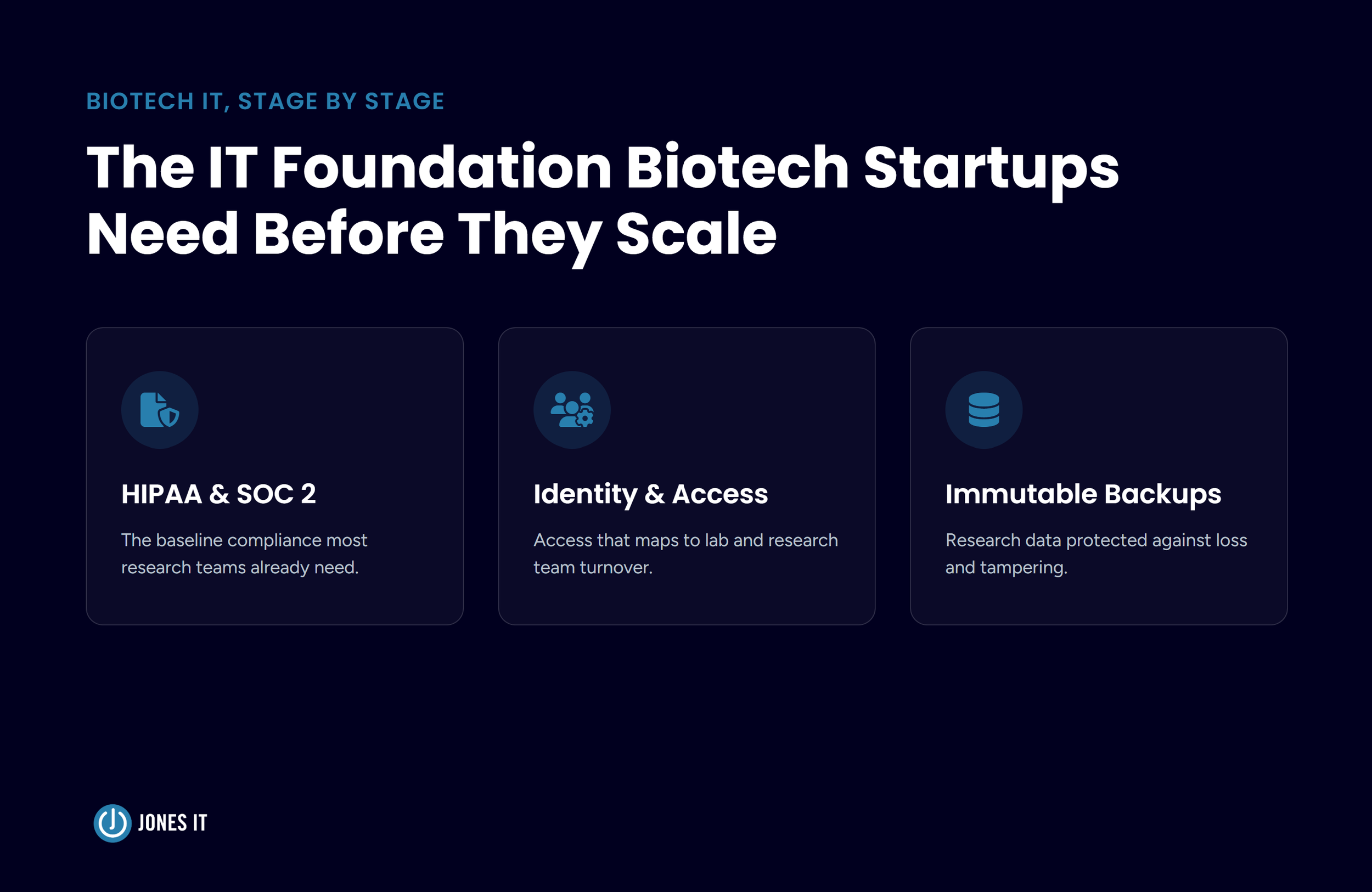
That pattern shows up often enough in biotech IT that it's worth walking through directly. Here's what managed IT services for a biotech startup actually need to cover, stage by stage, before growth outpaces the infrastructure underneath it.
HIPAA and SOC 2: The Baseline Most Biotech Startups Already Need
If your biotech company handles PHI as a covered entity or business associate, whether through a clinical partnership, a patient registry tied to a covered entity, or a telehealth-adjacent product, HIPAA compliance is baseline. That means PHI encrypted at rest and in transit, role-based access tied to job function rather than convenience, and a documented breach notification process your team has actually rehearsed rather than just written down.
SOC 2 matters for a different reason. Enterprise partners, hospital systems, and later-stage investors increasingly ask for a SOC 2 report before they'll sign anything, and the audit itself forces a level of access logging, vendor management, and incident response discipline that most ten-person research teams haven't built yet. We've watched the SOC 2 prep process catch access sprawl and unmanaged vendor integrations that had been sitting untouched for a year or more.
We worked with one biotech team whose SOC 2 auditor flagged a data-analysis vendor that three former employees still had active credentials for, a tool nobody currently on staff remembered signing up for. Nothing had gone wrong yet. The audit just happened to be the first time anyone looked closely enough to notice. That's the value of the process as much as the certificate at the end of it.
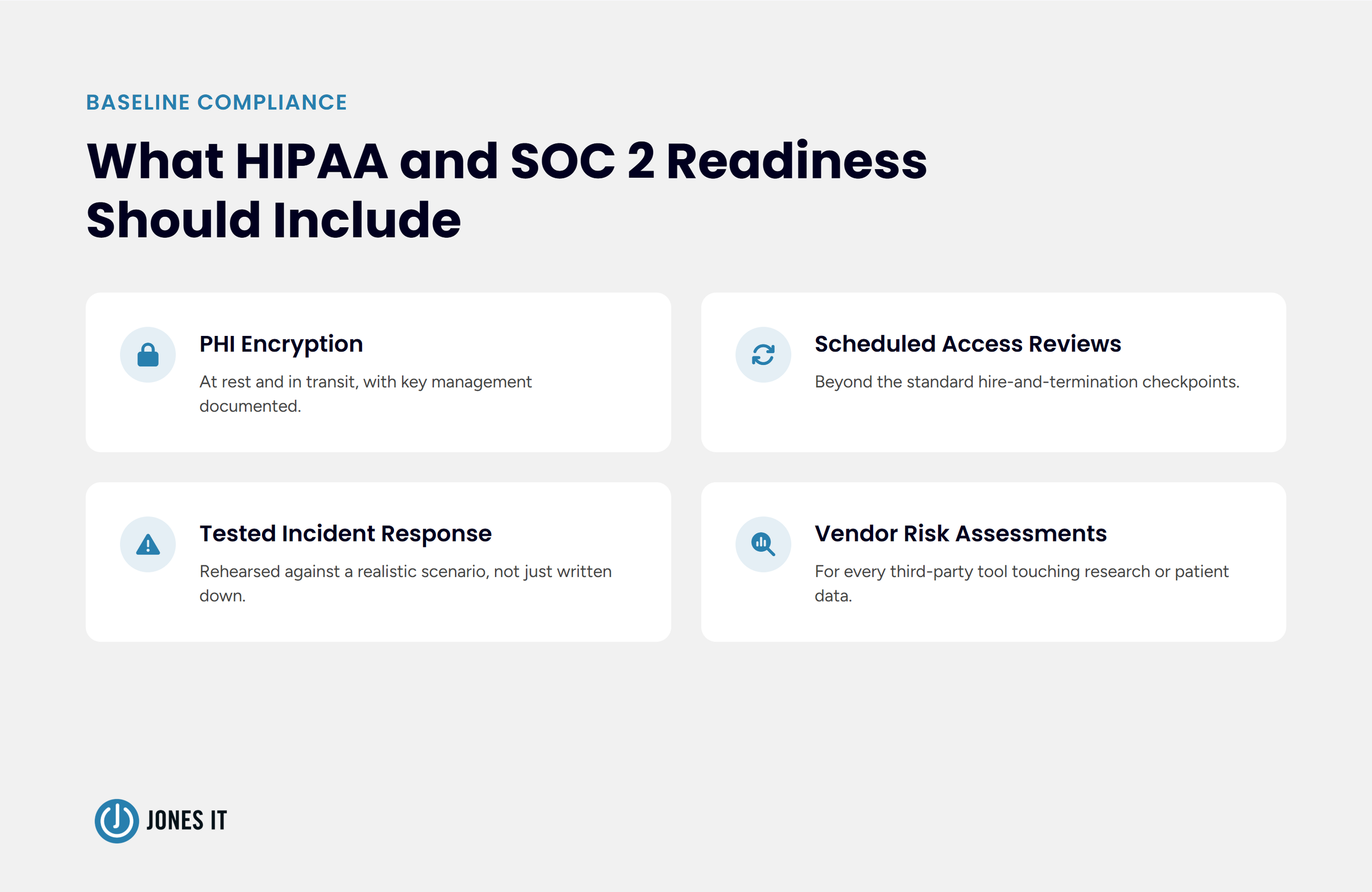
Here's what baseline compliance should include:
PHI encryption at rest and in transit, with encryption key management documented, not assumed.
Role-based access reviewed on a set schedule, beyond the standard hire-and-termination checkpoints.
An incident response plan tested against a realistic scenario at least once a year.
Vendor risk assessments for every third-party tool touching research or patient data.
These baseline controls aren't exotic, and none of them are specific to biotech. What's specific to biotech is how fast a research team's access needs change, and how much damage an over-permissioned account can do to data nobody backed up correctly.
Identity and Access Management for Lab and Research Teams
A biotech company's access needs to look different from a typical SaaS startup's. Rotating grad students, visiting researchers, and contractors on a project-by-project basis need access that maps to what they're actually working on, not a static role that outlives the project by a year. Lab instruments and LIMS (Laboratory Information Management System) systems often sit on their own network segment, separate from corporate laptops and email, and that segmentation needs to be deliberate rather than accidental.
Identity and access management done well starts with least privilege, in which nobody gets more access than the specific task requires, and access gets reviewed on a schedule instead of accumulating indefinitely. We've walked into research environments where a departed intern's credentials were still active eighteen months later, not because anyone was careless, but because nobody owned the offboarding checklist for guest researchers the way they owned it for full-time staff.
Device management follows the same logic. A shared lab laptop that connects to a LIMS instrument today and gets handed to a different contractor next quarter needs the same lifecycle discipline as a laptop issued to a full-time employee: enrollment, patching, and a clean wipe between users. Treating shared or instrument-adjacent devices as an afterthought is one of the more common gaps we find in research environments, mostly because nobody thinks of a device sitting next to a sequencer as part of the corporate IT footprint.
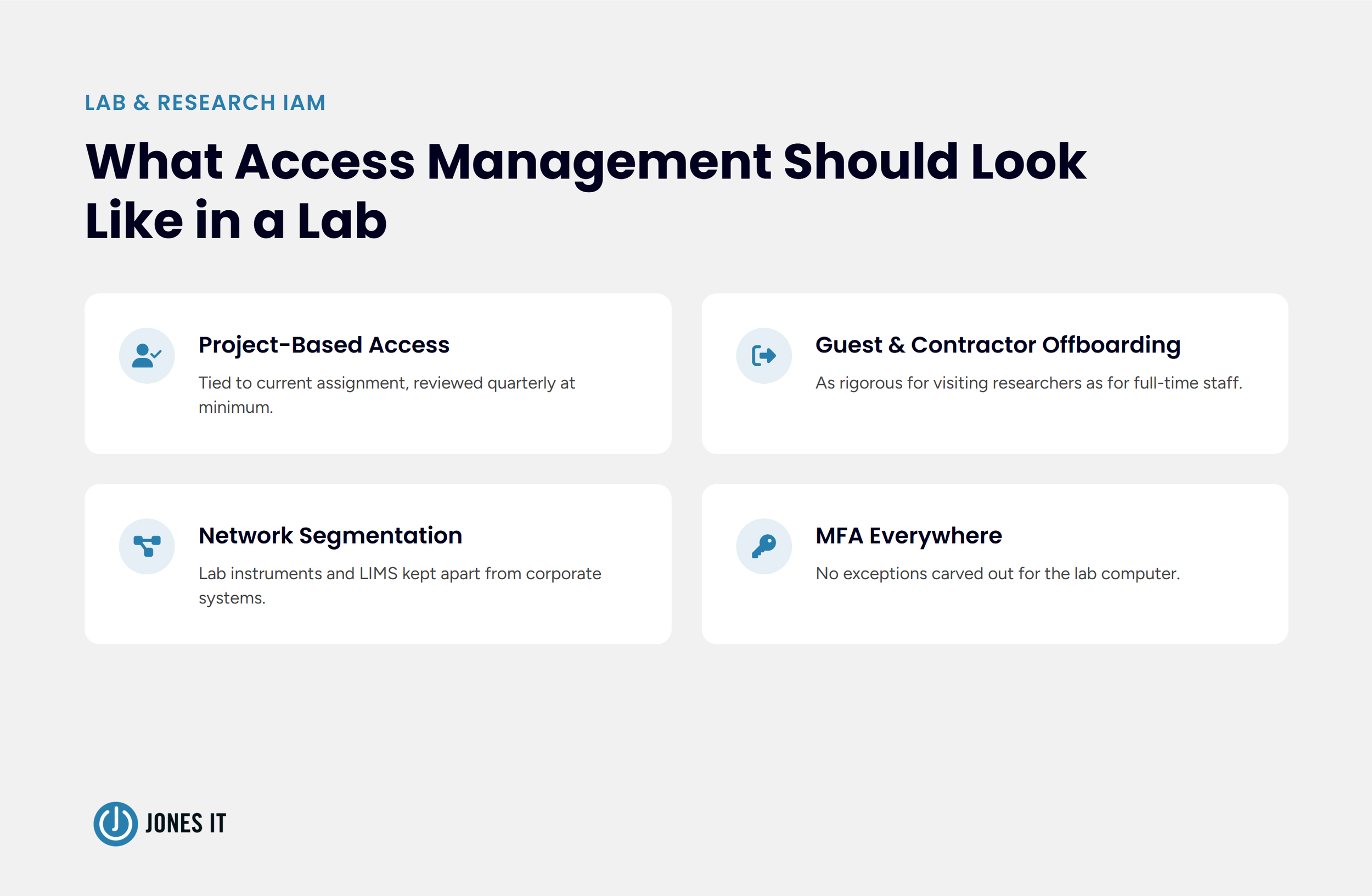
A few things worth confirming your IT support has in place:
Role-based access tied to current project assignment, reviewed quarterly at minimum.
A defined offboarding process that covers guest researchers, interns, and contractors as rigorously as full-time employees.
Network segmentation between lab instruments or LIMS systems and general corporate infrastructure.
Multi-factor authentication enforced across every system touching research or patient data, with no exceptions carved out for the lab computer.
Getting this right early costs a fraction of what it costs to untangle three years of accumulated access after the fact.
Backup and Business Continuity for Research Data
A failed experiment costs time. A corrupted dataset with no clean backup can cost months, and unlike a typical business file, a lot of research data can't be regenerated on demand. Sequencing runs, assay results, and years of accumulated experimental data are often the most valuable thing a biotech company owns, which makes backup architecture a business continuity question as much as an IT one.
Standard backup, the kind built around restoring files after routine hardware failure, isn't built for a scenario where an attacker or a bad update has been quietly altering data for weeks before anyone notices. That's where immutability matters: write-once, tamper-evident storage means a compromised account can't quietly overwrite a backup the way it can overwrite a live file share. Recovery point and recovery time objectives should be defined explicitly for lab and research systems, not inherited from whatever general IT policy the company started with.
Immutable backup architecture also happens to be one of the more effective defenses against ransomware, though it's worth building for the research-continuity reason on its own merits. An attacker who encrypts a live file share is far less dangerous to a company whose backups they can't touch. We've seen the reverse case too, where a company with backups that were technically current but sitting on the same network as everything else, which meant the ransomware reached the backups within the same incident.
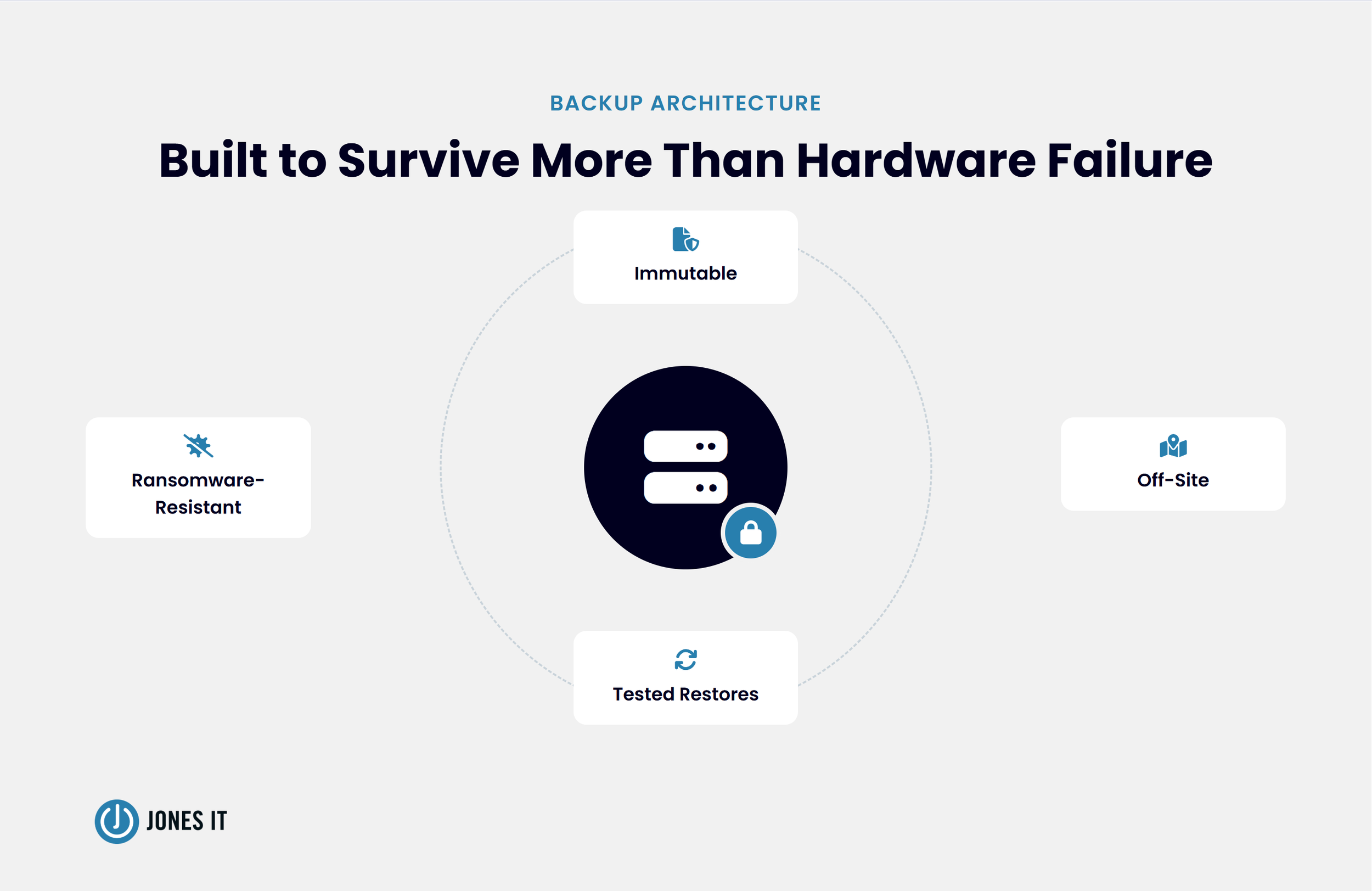
What this should look like in practice:
Immutable, off-site backups for research data, not just replicated copies.
Defined recovery point and recovery time objectives specific to lab and research systems.
A restore procedure that gets tested on a schedule rather than assumed to work.
Backup architecture designed with the assumption that an attacker may already be inside the environment.
Why Series C Is When Biotech Becomes a Bigger Target
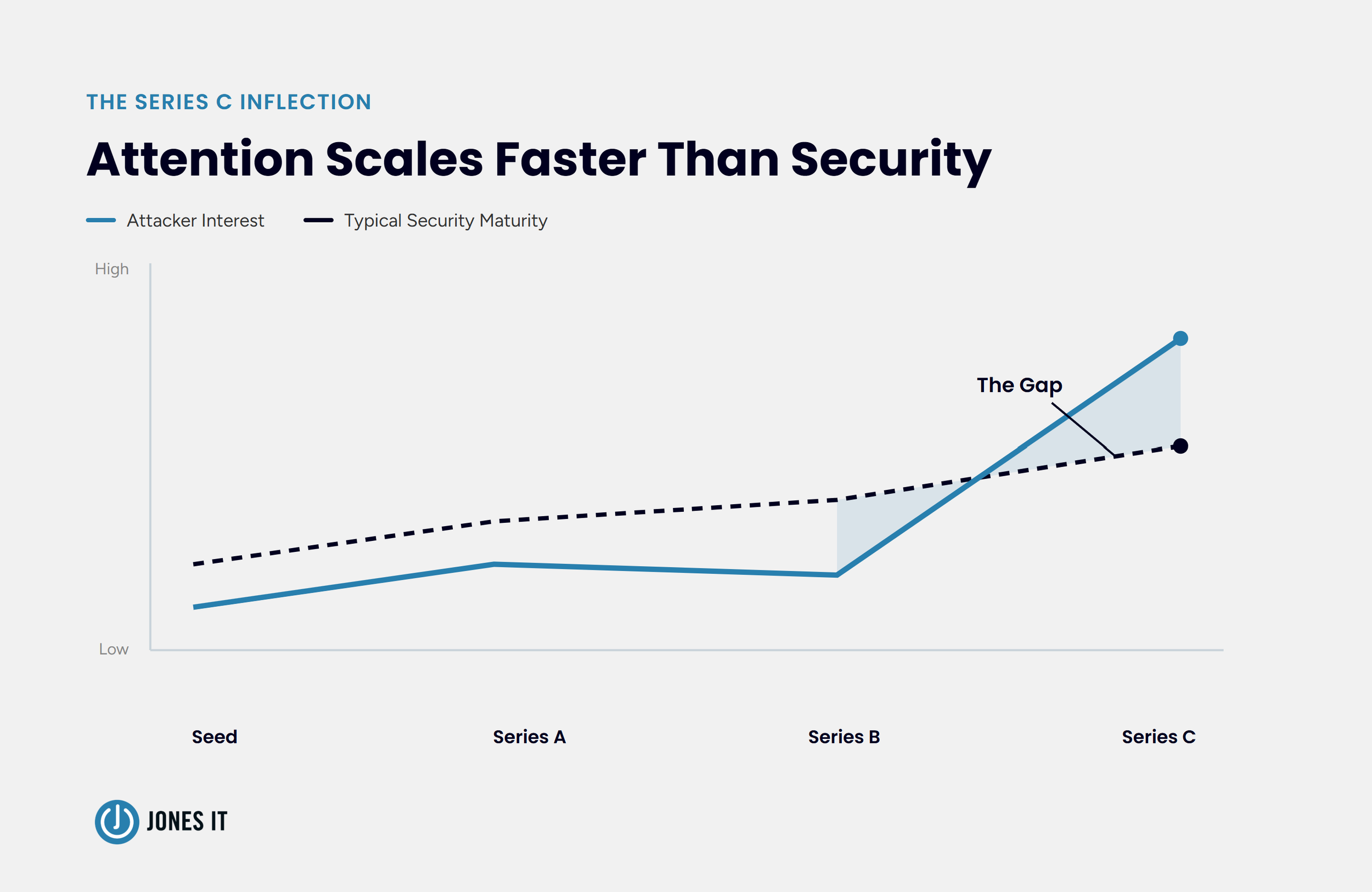
There's a pattern we've noticed across the biotech startups we work with. The funding stage where security actually matters most isn't the earliest one. It's Series C. A company at that stage has enough visibility, enough valuable data, and enough public attention around its funding to become an interesting target, but it often still has the security posture of a fifteen-person startup because nobody built the security systems past that point. That gap often starts even earlier, around Series B, as teams move from research into clinical development.
That timing creates a real mismatch. The company that closed a sizable round and put out a press release is now a more attractive target than it was six months earlier, and the acquirers or later-stage investors circling it will eventually ask security questions the founding team hasn't had to answer yet. We've walked into more than one Series C company where the security stack was still built for the ten-person lab that started the company, not the hundred-and-fifty-person organization running three concurrent trials. It's exactly the situation the company at the start of this post found itself in.
Closing that gap usually means moving from implicit trust within the network to a zero trust model where access is verified continuously rather than assumed, standing up actual monitoring through a SIEM or managed detection and response service instead of antivirus alone, and making sure backups are truly immutable rather than simply replicated. None of this is exotic. It's the same security fundamentals most growth-stage tech companies eventually adopt. Biotech companies just tend to need them earlier, because the data and the visibility both scale faster than most founding teams expect.
One track worth mentioning separately is that if your company operates under GxP (Good Laboratory, Clinical, or Manufacturing Practice) or FDA 21 CFR Part 11, you're working under a compliance framework that governs validated systems, audit trails, and electronic records, and it's a different discipline from general IT security. That work is owned by a dedicated quality or regulatory partner, but it depends on infrastructure that an MSP has to help keep in a validated state, including access control, change management, and audit trails among them. The security foundation described above, access control, monitoring, immutable backups, is the foundation that the program runs on top of, not a substitute for it.
How Jones IT Delivers Managed IT Services for Biotech Startups in the Bay Area
We work with biotech and life sciences companies across the Bay Area, from early research labs in South San Francisco to growth-stage teams in Mission Bay preparing for their next clinical milestone. We've partnered with innovators like Hexagon Bio, Verge Genomics, Hey Jane, and Ohalo, supporting their infrastructure through funding rounds, compliance audits, and everyday lab operations.
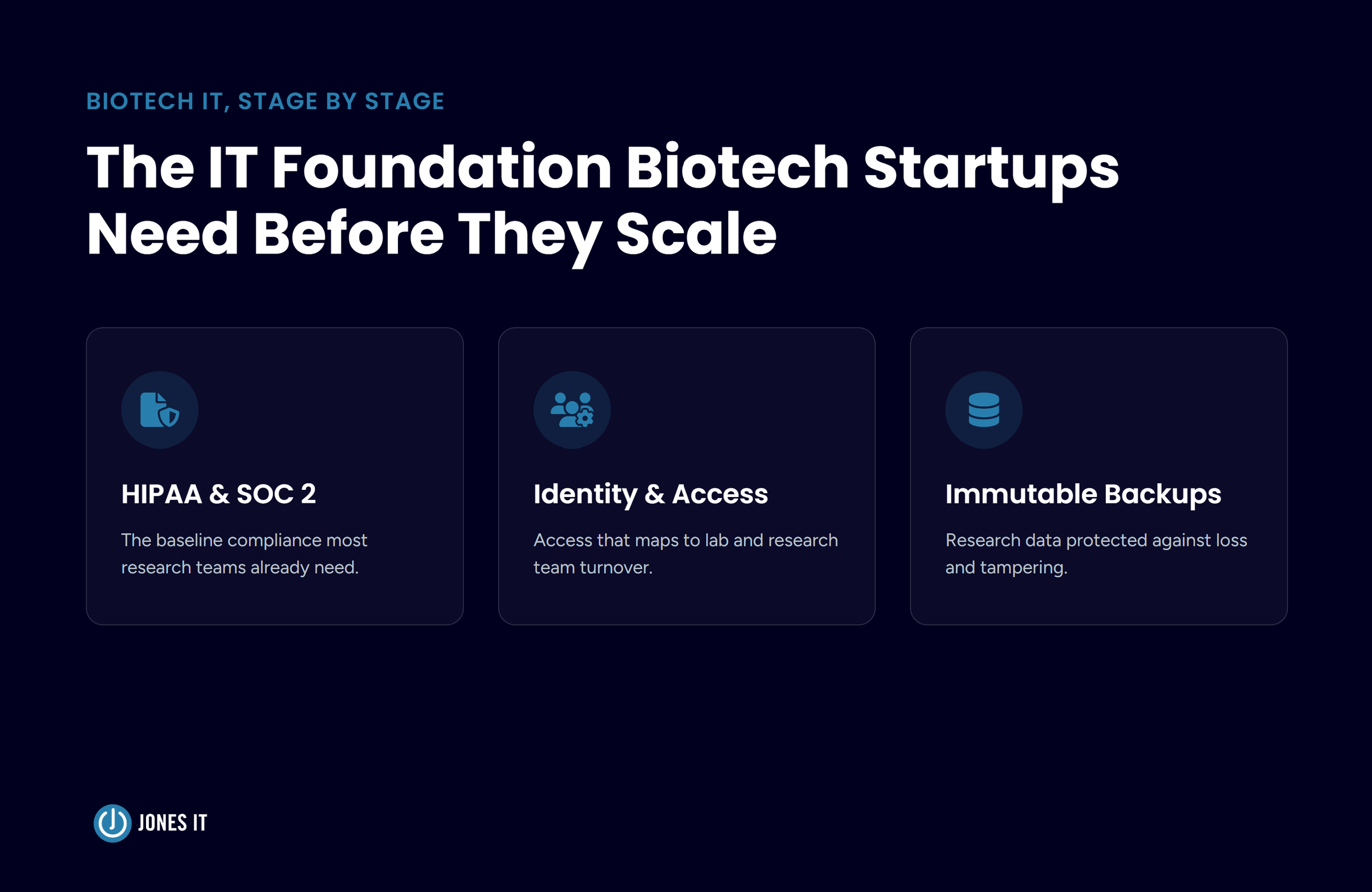
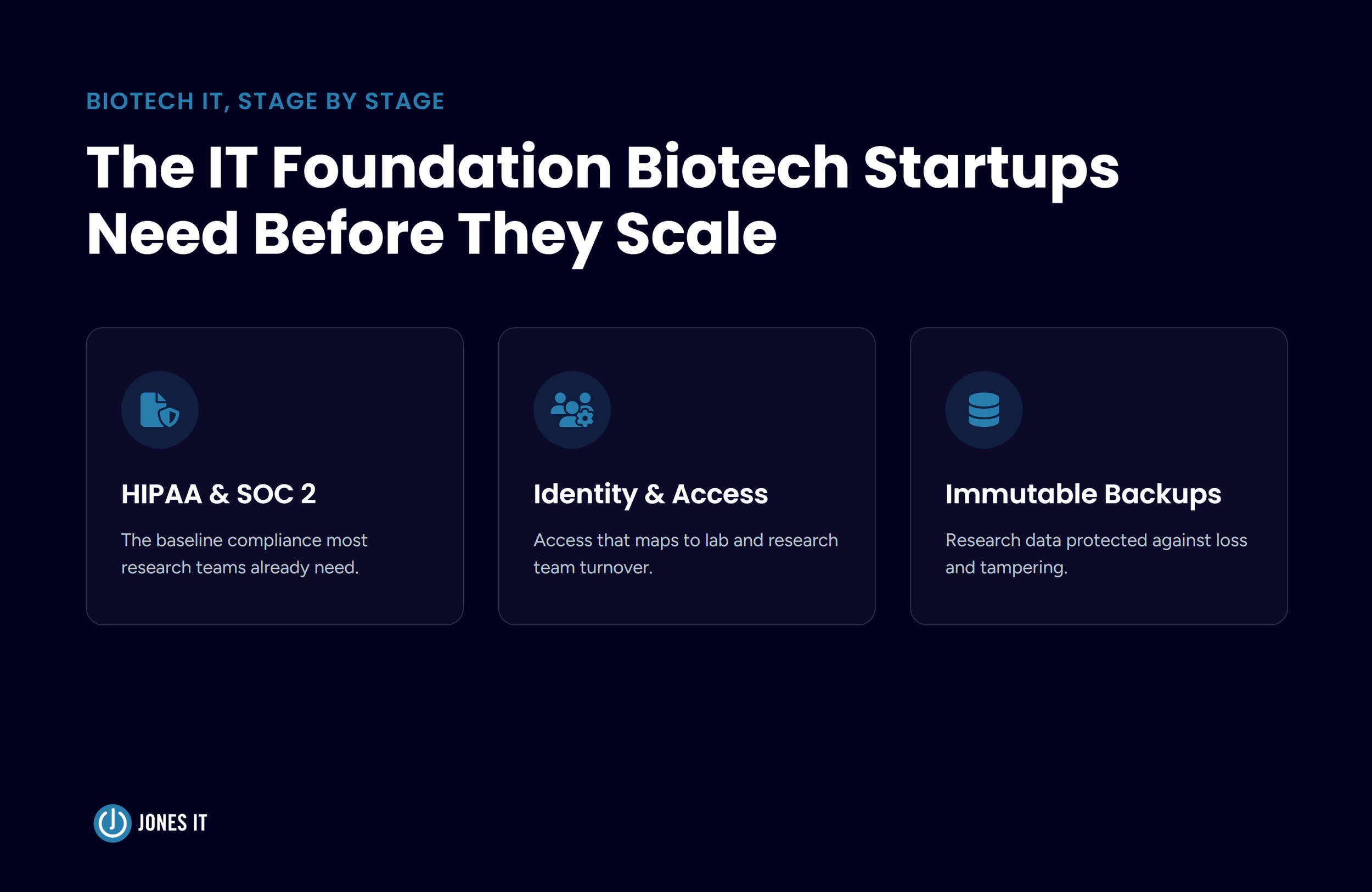
We build the infrastructure and security foundation your compliance program runs on: HIPAA and SOC 2 readiness, identity and access management tuned to how research teams actually work, and backup architecture built for data you can't afford to lose. If your company also operates under GxP or FDA 21 CFR Part 11, we work alongside your quality and regulatory partner rather than in place of them, so your infrastructure and your validation program are pulling in the same direction.
We recognize that every biotech startup has a unique balance between moving fast and maintaining rigorous compliance. Our role is to build the secure foundation that makes that balance possible.If you’re evaluating whether your current IT support can keep pace with your growth, we’d be happy to walk through your environment, identify any potential gaps, and discuss how to align your infrastructure with your upcoming clinical or funding goals.

Master employee offboarding compliance for SOC 2, HIPAA, and ISO 27001. Learn key requirements, framework differences, and how to build a unified process.