
Managed IT Services for Pre-IPO Companies: What to Require From Your MSP
TL;DR
Managed IT services for a pre-IPO company mean something different once SOX auditors are involved, not just device management and help desk coverage.
Ask any MSP to produce evidence, not describe a control: a timestamped change log, standing quarterly access reviews, and named approvers, all available on request, not assembled after the fact.
Access management and change management are the two domains where generalist providers show their limits fastest as you scale toward the S-1.
Jones IT's Compliance Kickstarter Program helps Bay Area companies close these gaps before the audit clock starts.
I sat across from a SaaS founder last spring who had just started interviewing new IT providers. His company was eighteen months out from a planned IPO, and his board had flagged infrastructure and security as a workstream that needed outside help before the S-1 process began in earnest. He had already talked to two managed service providers, both well-regarded Bay Area firms with long client lists and polished pitch decks. Both gave him confident answers about device management, help desk response times, and network uptime. Neither one asked a single question about segregation of duties, audit logging retention, or who would own evidence collection once the auditors arrived. He hired the third firm because it was the first conversation where someone asked what his auditors would actually be testing for.
That gap is the reason I wanted to write this post. Managed IT services for a pre-IPO company are not the same as those for a company that will never face a public-company audit. The IT provider is not just keeping the lights on and the help desk staffed. It is building and maintaining the evidence trail your SOX auditors will pull on, and that work has to start months before the first walkthrough, not after the request lands.
I have been on both sides of this conversation over the past two decades, as the founder evaluating vendors early in my career and as the vendor being evaluated for most of it since. Here is what I think a pre-IPO company actually needs to require from its MSP, and what most generalist providers quietly cannot deliver.
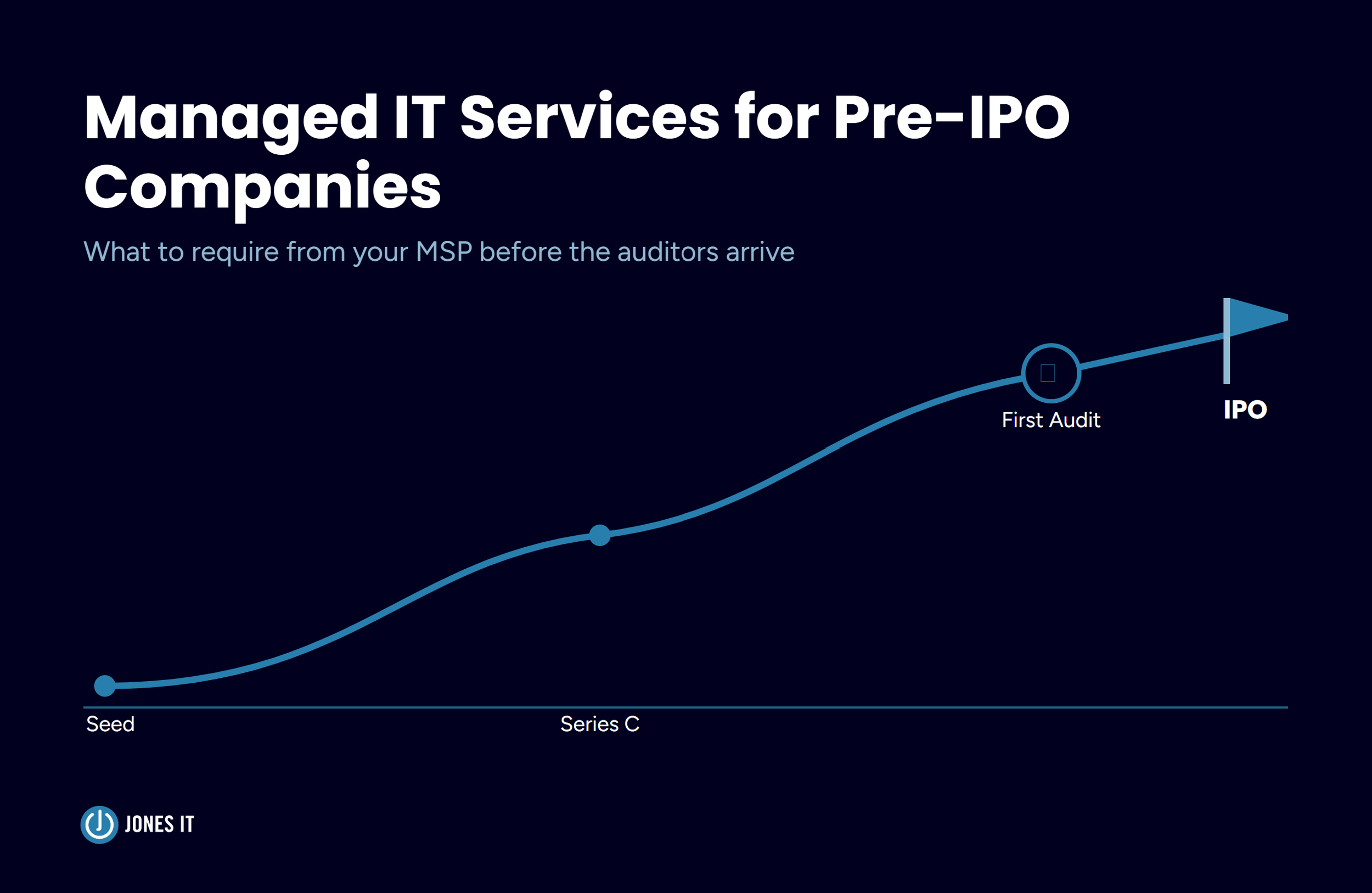
Why Managed IT Services Look Different for a Pre-IPO Company
Most managed service providers are built for a version of IT that ends at keeping things running, covering device provisioning, patch cycles, a helpdesk that answers tickets quickly, and dependable network uptime. For the overwhelming majority of small businesses, that coverage is enough. It is a reasonable, well-run business, and there is nothing wrong with it.
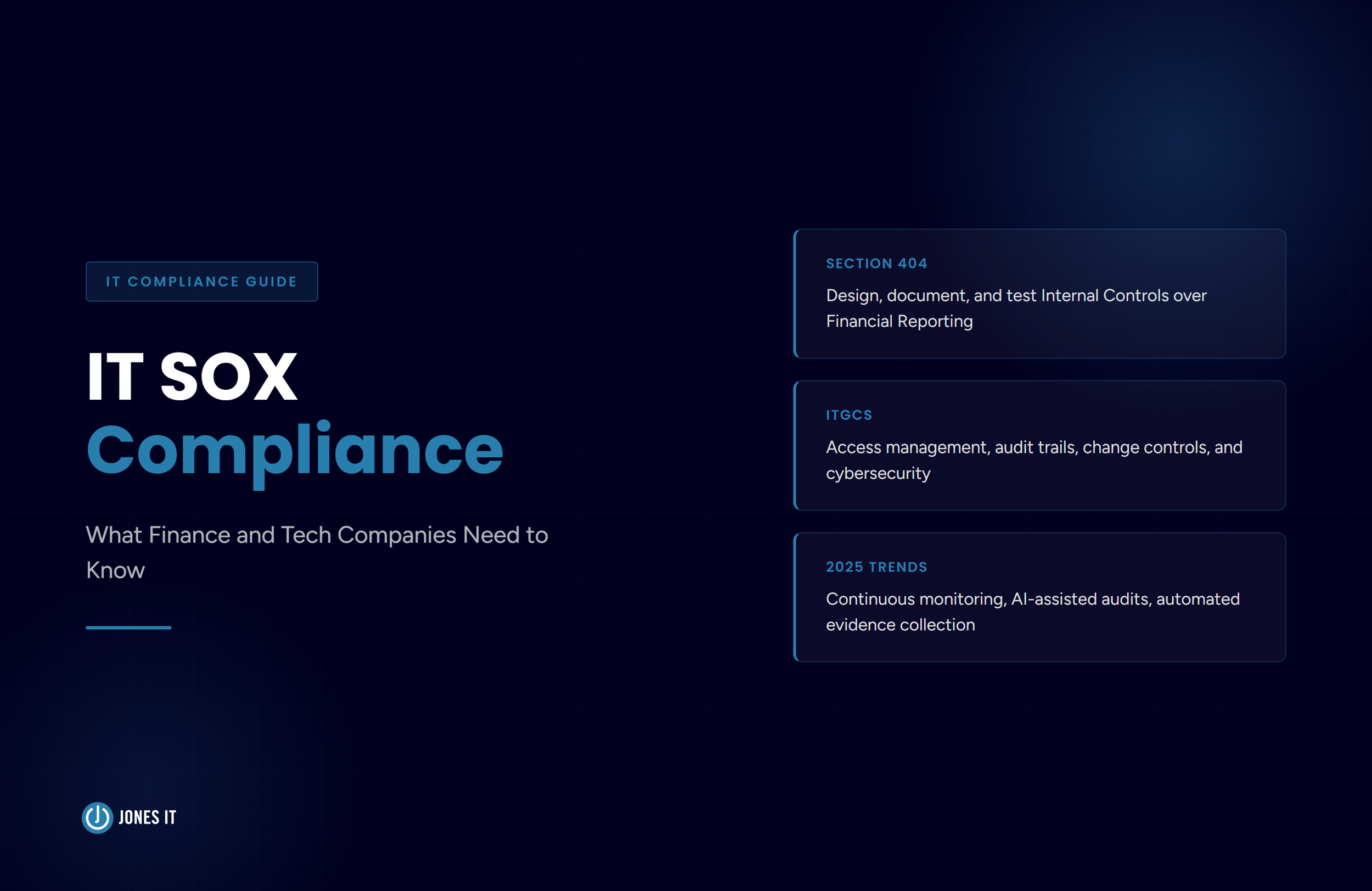
A company heading toward an IPO has a different problem, and it is not really a technology problem. Section 404 of the Sarbanes-Oxley Act requires public companies to establish, test, and attest to the effectiveness of their internal controls over financial reporting. Almost all of that reporting infrastructure lives inside IT systems now: ERP platforms, databases, the cloud applications that touch revenue recognition. Your MSP is the entity actually configuring access, logging changes, and encrypting the data that flows through those systems, whether they realize it or not.
I have watched this play out with founders who assumed their existing MSP would simply handle compliance once the board asked for it. In most cases, the MSP was perfectly competent within the scope for which they had originally been hired. They were just never hired to build an evidentiary system, because nobody had told them that was the job. That is not a knock on the MSP. It is a mismatch between what the company needed and what the contract actually specified.
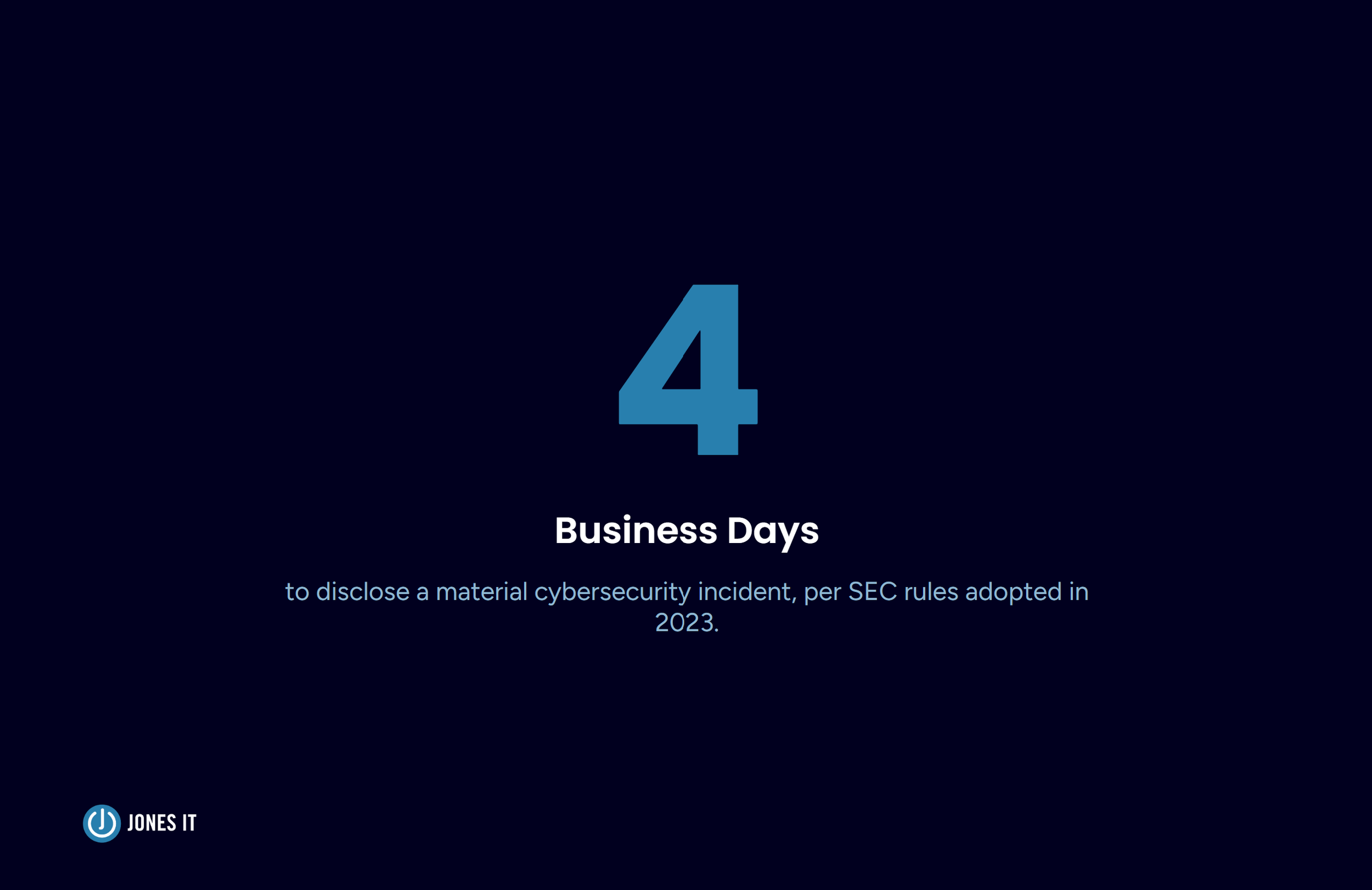
The same mismatch appears in incident response. Public companies now operate under SEC rules adopted in 2023 that require disclosure of material cybersecurity incidents within four business days of determining materiality. A generalist MSP can usually detect and contain an incident well enough. However, very few have ever built the escalation and communication chain that a four-day disclosure clock demands, because none of their other clients have ever needed one.
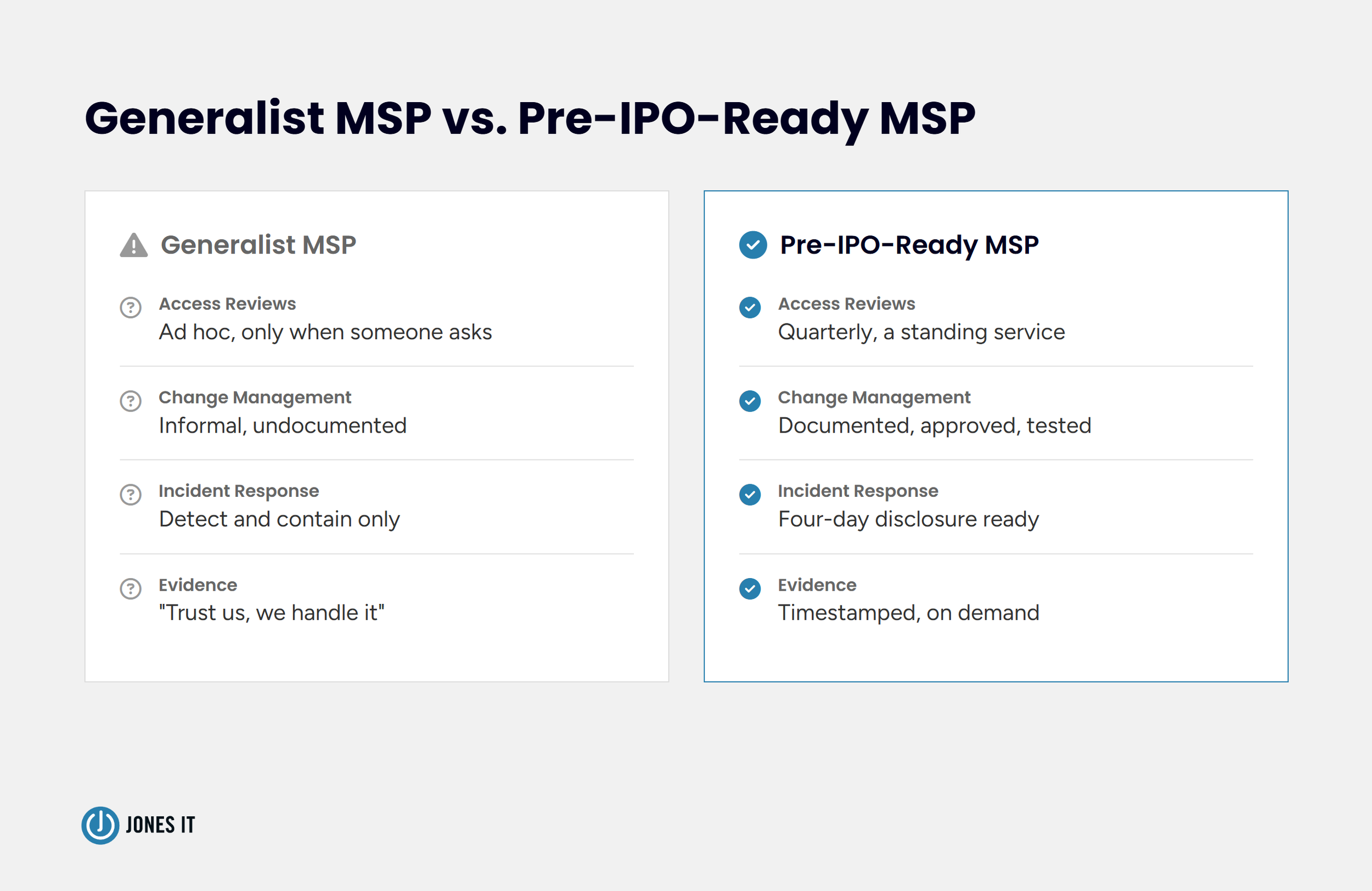
Audit Evidence: The Baseline Your MSP Must Produce
Here is the test I would run before signing with any MSP if I were heading toward an IPO: ask them to produce evidence, not describe a control.
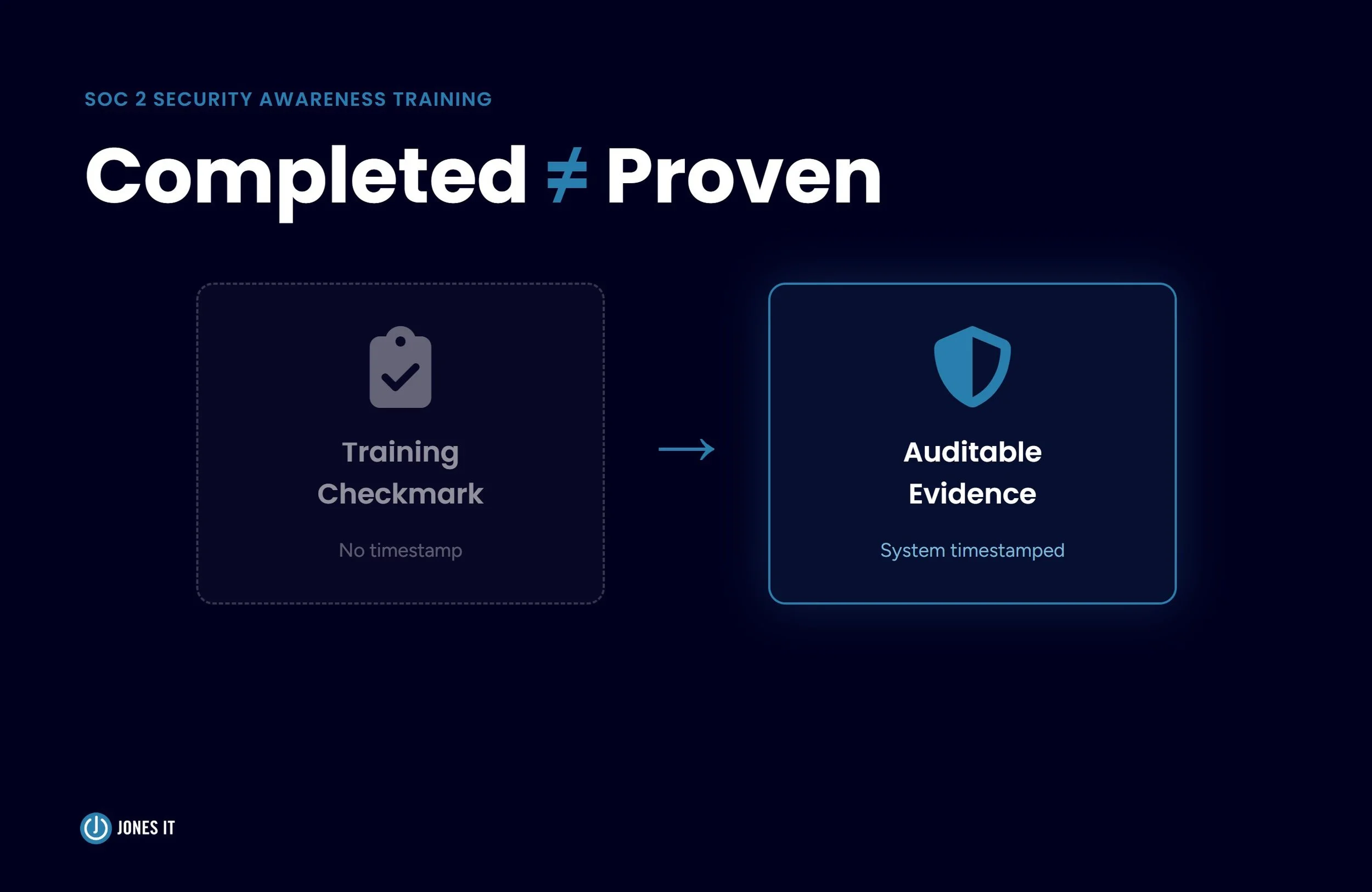
Any competent provider can tell you they manage access, log changes, and back up your data. What separates a pre-IPO-ready MSP from a generalist is whether they can hand you a timestamped, retrievable record proving all three happened, on a random Tuesday, without three weeks of scrambling first. SOX auditors do not accept a verbal description of a process. If it was not documented as it happened, it did not happen, as far as they are concerned.
A few questions surface this quickly in a vendor conversation:
Can they produce a change log with timestamps and approver names right now, for a client they already serve, or would this be their first time assembling one?
Do they already run quarterly access reviews as a standing service, or is that something you would need to request and define yourselves?
Can they name which of their own tools and sub-processors touch systems in scope, and confirm those tools maintain their own audit trails?
Have they supported a company through an actual SOX walkthrough before, or would your engagement be the one where they learn what auditors ask for?
I have found that the answer to the fourth question tells you almost everything. An MSP that has never sat in the room during a real walkthrough will guess at what matters. One that has gone through the process will tell you, unprompted, which control gets flagged most often and why.
There is a second, quieter test worth running. Ask how the MSP tracks its own obligations to you. If the answer involves a shared spreadsheet that lives in someone's inbox, you are looking at the same fragile system you are trying to move away from, just relocated to a vendor. A pre-IPO-ready MSP runs its own compliance operations on a GRC platform built for exactly this kind of record-keeping, and that discipline usually carries over into how they manage your environment as well.
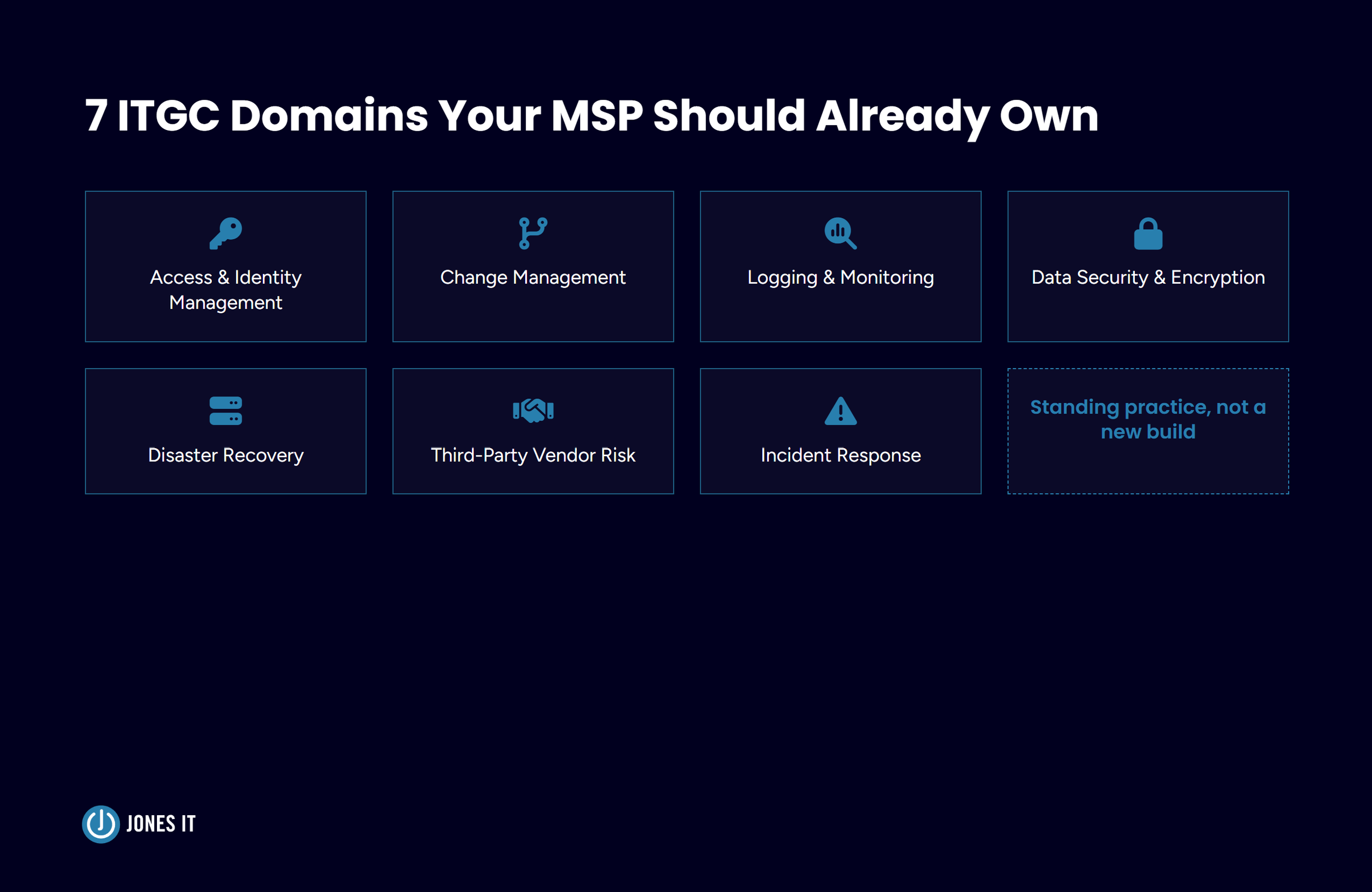
The ITGC Domains Your MSP Should Already Own
So how many of these should your MSP already have running before you sign, rather than after?
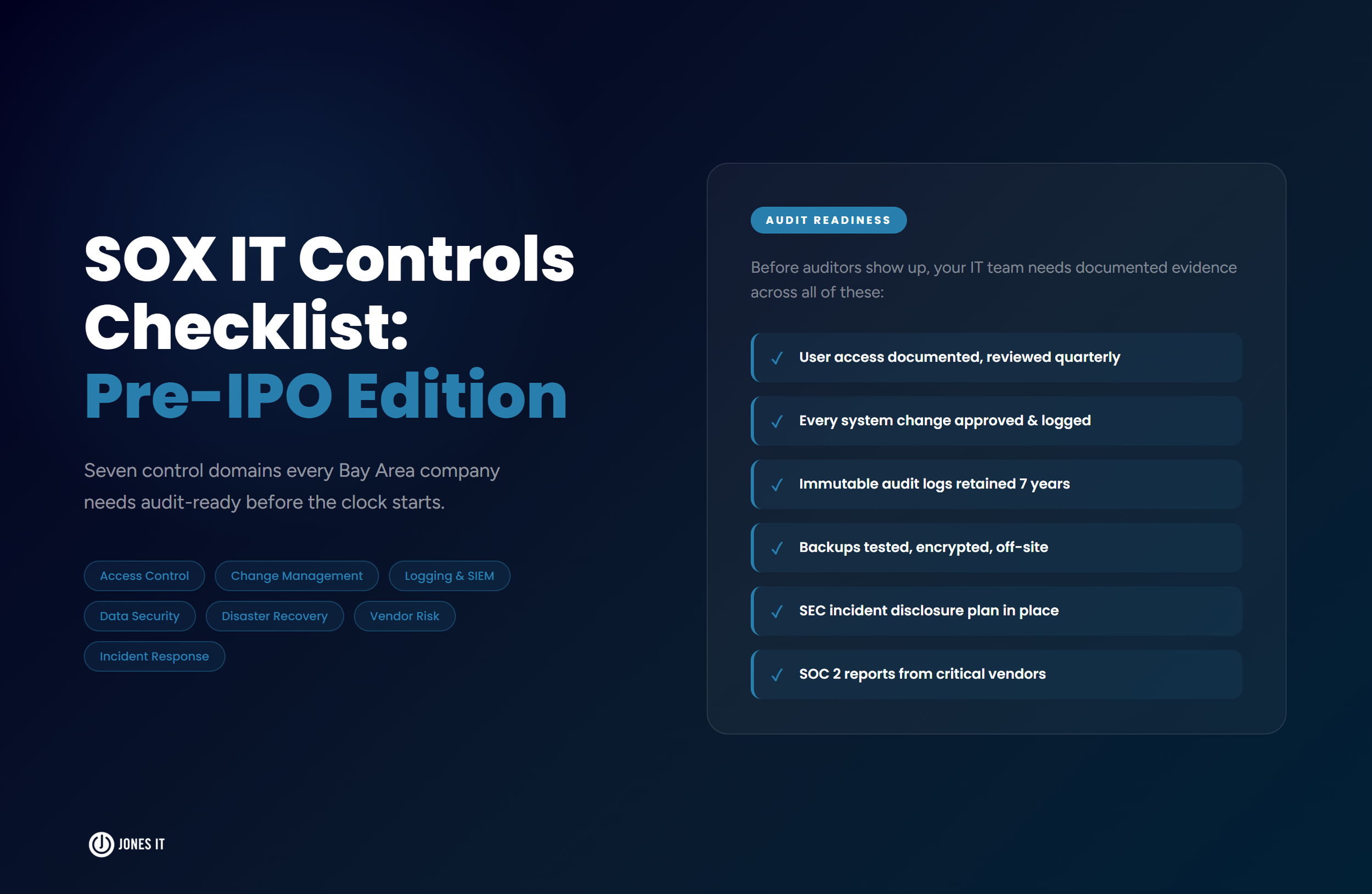
SOX auditors evaluate IT general controls (ITGC) across seven domains: user access and identity management, change management, system logging and monitoring, data security and encryption, disaster recovery, third-party vendor risk, and incident response. We have written a full technical breakdown of what each domain requires in our SOX IT Controls Checklist, so I will not repeat the whole thing here.
What matters for this conversation is narrower. Your MSP should already be operating in all seven domains for other clients, not building the muscle for the first time on your account. Encryption standards, backup testing, and vendor risk reviews should already be routine parts of how they run every engagement, not projects they propose adding once your audit is scheduled.
Ask a prospective provider which of the seven domains they run as a standing part of their service, and which ones would be a new build for them. A provider who treats disaster recovery testing, encryption enforcement, and vendor risk reviews as ongoing operational habits, rather than tasks triggered by an audit calendar, is the one who will keep you audit-ready year over year instead of scrambling every twelve months.
For a broader look at how SOX reshapes IT responsibility generally, our post on IT SOX compliance for finance and tech companies covers that ground.
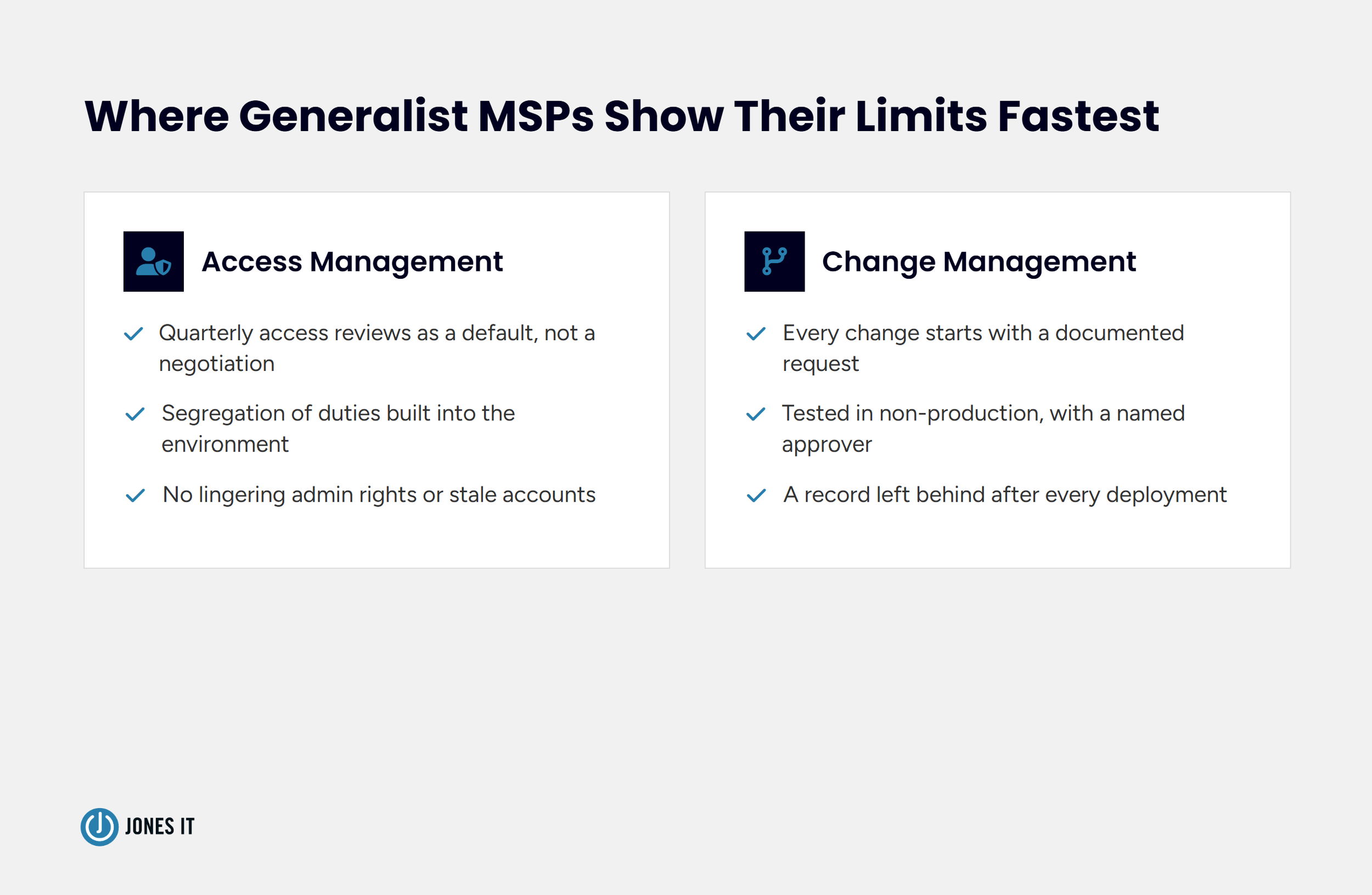
Access and Change Management as You Scale Toward the S-1
Two of the seven domains deserve more attention than the rest, because they are where I have seen the most companies get caught out, and where a generalist MSP shows its limits the fastest.
Access management is the first. Every fast-growing company accumulates access creep: engineers who inherited admin rights during an early sprint and never lost them, former employees still active in systems months after they left, roles that no longer match what a person actually does day to day. A pre-IPO-ready MSP treats quarterly access reviews as a default part of the engagement, not an add-on activity you have to negotiate for. They also build segregation of duties into the environment from the start, so no single engineer can request, approve, and deploy a change to a system that touches financial data. On a lean team where people wear three or four hats, this takes deliberate design, and it is exactly the kind of design a generalist provider has usually never had to think through.
Change management is the second. Startup culture runs on the ability to push a fix quickly, and that instinct does not disappear just because a company is approaching an IPO. It has to be channeled instead. A SOX-ready change process means every modification to a financial system generates a documented request, gets tested in a non-production environment, carries a named approver, and leaves a record of what happened after deployment. I have talked to founders whose engineering team spent the better part of a week before an audit piecing together a change history from memory, old ticket threads, and whoever happened to remember what shipped when. It worked, eventually. But nobody wants to do that twice, and a properly built MSP relationship makes sure nobody has to.
The point of both examples is the same. These habits need to be automatic well before the first auditor asks a question about either one, and automatic only happens if your provider was already running them for someone else before you signed.
How Jones IT Supports Pre-IPO Companies in the Bay Area
That is the same bar I hold our own team to. Evidence over description, quarterly access reviews as routine rather than a scramble, a change log that tells its own story without anyone reconstructing it from memory; all of it is how we try to run every pre-IPO engagement we take on, not just advice I would hand someone shopping for a different provider.
We have spent more than two decades working with growing Bay Area companies, and the pre-IPO transition is one we have walked through more times than I can count. The pattern is almost always the same. A company crosses a growth threshold, whether that is a board decision, a Series C close, or the first conversation with a Big Four auditor, and IT suddenly has to answer for controls nobody ever asked it to formally document.
Our Compliance Kickstarter Program is designed to handle that exact transition. We map your current environment against the ITGC domains your auditors will test, prioritize the gaps that carry the most exposure, and build the evidence trail alongside your compliance and legal teams rather than after them. Companies that start this work early walk into their first SOX audit with a clean access review history and a change log that already tells the whole story on its own. Companies that wait usually spend the weeks before the audit reconstructing that history from memory and old Slack threads, which is a much harder way to spend a month than it needs to be.
Most of the pre-IPO companies we work with are SaaS or fintech, though the pattern shows up just as often in healthcare companies preparing for a public offering. The specific regulation changes. The underlying requirement, that your IT provider can produce evidence on demand rather than promise it exists, does not.
If your company is on a path toward an IPO, and you are evaluating whether your current MSP, or a prospective one, is actually built for that level of scrutiny, I would rather have that conversation with you now than after the auditor's first request lands on someone's desk.
Once you have chosen the right partner, the work does not end there. Our guide on getting maximum value from a managed IT services partnership covers what that relationship should look like once the vendor evaluation is behind you.
Reach out to us, and we can walk through where you are today and what the next twelve months of your IT roadmap should look like.

About The Author

Evan JonesFounder and CEO of Jones IT
With over two decades of IT experience in San Francisco, Evan guides Jones IT's long-term strategy, finances, and culture, with a vision of building the city's highest-rated IT services firm. Outside of work, you'll find him on the golf course or running Bay Area Warriors, his non-profit connecting Bay Area kids to college through basketball.
EU AI Act compliance applies the moment your AI system's output reaches one EU user, no EU office required. Don't let compliance stall your next deal.