
A founder came to us within two weeks of closing an enterprise deal with a logistics company in Rotterdam. The product was solid, the pricing was settled, and the champion on the other side had already looped in procurement to finalize paperwork. Then the security questionnaire came back with a section nobody on the founding team had seen before: a request for documentation on how the startup's AI features complied with the EU AI Act. The deal didn't die, but it slipped six weeks while legal counsel scrambled to answer questions nobody had prepped for.
We've heard versions of this story from more than one Bay Area AI company this year, and none of them were building anything exotic: one had a support chatbot, another had a resume-screening feature nobody had thought twice about. EU AI Act compliance is quietly becoming a prerequisite for selling into Europe, and most founders find out about it the way this one did, in the middle of a live deal, from someone else's checklist.
EU AI Act Jurisdictional Scope: Why It Applies to US Startups
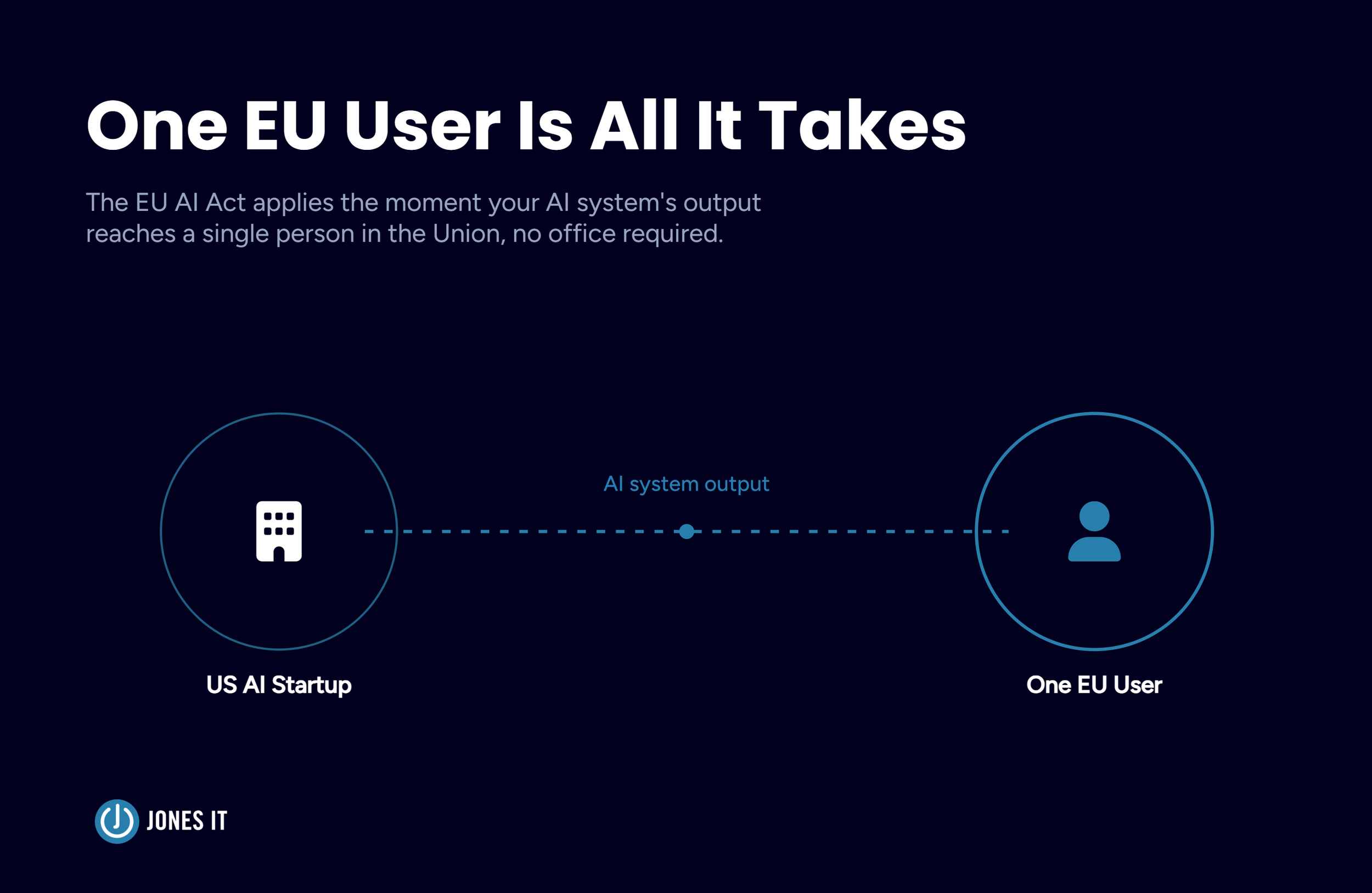
The EU AI Act (Regulation (EU) 2024/1689) applies to a US startup the moment an AI system's output reaches a single user inside the European Union, regardless of where the company is incorporated. That's the part that catches founders off guard. Article 2(1)(c) extends the regulation to providers and deployers located in a third country whenever the output produced by their AI system is used in the Union. There's no revenue threshold, no headcount minimum, and no requirement that the company has any physical presence in Europe at all.
In practice, this output-use trigger catches more Bay Area startups than most founders expect. A few common ways it happens:
A customer support chatbot responds to a user logging in from Amsterdam.
A contractor or remote engineer based in Berlin uses an internal AI tool as part of their job.
A resume-screening tool processes an application from a candidate in the EU.
Marketing automation generates AI-personalized content aimed at a European audience segment.
None of these require a European subsidiary or a single euro of EU revenue. I've sat in enough founder conversations to know how counterintuitive this feels. The instinct is to assume regulation follows a market you've deliberately entered, not one that finds you through a single user interaction. The EU AI Act doesn't work that way.
EU AI Act Compliance Timeline: Key Enforcement Dates for Startups
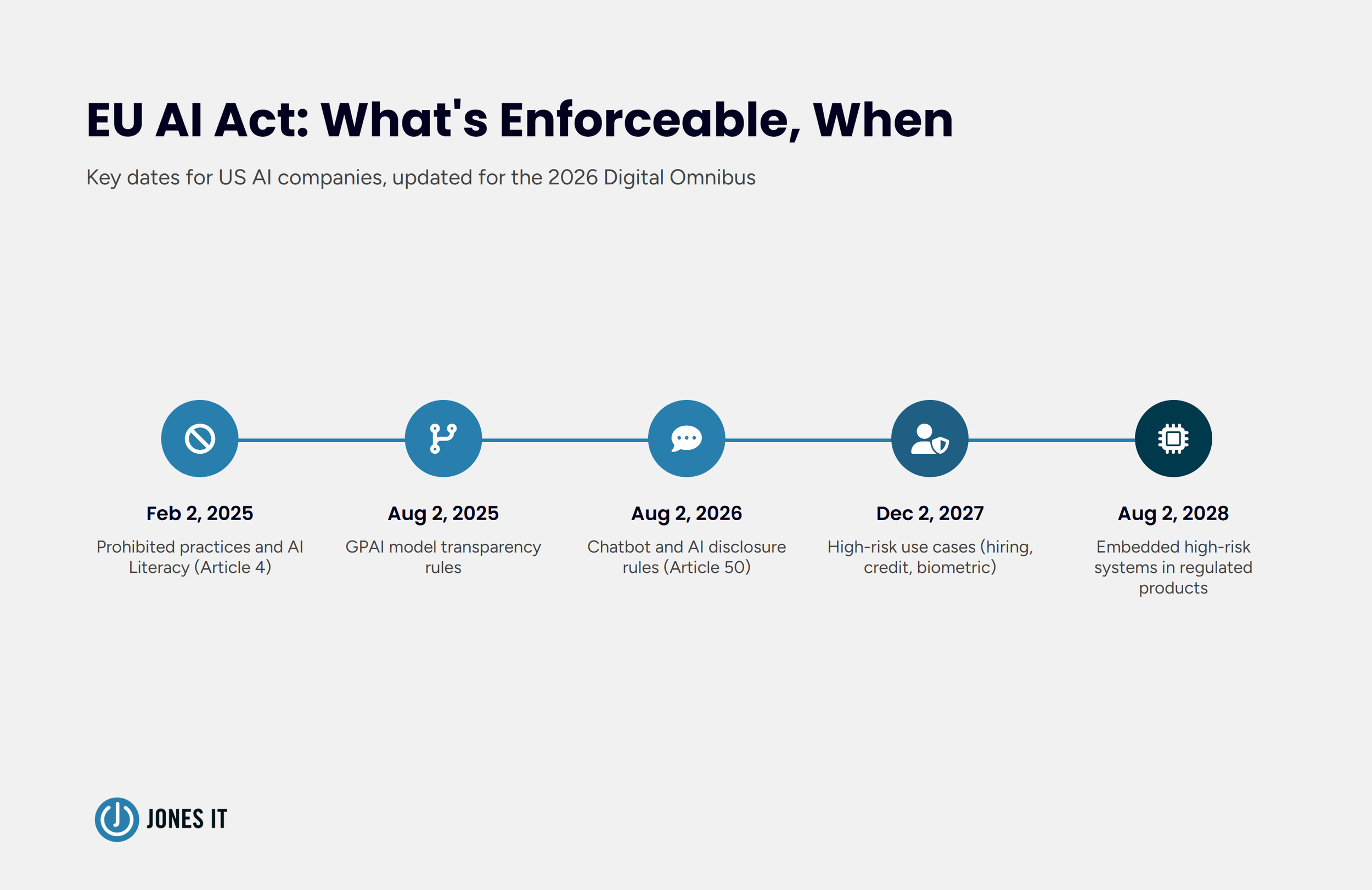
Some of the EU AI Act's obligations aren't hypothetical or years away. They're already live. Prohibited practices under the Act, including emotion recognition systems in the workplace and untargeted scraping of images for facial recognition databases, became enforceable on February 2, 2025. AI Literacy requirements under Article 4 took effect the same day, requiring providers and deployers to take reasonable measures to help their staff understand how the AI systems they use actually work.
Transparency obligations under Article 50, the rule requiring chatbots and other AI systems that interact directly with people to disclose that they're AI, became enforceable on August 2, 2026. If your product includes a chatbot, an AI agent, or a support tool that talks to EU users, that disclosure requirement already applies to you right now.
The rest of the timeline shifted this year. The Digital Omnibus on AI (Regulation (EU) 2026/1744), which entered into force on July 27, 2026, pushed back the deadlines for high-risk AI systems and lightened the documentation burden for smaller companies. High-risk obligations tied to Annex III use cases, things like hiring tools, credit scoring, and biometric identification, now apply starting December 2, 2027, instead of the original August 2026 date. Embedded high-risk systems tied to regulated products move to August 2, 2028.
The Digital Omnibus also rewrote the AI Literacy requirement itself, from a duty to guarantee a specific outcome into a duty to take reasonable measures toward one. That's a meaningfully lower bar than the original text, but it still isn't a free pass. Reasonable measures still means having a policy, keeping a record of which AI tools your team uses, and being able to show you thought about it before an EU customer asks, not after.
EU AI Act Roles: Understanding Provider vs. Deployer Obligations
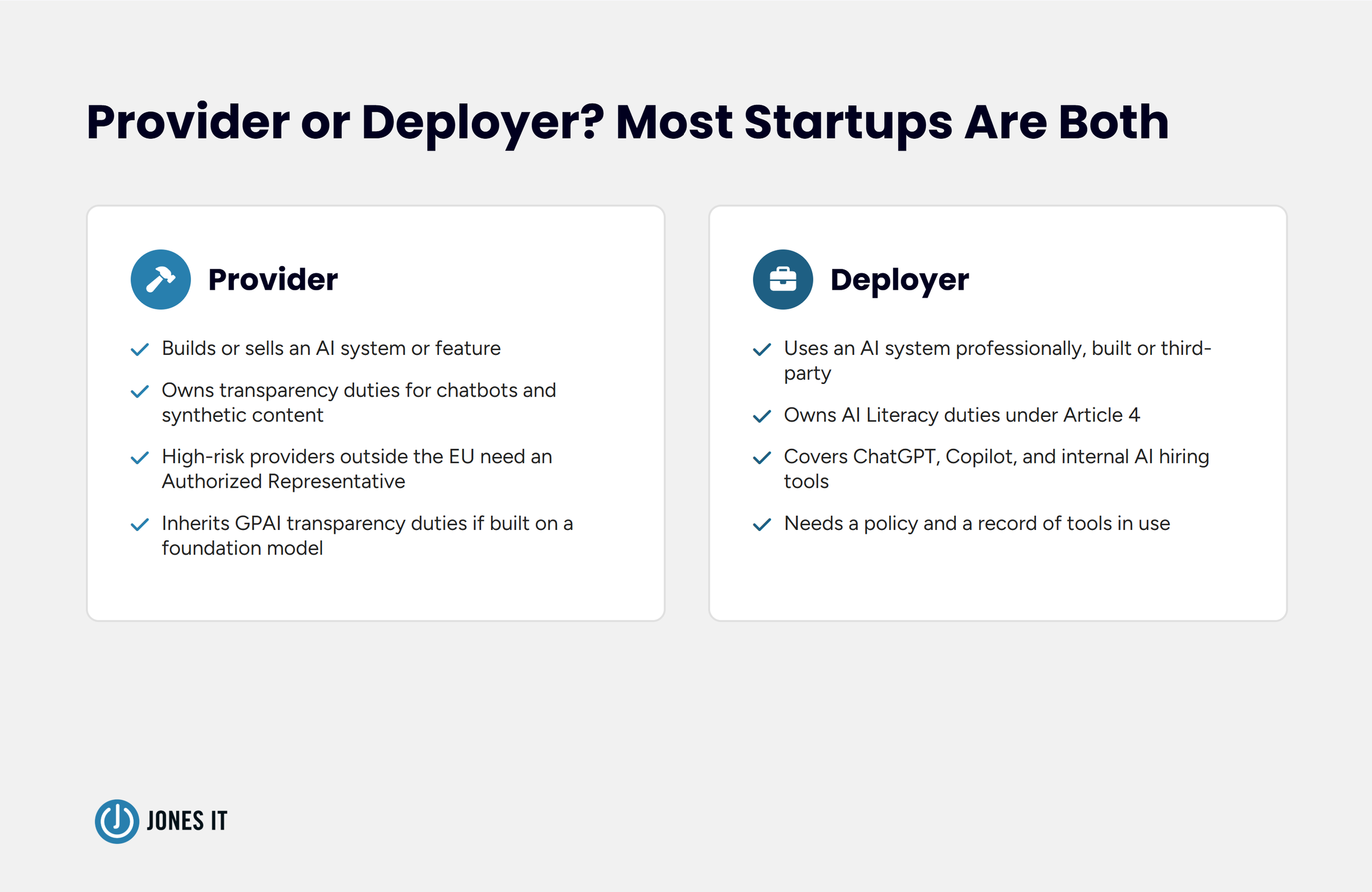
The EU AI Act splits obligations between two roles: providers, who build or sell an AI system, and deployers, who use one professionally. Most Bay Area AI startups are both at once, which is part of what makes this confusing. If your product includes an AI feature you built, you're a provider of that feature. If your team also uses ChatGPT, GitHub Copilot, or an AI hiring tool internally, you're a deployer of those tools too.
The distinction matters most for providers of high-risk AI systems, a narrow but consequential category covering things like hiring and promotion tools, credit and insurance scoring, and biometric identification. Providers of high-risk systems established outside the EU must appoint an EU Authorized Representative under Article 22 before making the system available on the EU market. Finding a European entity willing to take on that liability is a genuine procurement problem, not a formality. If your product doesn't touch a high-risk use case, you can skip this step entirely, which is worth confirming early rather than assuming the worst.
That's a narrower slice of AI risk than the broader operational risks most SMEs face day to day. Our AI Risk Management FAQ for SME Leaders covers the wider picture.
Providers building on top of general-purpose AI models, meaning anything built on GPT, Claude, Llama, or a similar foundation model, inherited transparency obligations of their own starting August 2, 2025. If your product is a wrapper around someone else's model, your AI Act exposure runs through both your own product and the model underneath it.
The Procurement Risk: How EU Enterprise Buyers Are Enforcing AI Compliance
Here's the part that changes the calculus for founders: the first enforcer most Bay Area AI startups will meet isn't a regulator in Brussels; it's an EU customer's procurement team. Article 50's transparency requirement, disclosing that a chatbot is AI, sounds like a small, low-risk obligation. But EU enterprise buyers are now building AI Act questions directly into RFPs, security reviews, and vendor due diligence checklists, the same way SOC 2 reports became a baseline ask for enterprise SaaS deals a few years back.
That supply-chain pressure moves fast. An EU bank, insurer, or healthcare provider that deploys your AI system has its own supervisors asking what it uses and how those vendors document compliance. The rational move for that customer is to push the requirement down to you before signing. We're seeing this show up as new sections in master service agreements: AI Act representations, cooperation clauses, and sometimes indemnities that didn't exist in vendor contracts eighteen months ago. This is especially true for fintech startups selling into European banks and insurers, who already navigate some of the heaviest vendor due diligence in tech.
The founders who get ahead of this treat AI Act documentation the same way they already treat SOC 2 evidence: something you hand over in a day, not something you build from scratch under deal pressure.
The Cost of Non-Compliance and Impact on US AI Startups
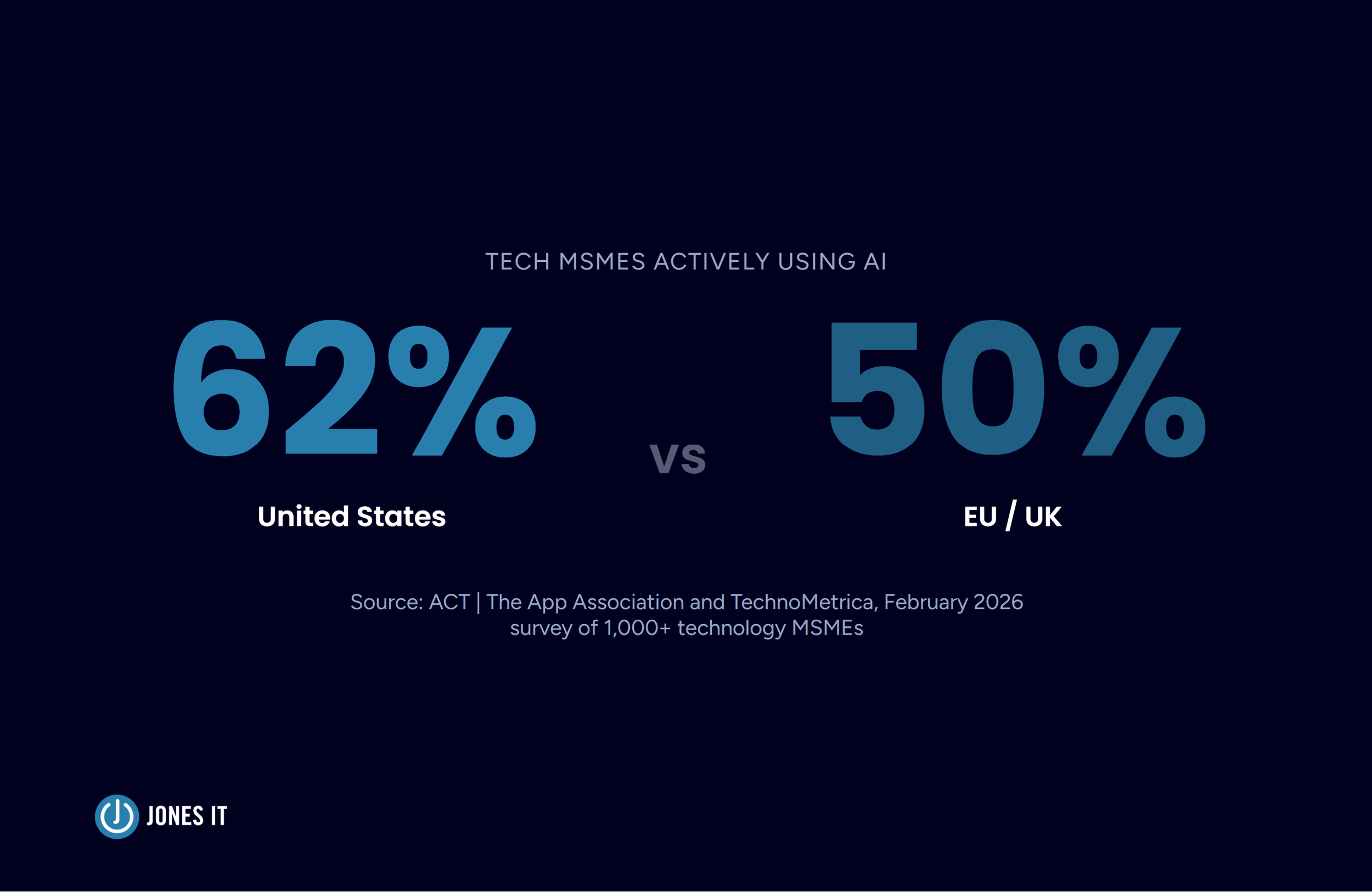
There's a real argument that getting ahead of this is a competitive advantage. A February 2026 survey of more than 1,000 technology MSMEs across the US, EU, and UK, commissioned by ACT | The App Association, conducted by TechnoMetrica, found that 62 percent of US tech companies actively use AI compared to 50 percent in the EU and UK. 45 percent of US firms have fully embedded AI into their workflows, against 32 percent in the EU/UK. The same survey put the average annual cost of AI-related regulatory delay at $109,000 to $375,000 per firm for the EU and UK companies affected, rising to $186,000 to $528,000 for the firms hit hardest.
That gap is the opportunity. US-based AI startups that build compliant products from the start can sell into Europe without the friction European competitors are stuck absorbing. A startup that can produce clean AI Act documentation on request closes EU deals faster than one that's explaining, mid-negotiation, why it's never heard of the regulation.
The same survey found US developers lean harder into exactly the categories most Bay Area AI startups build in. 57 percent build enterprise AI copilots, compared to 41 percent in the EU/UK, and 55 percent build SaaS and other business tools, compared to 42 percent. Those are the products with the fastest path to recurring revenue, and they're also the products most likely to end up in front of an EU enterprise buyer's procurement team.
It's also not a guarantee. If the Digital Omnibus keeps easing deadlines, some of today's urgency will fade with it. But betting a go-to-market plan on Brussels moving slower than your EU pipeline is a bet, not a strategy.
EU AI Act Compliance Checklist for AI Startups
The EU built real accommodations for smaller companies into this regulation, and most founders don't know they exist. SMEs get priority, free access to regulatory sandboxes for testing AI systems before launch. Fines for SMEs are capped at the lower end of the statutory ranges rather than the higher end that applies to large enterprises. The Digital Omnibus extended simplified technical documentation requirements to SMEs and small mid-cap companies too. That directly cuts the paperwork tied to high-risk conformity assessments for the companies small enough to need the break most.
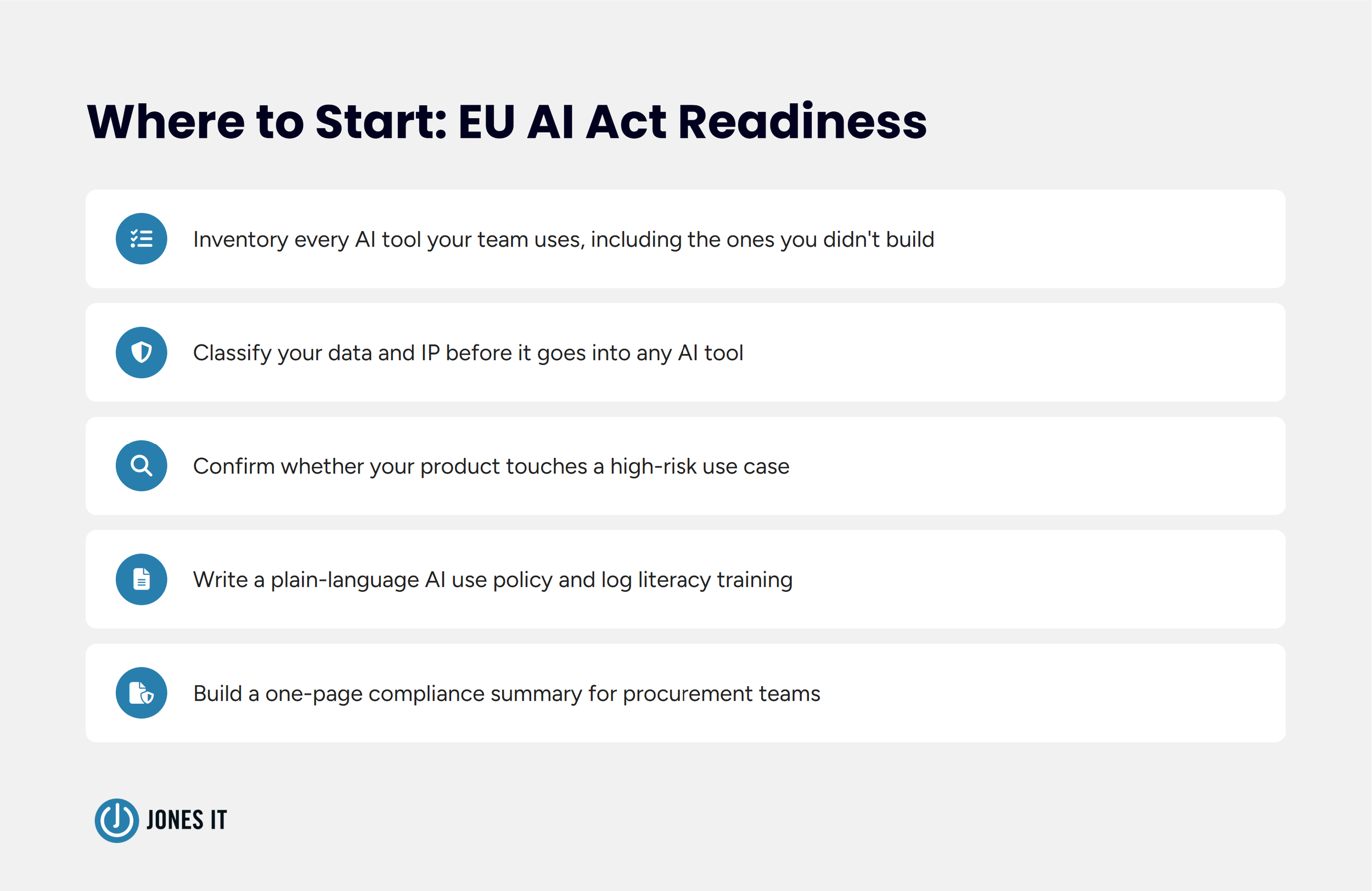
Here's where we'd tell a founder to start:
Inventory every AI tool your team uses, including the ones you didn't build. You can't document what you haven't listed.
Classify your data and IP before it goes into any AI tool. Feeding proprietary code or trade secrets into a tool with unclear data handling can compromise the novelty of an invention before you've had the chance to patent it.
Confirm whether your product touches a high-risk use case, like hiring, credit, or biometric identification, before assuming the heaviest obligations apply to you.
Write a short, plain-language AI use policy and keep a record of AI literacy training for your team. This is the low-cost, high-leverage piece that satisfies Article 4 today.
Build a one-page compliance summary you can hand to a procurement team the moment they ask, before you're mid-negotiation on a deal.
None of this requires a legal department the size of a Fortune 500 company's. It just requires doing the inventory work before an EU customer's procurement team asks for it, not after.
Why Proactive AI Compliance is Your Best Sales Tool
The EU AI Act is no longer a distant regulatory curiosity; it is a live commercial filter. EU enterprise buyers are now using these standards to qualify vendors, and the startups that treat AI Act readiness as a proactive go-to-market strategy are closing deals while competitors stall. Don't wait for a six-week procurement detour to get your house in order; build the documentation today so you can say "yes" to the next deal without hesitation.
Ready to get ahead of the audit?
If you’re unsure if your current tool stack puts you in scope, or if you need to build the governance artifacts that enterprise procurement teams now demand, let's talk. Reach out to our team to schedule a consultation.

About The Author

Evan JonesFounder and CEO of Jones IT
With over two decades of IT experience in San Francisco, Evan guides Jones IT's long-term strategy, finances, and culture, with a vision of building the city's highest-rated IT services firm. Outside of work, you'll find him on the golf course or running Bay Area Warriors, his non-profit connecting Bay Area kids to college through basketball.
Learn how to hand off Level 1 support to a co-managed IT help desk without losing control or dip in quality, and free up your team for strategic IT projects.