
When Does a Startup Need a Managed IT Provider?
"We have a tech co-founder" is one of the most expensive sentences a startup can say.
Not because tech co-founders aren't invaluable. They are. But somewhere between the seed round and the Series A, that phrase quietly shifts meaning. It starts as a real answer to "who handles your infrastructure?" and slowly becomes a placeholder for a decision that keeps getting deferred.
Here's how it usually goes. The CTO sets up Google Workspace and GitHub on day one, provisions everyone's laptops, and figures out the VPN. At eight people, that's a two-hour job. At twenty people, it's an ongoing responsibility that nobody officially owns. Engineers ask them IT questions in Slack. New hires wait two days for access that should have taken two hours. A contractor who left four months ago still has credentials nobody got around to revoking.
The tech co-founder isn't dropping the ball. They're just doing five jobs, and IT is the one that expands invisibly while everything else is demanding attention.
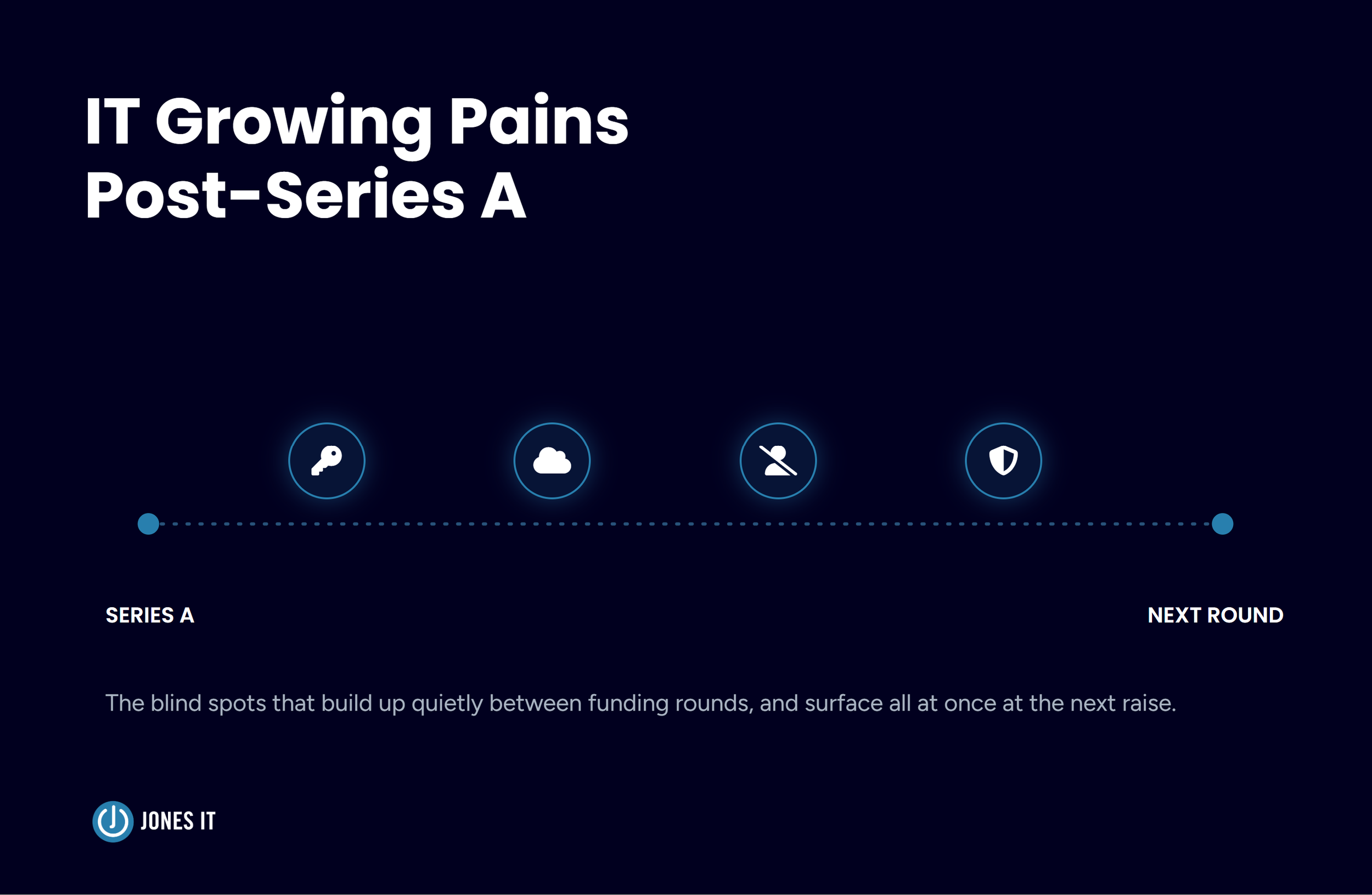
We've been supporting Bay Area startups for over twenty years, and this pattern shows up constantly across SoMa SaaS companies, Mission Bay biotech firms, and Financial District fintech startups. The inflection point isn't a single incident. It's a slow accumulation of deferred IT work until one day something breaks at the worst possible moment: a stolen laptop the week before a fundraise, a SOC 2 audit that surfaces three years of access control gaps, a new enterprise customer asking for your security posture documentation.
The question isn't whether your startup needs managed IT. It's whether you recognize the moment before it becomes expensive.

Signs Your Startup Has Outgrown Informal IT Management
At five people, IT management is barely a function. Someone sets up the tools, everyone figures out their own laptop, and onboarding takes an afternoon. That works fine.
At fifteen people, cracks appear. The engineer who originally set everything up is now three product cycles deep. Someone is still using a personal Gmail for a vendor relationship because the migration never finished. A contractor from six months ago still has access to the GitHub org.
At twenty-five people, you have a real problem.
The challenge is that there's no alarm that goes off. The complexity accumulates gradually, each issue small enough to defer. A stolen laptop is the first time everything becomes visible at once. Or a SOC 2 audit. Or a due diligence call where an investor asks for your access control policy, and you realize you don't have one.
The inflection point isn't a specific headcount. It's when managing IT starts pulling focus away from the things that actually grow the business.
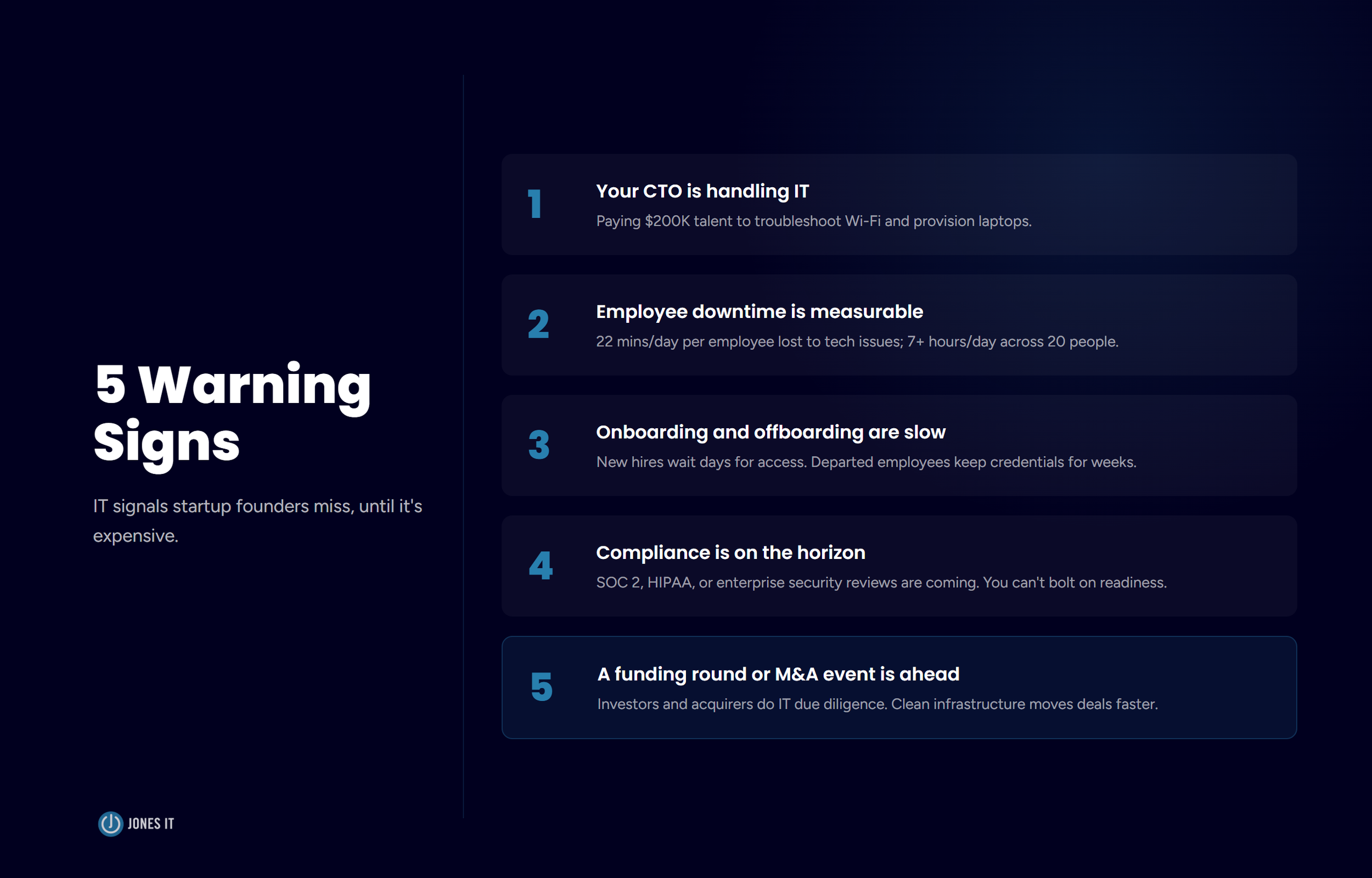
The 5 IT Warning Signs Startup Founders Ignore
Most founders recognize these warning signs in retrospect. But the goal is to catch them before they become expensive.
1. Cost Saving Fallacy
Your CTO or a senior engineer handling IT is the costliest signal and the easiest to rationalize. A senior engineer in San Francisco costs $180,000 to $220,000 a year in salary alone. When that person spends even a few hours a week on laptop provisioning, access management, and Wi-Fi troubleshooting, you're paying premium talent for work that shouldn't be on their plate. Every hour they spend on IT is an hour not spent on product development.
2. Creeping Employee Downtime
Employee downtime is measurable. Research by Nexthink puts the average time employees lose to tech issues at around 22 minutes per day. At twenty employees, that's roughly seven hours of lost productivity every single day. When your team is growing fast, and every person has meaningful work to do, that's not a rounding error.
3. Onboarding and Offboarding Inconsistencies
Onboarding and offboarding are slow or inconsistent. A new engineer starting on Monday shouldn't still be waiting for tool access on Wednesday. A departing employee's credentials should be revoked on their last day, not whenever someone gets around to it. At scale, inconsistent offboarding is a direct security liability.
4. Compliance Mishaps
Compliance requirements are on your horizon. If you're in fintech, healthtech, or SaaS and have enterprise customers, SOC 2, HIPAA, or other frameworks are either already required or coming soon. Compliance readiness isn't something you bolt on after the fact. The access controls, audit logs, endpoint management, and policies that auditors look for take months to build correctly.
5. Neglected Documentation
When you're preparing for a funding round or M&A event, investors and acquirers will do IT due diligence. They will look at your identity management, your endpoint security posture, your vendor access controls, and your incident response history. Startups with clean IT infrastructure move faster through due diligence, while startups without it spend the weeks before a term sheet frantically documenting processes that barely exist.
The Real Cost of Delaying Managed IT Services
The instinct to defer is understandable. Every dollar counts at the seed stage, and "managed IT" can sound like something for companies with a proper ops team and a Facilities Manager. But the math on delay doesn't work in favor of such an argument.
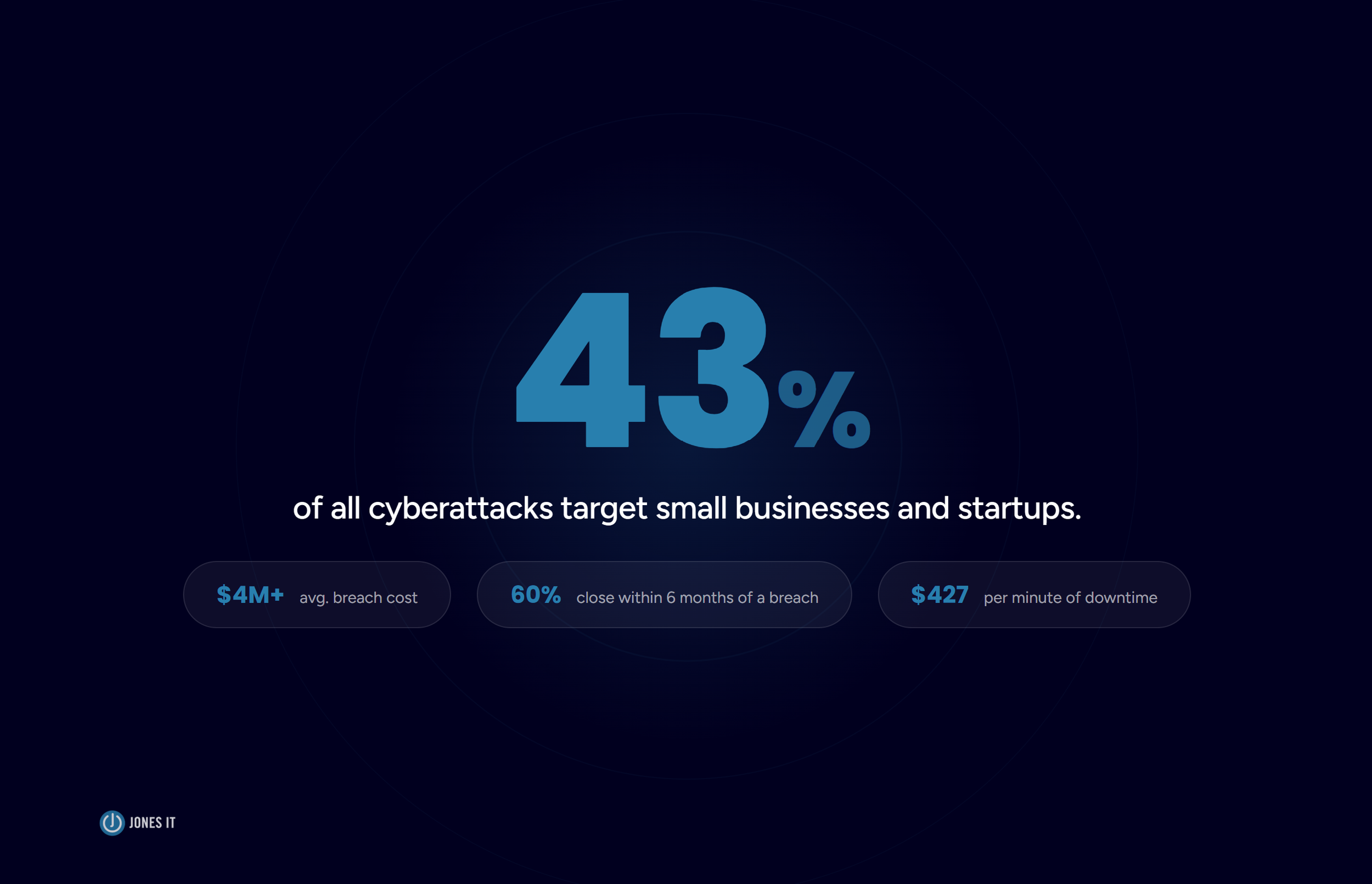
Small businesses and startups are the target of nearly 43% of all cyberattacks, according to data from Verizon's Data Breach Investigations Report. A breach at Series A scale, where you're handling customer data, employee records, and potentially regulated financial or health information, can cost well over $4 million on average. Moreover, the reputational damage with early enterprise customers can be far more expensive than that.
System downtime has a direct revenue cost. For smaller companies, unplanned downtime runs approximately $427 per minute, according to research published by Gartner. A few hours of an outage caused by a misconfigured server or an unpatched vulnerability isn't just a frustration. It's a financial line item.
There's also the hidden cost of the work your team absorbs. When engineers troubleshoot network issues, when your COO spends a morning dealing with a vendor access problem, when onboarding a new hire takes two days instead of two hours, those costs are real even if they don't show up on an invoice.
We work with a lot of startups that come to us after one of these pain points becomes acute. The conversation is almost always the same: the founders wish they had made the move three to six months earlier.
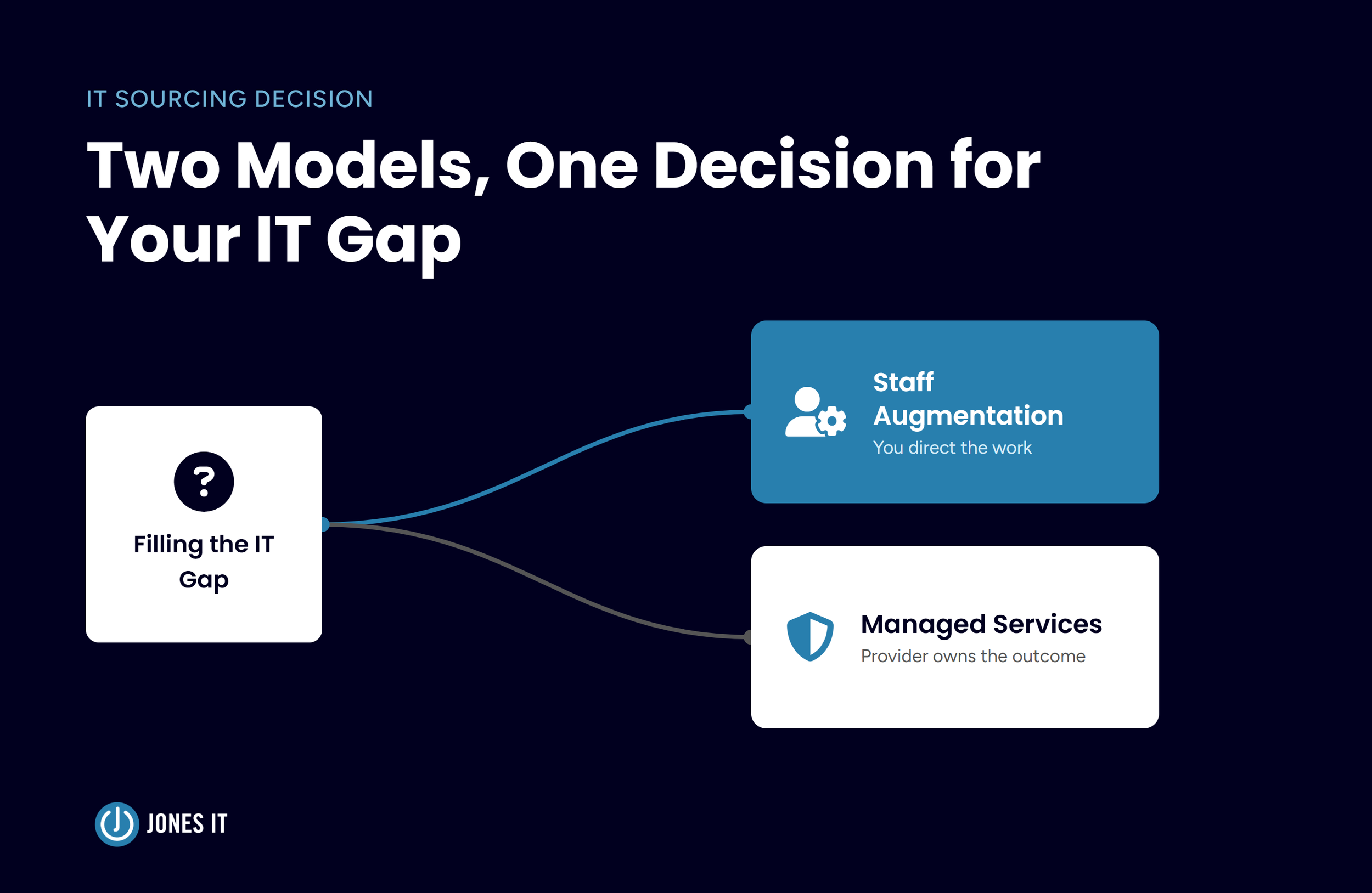
MSP vs. In-House IT: What Makes Sense for a Growing Startup
This is the most common objection we hear from Series A founders, and it's worth addressing directly.
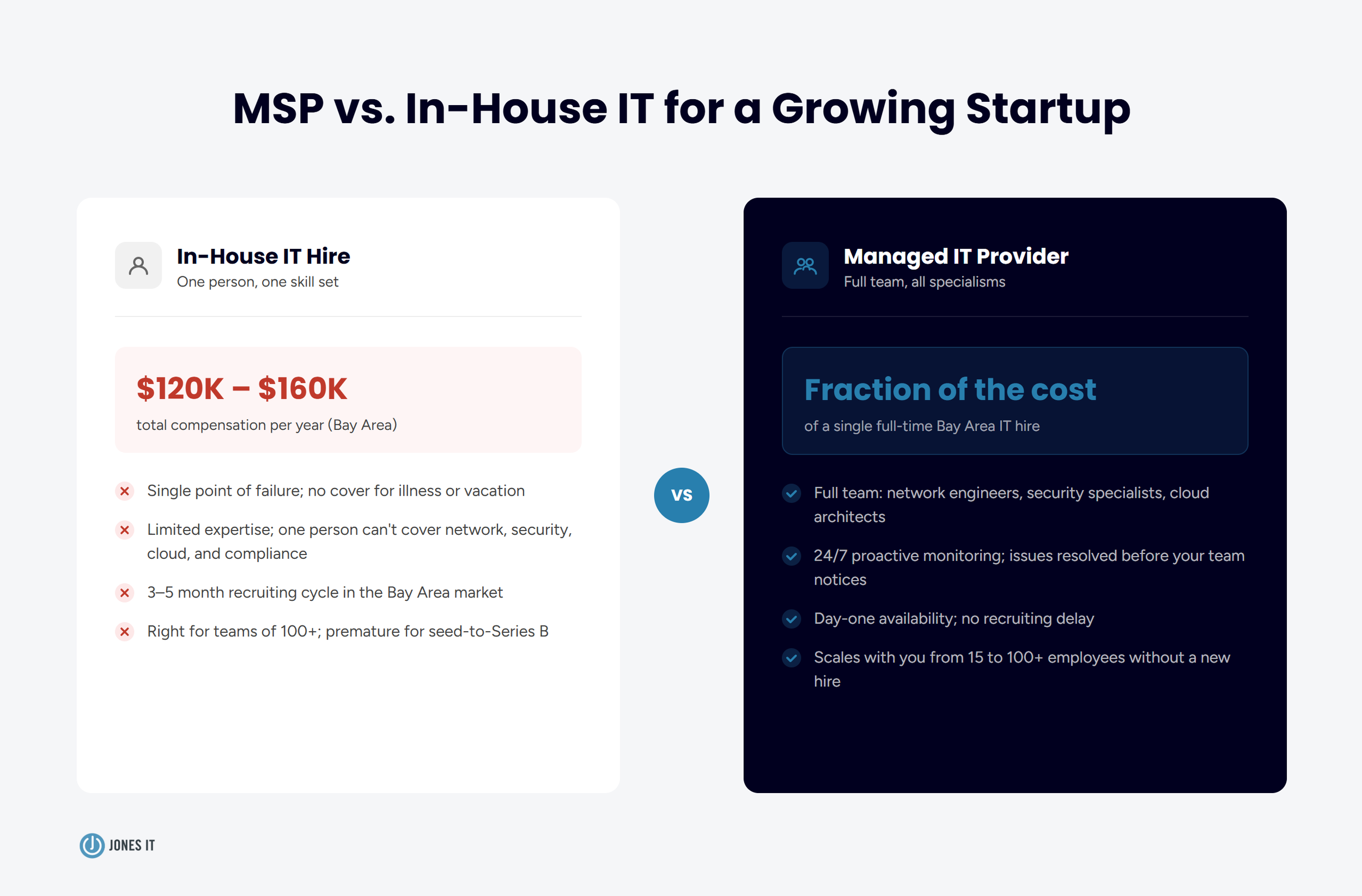
A competent IT hire in San Francisco carries a total compensation package of $120,000 to $160,000 per year. That gets you one person, with one set of skills, covering one shift. No redundancy for illness or vacation. No deep bench of expertise across networking, cybersecurity, cloud infrastructure, compliance, and endpoint management. And a recruiting process that, in the Bay Area market, typically takes three to five months.
On the other hand, a managed IT provider gives you a team. At Jones IT, when a client calls with an issue, they're not waiting for one person to be available. They're reaching a team that has handled the same problem dozens of times across similar companies. For most startups between 15 and 75 employees, that coverage costs a fraction of a single full-time hire.
There is a right time to bring IT in-house. It's usually when your headcount is pushing past 100, your infrastructure complexity justifies a full-time dedicated resource, or you have regulatory requirements that demand it. Before that point, an MSP covers the same ground for less money and gets you to that scale faster.
What Managed IT Services Include for Seed-to-Series B Startups
The term "managed IT" can sound vague, so here's what it looks like in practice for an SF Bay Area startup at your stage.
1. Device management and security.
Every laptop, phone, and tablet in your fleet is enrolled in MDM (Mobile Device Management) so you can remotely wipe a stolen device, enforce encryption, push security patches automatically, and maintain an audit trail of who has what. This is baseline security hygiene that becomes a compliance requirement the moment you start handling sensitive customer data.
2. Identity and access management.
A clean identity stack means every employee has exactly the access they need, provisioned on day one and revoked cleanly on their last day. Single sign-on across your SaaS tools, MFA enforced across the board, and a documented process for managing privileged access. This is typically what SOC 2 auditors look for first.
3. Network and infrastructure.
Whether you're in a WeWork in Mid-Market, a dedicated office in Dogpatch, or running a fully distributed team, your network infrastructure needs to be reliable, properly segmented, and monitored. We set up and maintain office networks for dozens of Bay Area startups, and we resolve the kind of issues that would bring a company to a halt before they ever reach your team.
4. Compliance readiness support.
For startups on a path to SOC 2, HIPAA, or other frameworks, the right MSP does more than just keep the lights on. We work alongside your compliance program to ensure the technical controls are in place: audit logging, access reviews, vulnerability management, and the documentation that auditors require. Our Compliance Kickstarter Program was designed specifically for startups that need to get compliance-ready fast, without derailing their engineering team in the process.
5. Proactive monitoring.
Rather than waiting for something to break, we monitor your infrastructure around the clock. Most of the issues we catch and resolve never reach your team at all.
How to Know When Your Startup Is Ready for an MSP
If you're a founder or COO reading this and wondering whether it applies to you, three questions are worth sitting with.
First: who handles IT when something breaks at 9 pm before a product launch? If the honest answer is "someone on the engineering team, unhappily," you already have your answer.
Second: if an employee left today without notice, could you revoke all their access within the hour? Any hesitation here means your offboarding process has gaps that represent real security exposure.
Third: if a prospective enterprise customer asked to review your security posture documentation tomorrow, what would you send them? For startups targeting enterprise sales, this question comes up sooner than most founders expect.
You don't need all three answers to be red flags. One is enough.
The Right Time Is Usually Before You Think It Is
The startups we work with that have the smoothest growth trajectories are the ones that got their IT foundation right early. Not because they spent more money, but because they didn't spend the first year of growth firefighting infrastructure problems while also trying to build their product, close customers, and hire a team.
We've been doing this work in the Bay Area for over two decades, and the companies that get it right share one characteristic: they treat IT as infrastructure for growth, not overhead to minimize. That shift in framing tends to happen once. After that, it's just part of how the company operates.
If you're a founder or COO at a Bay Area startup and you're starting to feel the friction we've described here, we'd welcome a conversation. You can also read more about how we approach IT for growing startups in our post on how to scale IT after a Series A, and our overview of what managed IT services actually include.
Talk to Jones IT about Managed IT for your startup and see how we've helped Bay Area companies from seed through Series B build IT infrastructure that grows with them.

About The Author

Hari SubediMarketing Manager at Jones IT
Hari is an online marketing professional with a focus on content marketing. He writes on topics related to IT, Security, and Small Business. He is also the founder and managing director of Girivar Kft., a business services company located in Budapest, Hungary.

Mac vs. PC for startups isn't a company-wide choice; it’s a per-role one. Use this framework to match hardware to software needs and efficiently manage a mixed fleet.