
Updated: June 23, 2026
The first thing I noticed when we started working with a fintech startup in San Francisco's Financial District was that they had no idea what was on their network. They were 42 people, had just closed their Series A, and were three months into a SOC 2 Type II push. Their engineering team was sharp, and their product was good. But when I asked who was responsible for reviewing access logs, I got a long pause and then: "We have logs?"
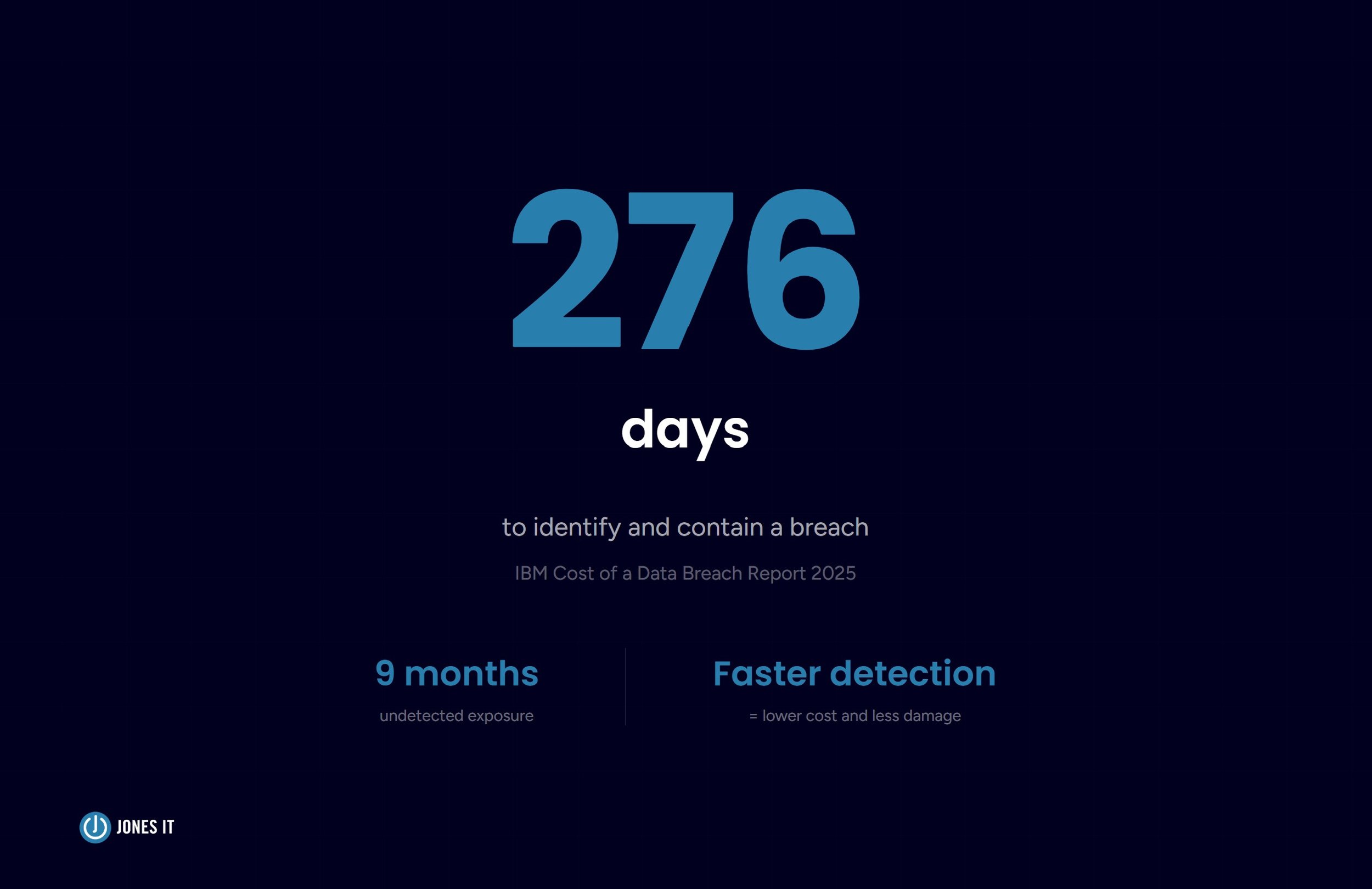
This kind of situation is more common than you may think. Security often scales reactively, bolted on after a compliance requirement or, worse, after an incident. The problem is that reactive security is expensive. According to IBM's Cost of a Data Breach Report 2025, organizations take an average of 276 days, roughly nine months, to identify and contain a breach. The longer a threat sits in your environment, the more damage it does and the more it costs to remediate.
This reactive cycle is exactly what we aimed to fix by establishing a measurable security posture, which is the term for how prepared your organization actually is to prevent, detect, and respond to those threats. This guide walks through exactly how to strengthen it, using the same steps we used with that fintech client and with dozens of other Bay Area startups since.
What Is Security Posture?
Security posture measures an organization's overall readiness to defend against and respond to cyber threats. The National Institute of Standards and Technology (NIST) defines it as "the security status of an enterprise's networks, information, and systems based on information security resources (e.g., people, hardware, software, policies) and capabilities in place to manage the defense of the enterprise and to react as the situation changes."
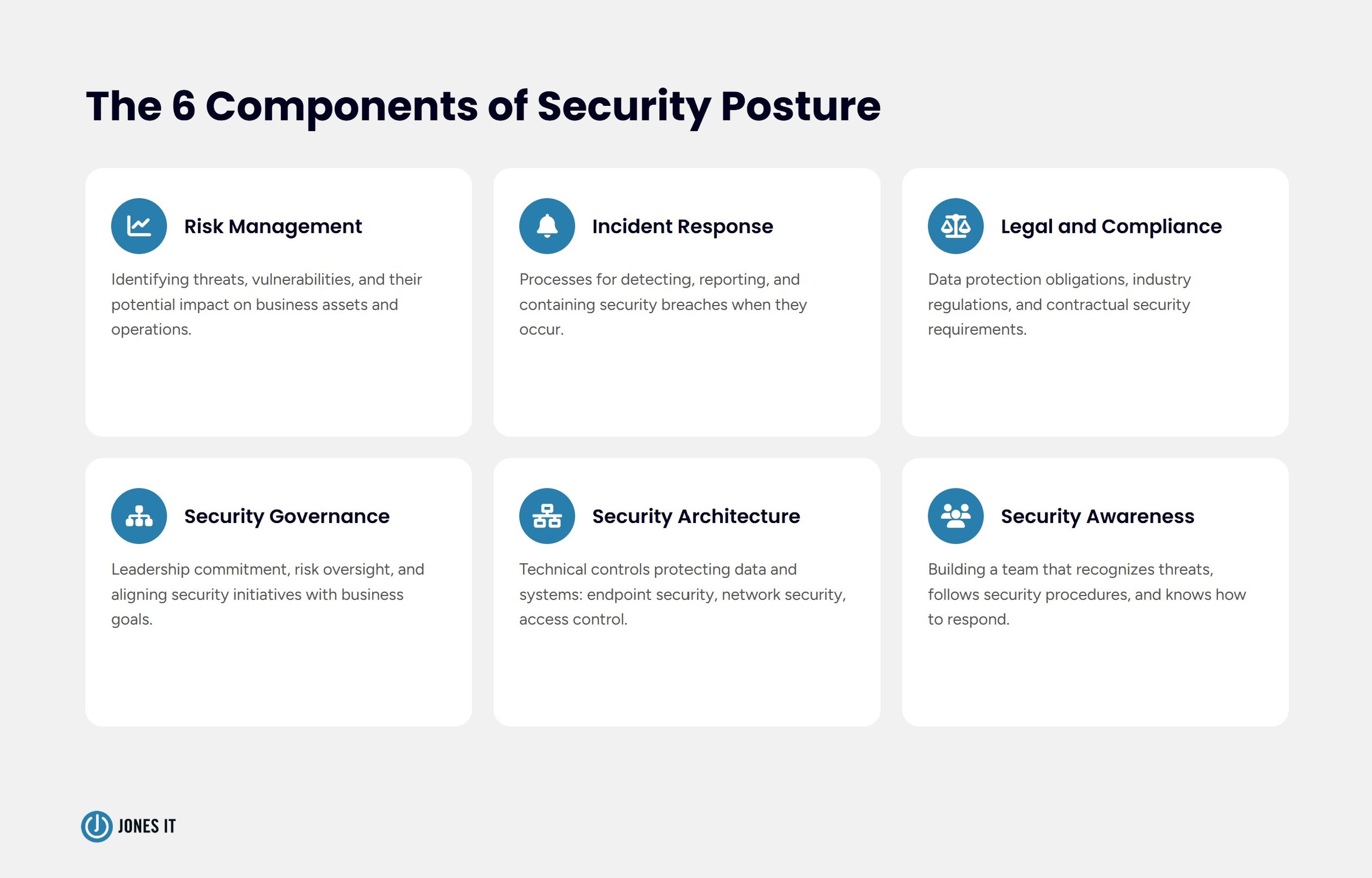
In practical terms, security posture covers six components:
Risk management: identifying threats, vulnerabilities, and their potential impact on your assets.
Incident response: the processes for detecting, reporting, and containing security breaches.
Legal and compliance considerations: data protection obligations, industry-specific regulations, and contractual requirements.
Security governance: leadership commitment to security, risk oversight, and alignment with business objectives.
Security architecture: the technical controls protecting your data and systems, including endpoint security, network security, and access control.
Security awareness and training: building a team that recognizes threats and knows how to respond.
For a startup scaling from 20 to 100 people, every one of those components needs to mature alongside the organization. Here is how to do that systematically.
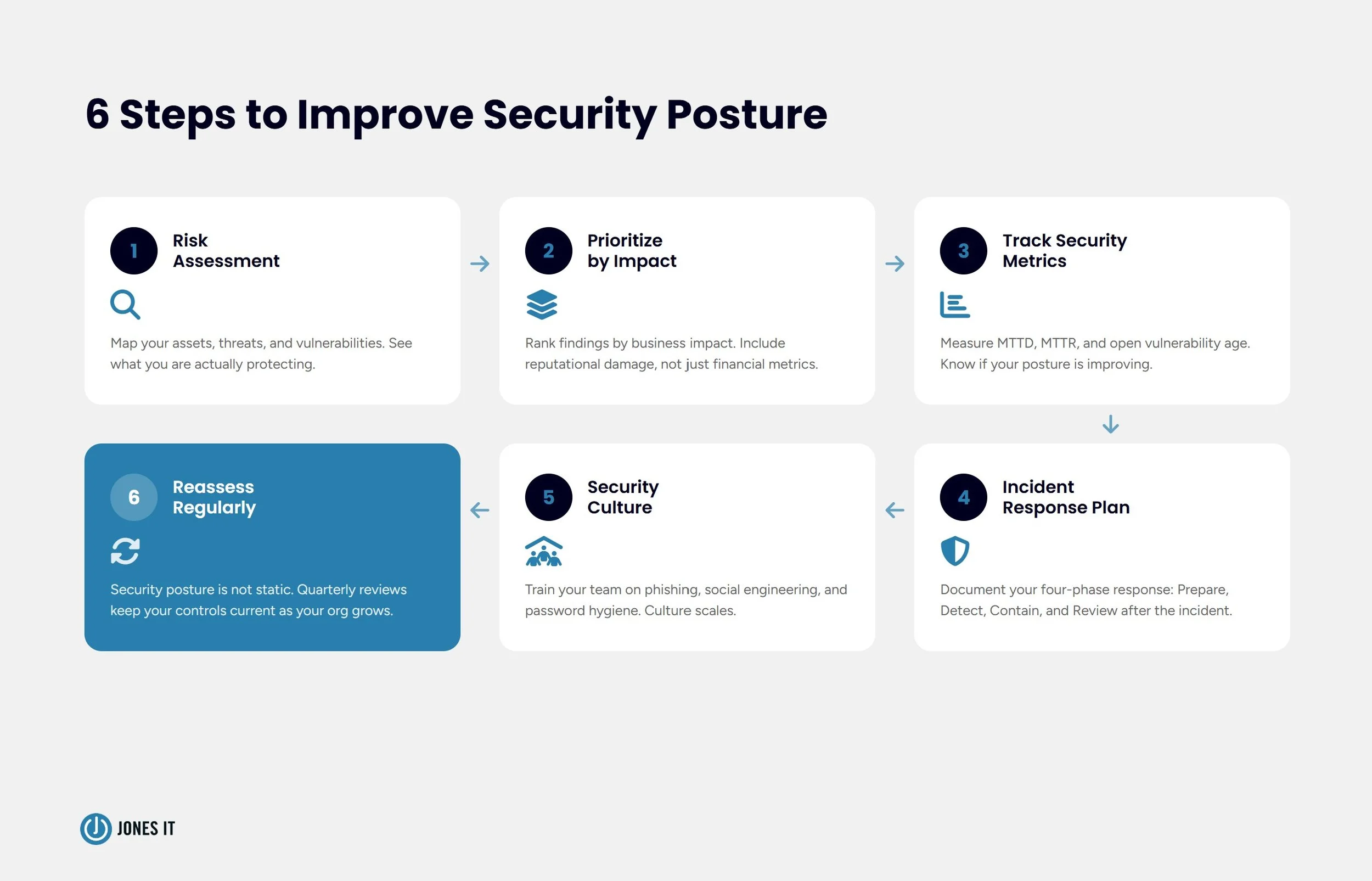
Step 1: Start with a Risk Assessment
Back to the fintech client. After the logs conversation, we ran a cybersecurity risk assessment. What we found was a familiar picture: shadow IT tools that nobody had formally approved, shared admin credentials on three systems, and a vendor with access to their production environment although they had been offboarded six months prior.
None of these were exotic vulnerabilities, but all of them were real risks.
A cybersecurity risk assessment is the foundation of improving security posture because you cannot protect what you cannot see. The assessment identifies critical business functions and data, maps your existing IT assets and compliance requirements, determines exposure to known threats and attack vectors, and evaluates the maturity of the controls you currently have in place.
Risk assessments also extend to your supply chain. Third-party vendors with access to your systems are an extension of your attack surface, and assessing them is part of assessing yourself. One of the most common findings we come across in startup environments is that vendor access has not been audited since it was first granted.
Step 2: Prioritize Risk by Business Impact
Thirty findings is not unusual. What matters is not the length of the list but how you work through it.
Prioritizing by business impact means asking if this vulnerability were exploited, what would the actual damage be? Not every finding carries the same weight. An unpatched system holding customer payment data is a categorically different risk than a weak password on an internal wiki that contains no sensitive information.
One thing I always flag for clients: do not rely solely on financial metrics when prioritizing. Reputational damage and loss of customer trust often cause more lasting harm than the direct cost of a breach, especially for startups whose growth depends on that trust. You can still attach rough monetary values to intangibles to make prioritization more objective, but leave room in your risk model for consequences that do not show up on a balance sheet.
The first risk assessment also serves as your benchmark. Every subsequent assessment is measured against it, so being thorough early pays off over time.
Step 3: Track Security Metrics
Three months after the remediation work, the fintech client's CTO asked me how they would know if things were getting better. It was a good question. Security without measurement is maintenance without a checklist: you might be doing the right things, but you have no way to verify it.
Security metrics give you visibility into the effectiveness of your security controls and help identify where risks are accumulating. The metrics you track become your key performance indicators (KPIs) for the security program, so they need to be relevant to your actual operations, reliable enough to trust, and simple enough for leadership to understand.
The most useful metrics for a growing startup include:
Intrusion attempts: the volume and source of blocked access attempts.
Security incidents: number of confirmed incidents per quarter, trended over time.
Mean time to detect (MTTD): how long between a threat entering your environment and your team identifying it.
Mean time to resolve (MTTR): how long from detection to full containment and remediation.
Mean time to contain (MTTC): specifically the time between detection and isolation of the threat.
Mean age of open vulnerabilities: how long known vulnerabilities sit unpatched.
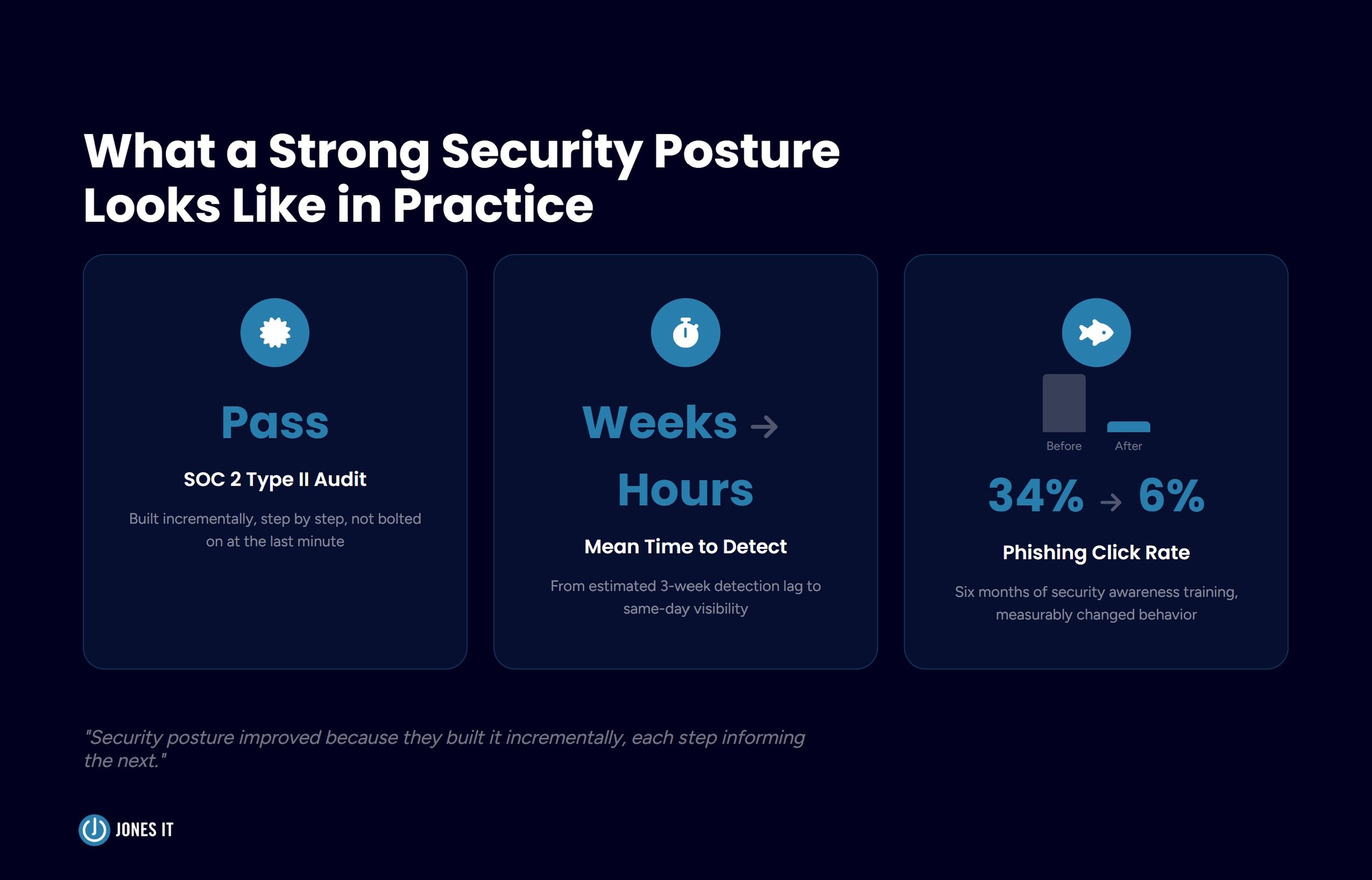
For that fintech client, the first MTTD measurement was sobering: they would not have detected a lateral movement event for an estimated three weeks based on their existing tooling and review cadence. That single number justified investment in better endpoint detection faster than any policy document could have.
Step 4: Build an Incident Response Plan
When a security incident does happen, how quickly your team responds determines how much damage you contain. An incident response plan is the document that makes that response fast, coordinated, and systematic instead of panicked and improvised.
Most startups at the Series A stage do not have one. When I asked the fintech client what they would do if they discovered unauthorized access to their customer database at 11 PM on a Friday, the answer was: "Probably call the CEO and figure it out from there." That is a plan, technically. It is also the scenario that turns a containable breach into a full-scale crisis.
A solid incident response plan covers four phases:
Preparation
Define the incident response team, their roles, and contact information. Establish what constitutes a security incident (not every alert is one). Document the escalation path and communication protocols, including what you are required to disclose to customers and regulators under applicable law.
Detection and Analysis
Establish how your team documents, prioritizes, and responds to incidents. This includes the tools and processes for identifying whether an event is a true incident, determining its scope, and notifying relevant stakeholders.
Containment, Elimination, and Recovery
The actions taken to stop the threat, remove it from your environment, and restore normal operations. These steps vary depending on the type of incident, but the goal is always the same: stop the damage, eradicate the cause, and get the business back to functioning. This phase also addresses the vulnerabilities that allowed the incident to occur in the first place.
Post-Incident Activity
After the threat is eliminated, review what happened, assess the severity and financial impact, and evaluate whether your controls performed as expected. This is where you update your security posture based on what you learned.
Step 5: Create a Security-Conscious Culture
Security tools and policies only work when the people using them understand why they matter. A security-conscious culture is one where employees recognize threats, follow procedures, and know what to do when something looks wrong, without needing a security engineer standing over their shoulder.
For the fintech client, culture was where the fastest wins came. We ran a baseline phishing simulation and found that 34% of employees clicked the test link. Six months of training later, including sessions on how phishing attacks work and what social engineering looks like in a startup context, that number dropped to 6%.
Building that culture involves regular training on phishing, password hygiene, social engineering tactics, and the organization's specific security policies and procedures. It also involves making security feel approachable rather than punitive: employees who are afraid to report a suspicious email because they think they will get in trouble are a much bigger liability than employees who click a bad link and immediately flag it.
Security culture is also where leadership buy-in matters most. If security is treated as an IT team problem rather than an organizational priority, the culture will reflect that.
Step 6: Reassess Regularly
Security posture is not a project with an end date. It evolves constantly in response to changes in your business, your technology stack, and the threat landscape. Outdated controls create a false sense of security, which is often more dangerous than having no controls at all because it leads to complacency.
The fintech client now reassesses their security posture quarterly. The scope varies: full risk assessments happen annually, while metric reviews, access audits, and policy updates happen on a shorter cadence. What that rhythm gives them is early visibility into drift: new tools that got added without security review, access that expanded beyond its original scope, or training that has not been refreshed since the threat landscape changed.
Aligning your security program to a recognized framework, like ISO 27001 or the NIST Cybersecurity Framework, gives that reassessment process structure. Frameworks define what good looks like at each maturity level, so you always know what you are measuring against.
A Stronger Security Posture Takes Time, but It Starts with One Assessment
That fintech client is now eighteen months into their security program. They passed their SOC 2 Type II audit. Their MTTD has dropped from weeks to hours. Their team reports phishing attempts as a matter of routine. None of that happened because they bought a single tool or ran a single training session; it happened because they built security posture incrementally, each step informing the next.
The steps in this guide: risk assessment, risk prioritization, security metrics, incident response planning, security culture, and regular reassessment, are the same steps we use with every client, from early-stage SaaS startups to fintech companies navigating SOX and PCI DSS requirements. They scale with your organization because they are built around your actual risk, not a generic template.
If you want to know where your organization actually stands, reach out. We offer free IT security assessments for Bay Area startups, and a security posture review is a natural starting point.




Learn how to establish an AI tool approval process for startups with this 5-step workflow, vendor review checklist, and data loss prevention controls.