
SOC 2 Security Awareness Training: What Your Auditor Actually Wants to See
A 45-person SaaS startup had run security awareness training for two years before their SOC 2 Type II observation period opened. Every employee took an annual course through a free platform, and completions were logged in a shared spreadsheet that the ops manager updated whenever she had a spare afternoon between everything else on her plate. Nobody thought there was a gap here. The training happened. People clicked through the modules on phishing and password hygiene and moved on with their day.
Then the auditor asked a specific question about an engineer who had started on May 12th. The startup’s own policy required training completion within 30 days of a new hire’s start date. Could they produce a timestamp showing exactly when that engineer finished the course, tied back to that start date?
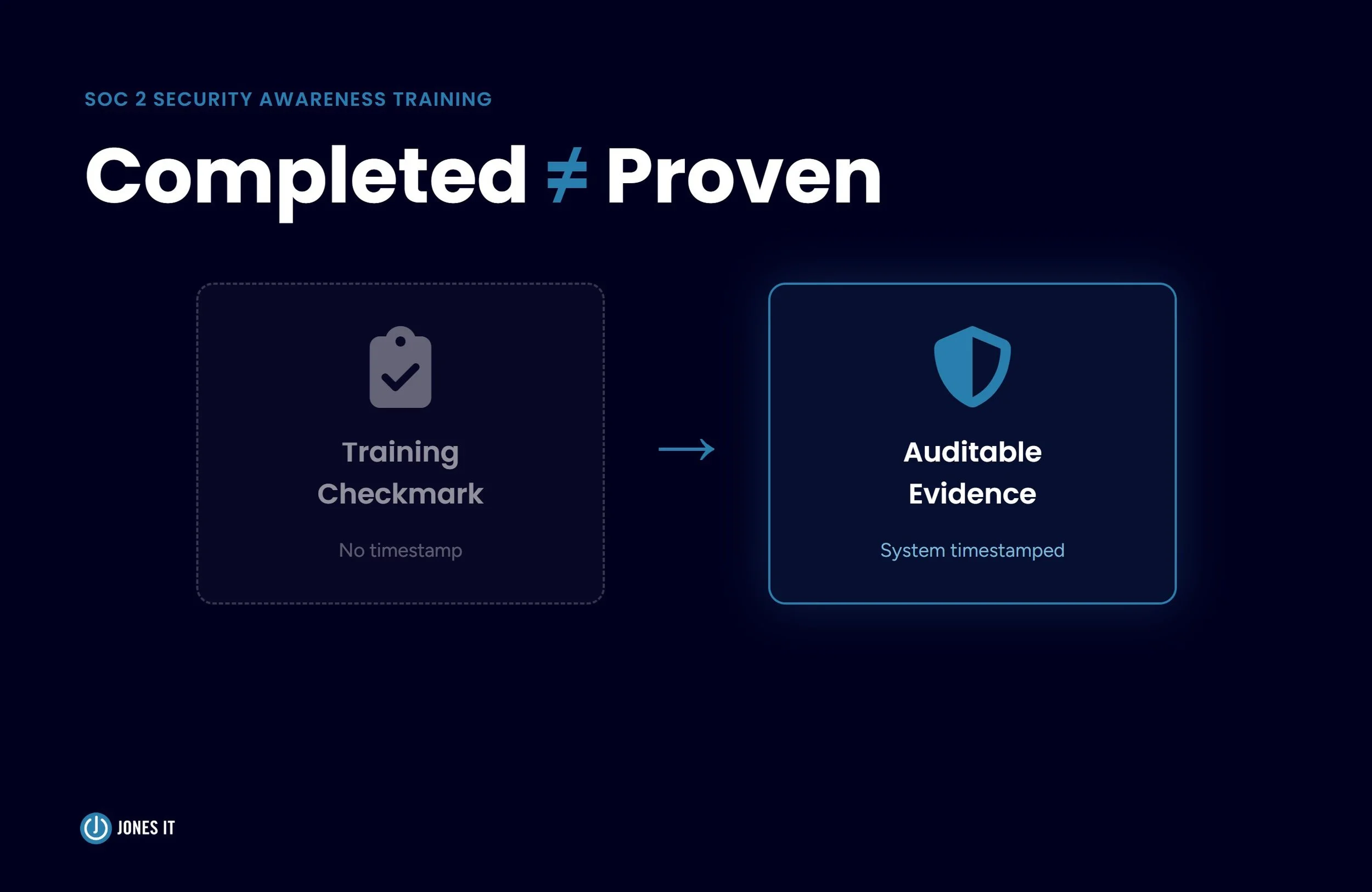
The spreadsheet had a checkmark in that row, but didn’t have a timestamp. The ops manager, to her credit, admitted that she’d gone through and checked boxes during audit prep week, relying on memory and a handful of old calendar invites. The training had happened, but the proof that it happened on time, generated as it happened rather than reconstructed weeks later, did not exist.
That gap became a formal exception in the final report. It’s a fixable one, and it’s the kind we help clients close before it ever reaches fieldwork. If your training program still lives in a spreadsheet the way theirs did, it is worth getting ahead of the evidence requirements before your auditor asks. If you are earlier in the process and want the fuller compliance picture, our SOC 2 compliance roadmap for startups walks through what needs to be in place month by month before an observation period starts.
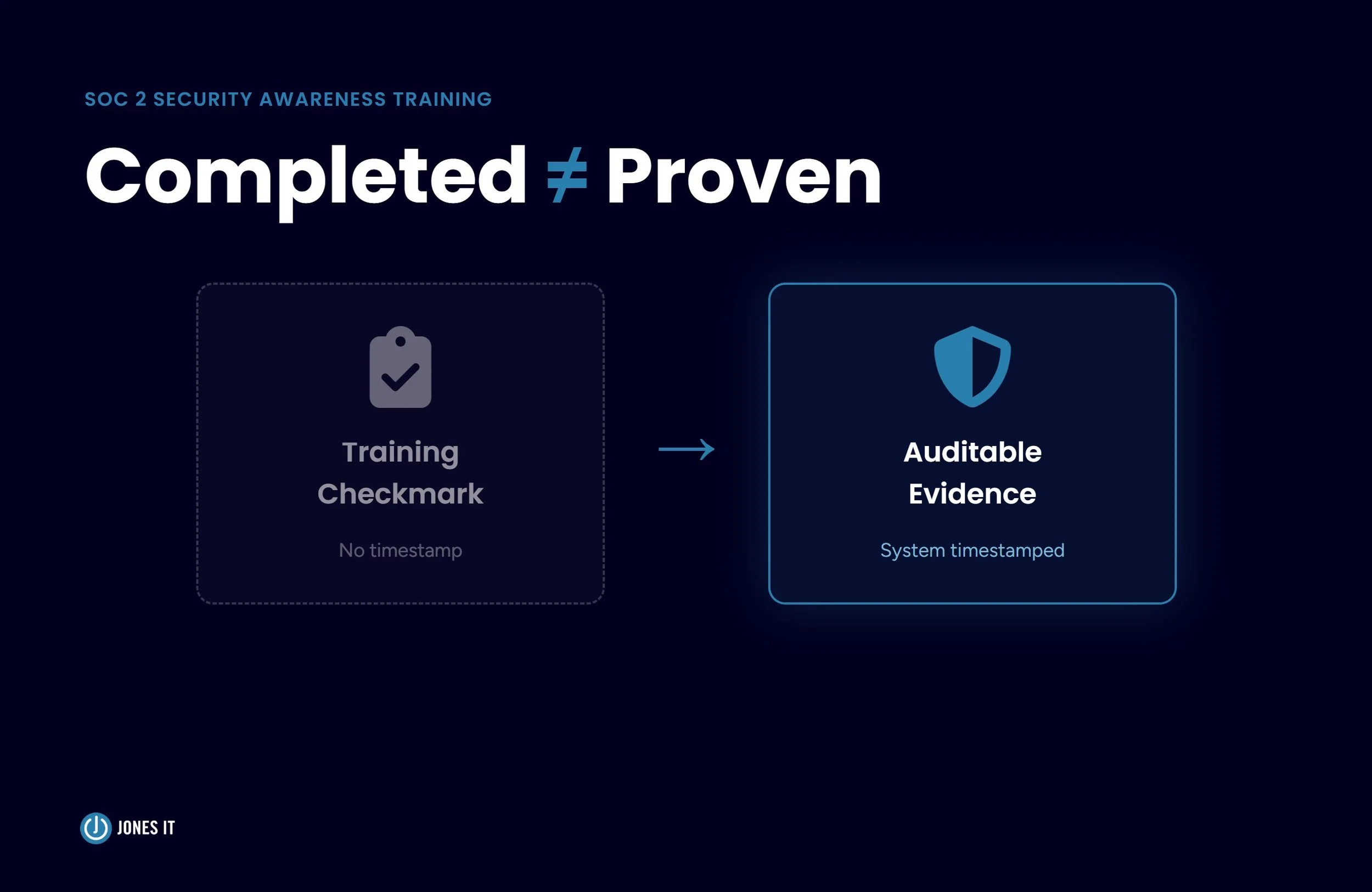
Why “We Did the Training” Isn’t the Same as “We Can Prove It”
A SOC 2 Type II audit is not a single check of whether a control exists. It’s a forensic look at whether that control operated consistently across the entire observation period, and the auditor’s process runs in a specific order, starting with how you’ve written the control objective first, then looking for evidence that matches it. If the evidence doesn’t explicitly support the language you wrote, the control fails, even when the underlying activity (people getting trained) actually happened.
SOC 2’s Trust Services Criteria address this under the Common Criteria series, specifically CC1.4 and CC2.2. CC1.4 requires the organization to demonstrate a commitment to developing competent personnel, which in practice means training that builds the skills employees need to meet their security responsibilities. CC2.2 covers internal communication of security information, including how incidents get reported. In plain terms, CC1.4 asks whether people were trained, and CC2.2 asks whether they know what to do with what they learned. Auditors treat the two as connected: a training program is both a control in its own right and the evidence base for showing the company communicated what it claims to have communicated.
What auditors are really asking for is a “living, auditable map,” a clear line from a written control to the specific record that proves it happened, for a specific person, on a specific date. A spreadsheet filled in after the fact isn’t a map. It’s a narrative reconstructed to match a question, and auditors are trained to spot the difference.
I keep coming back to how avoidable this exception was. Nobody at that company skipped training or lied about completing it. They just never treated the paper trail as its own deliverable, separate from the training itself, and that’s the exact distinction the control is testing.
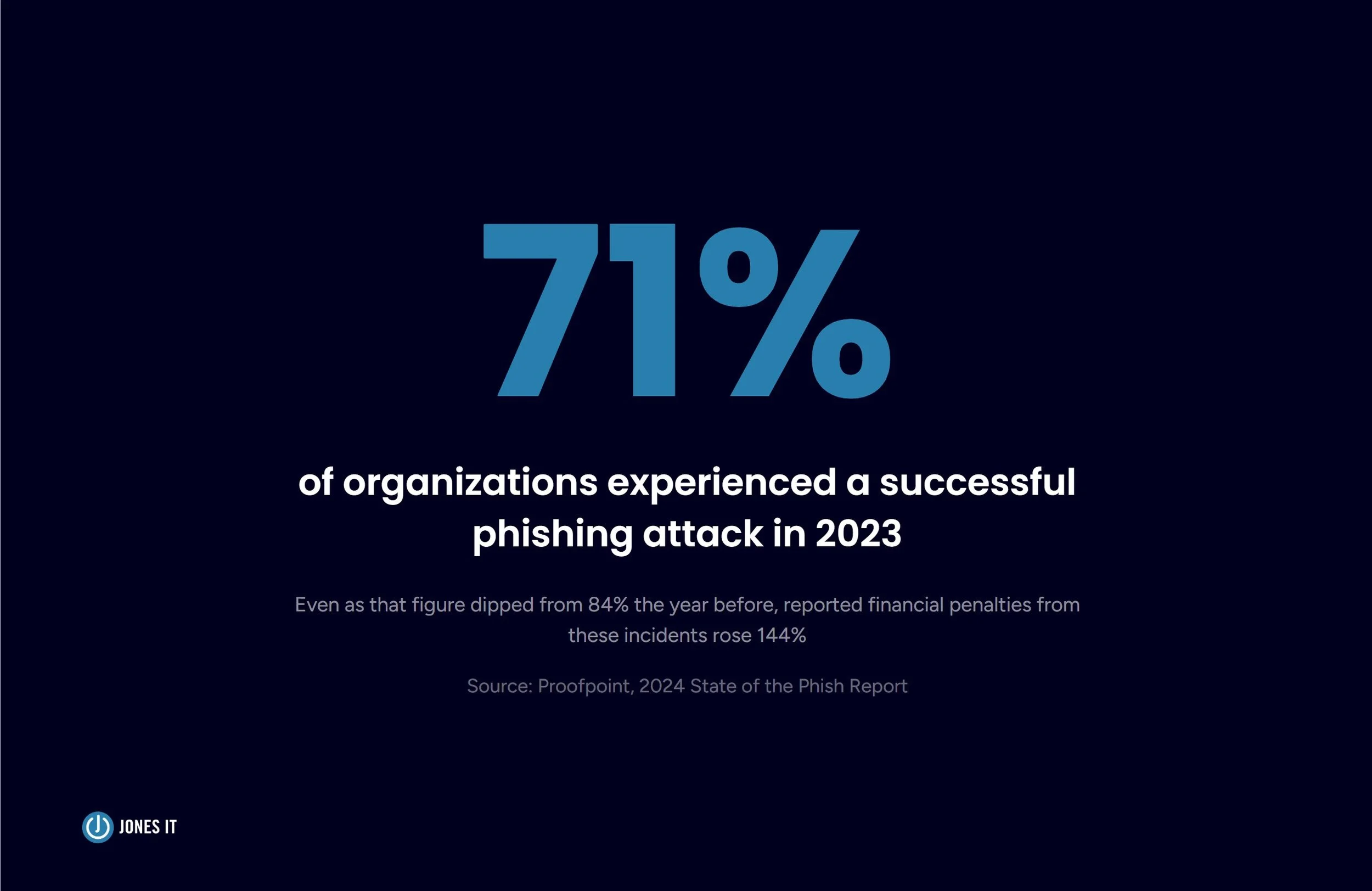
This isn't just about checkboxes. Proofpoint’s 2024 State of the Phish report found that 71% of organizations experienced at least one successful phishing attack in 2023. That figure actually ticked down slightly from 84% the year before, but reports of financial penalties tied to those incidents jumped 144%, and reputational damage complaints rose 50%, drawn from telemetry across more than 230,000 organizations worldwide. Training your people matters. Proving you trained them, on schedule, in a form an auditor can trust, matters just as much.
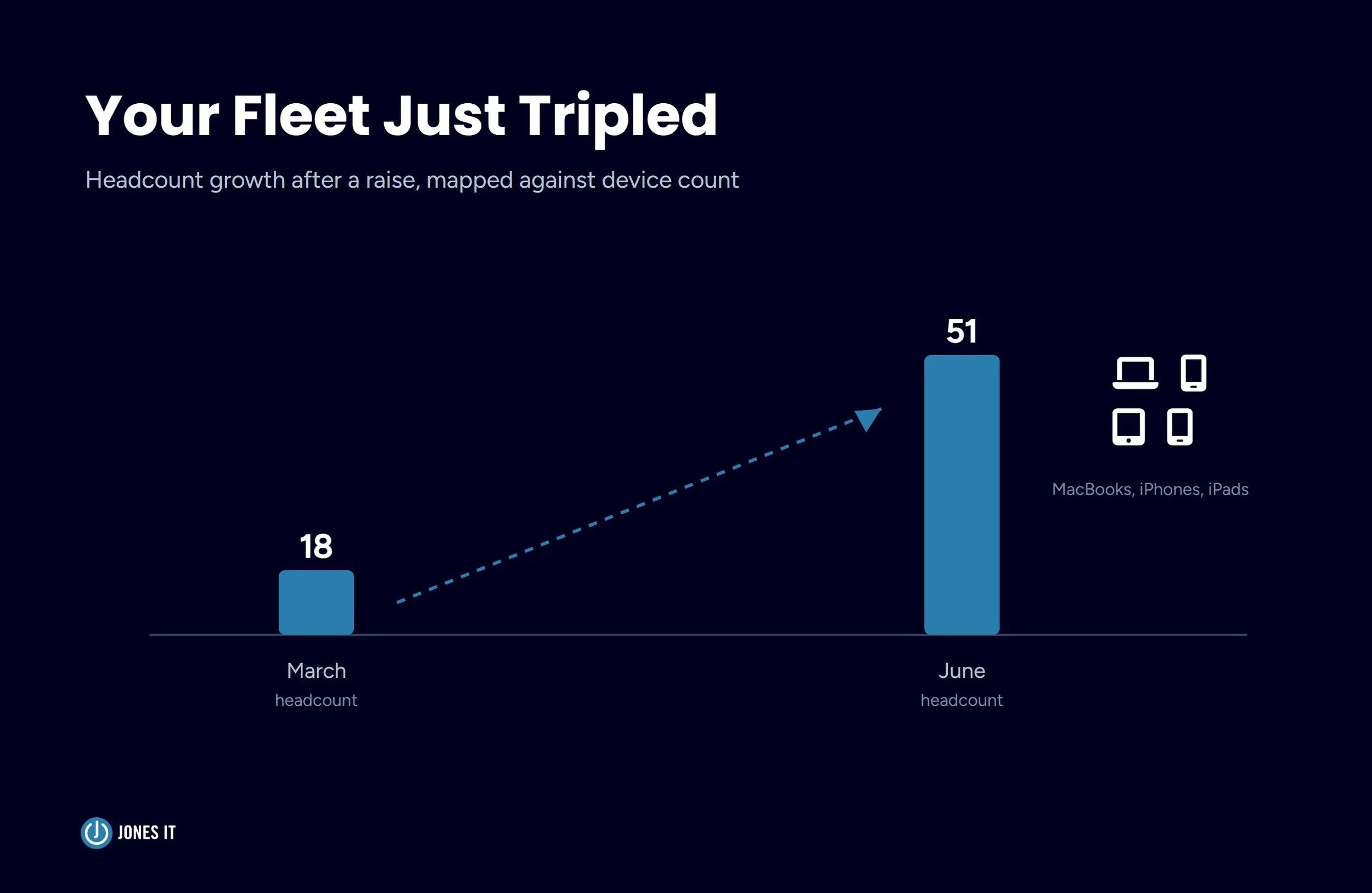
This is the human half of the same control family. Auditors expect the device and network layer locked down too, and if your fleet has grown the way headcount usually does at this stage, our post on SOC 2 device access controls for your Apple fleet covers the other half, which includes certificates, segmentation, and the MDM evidence auditors expect to see there.
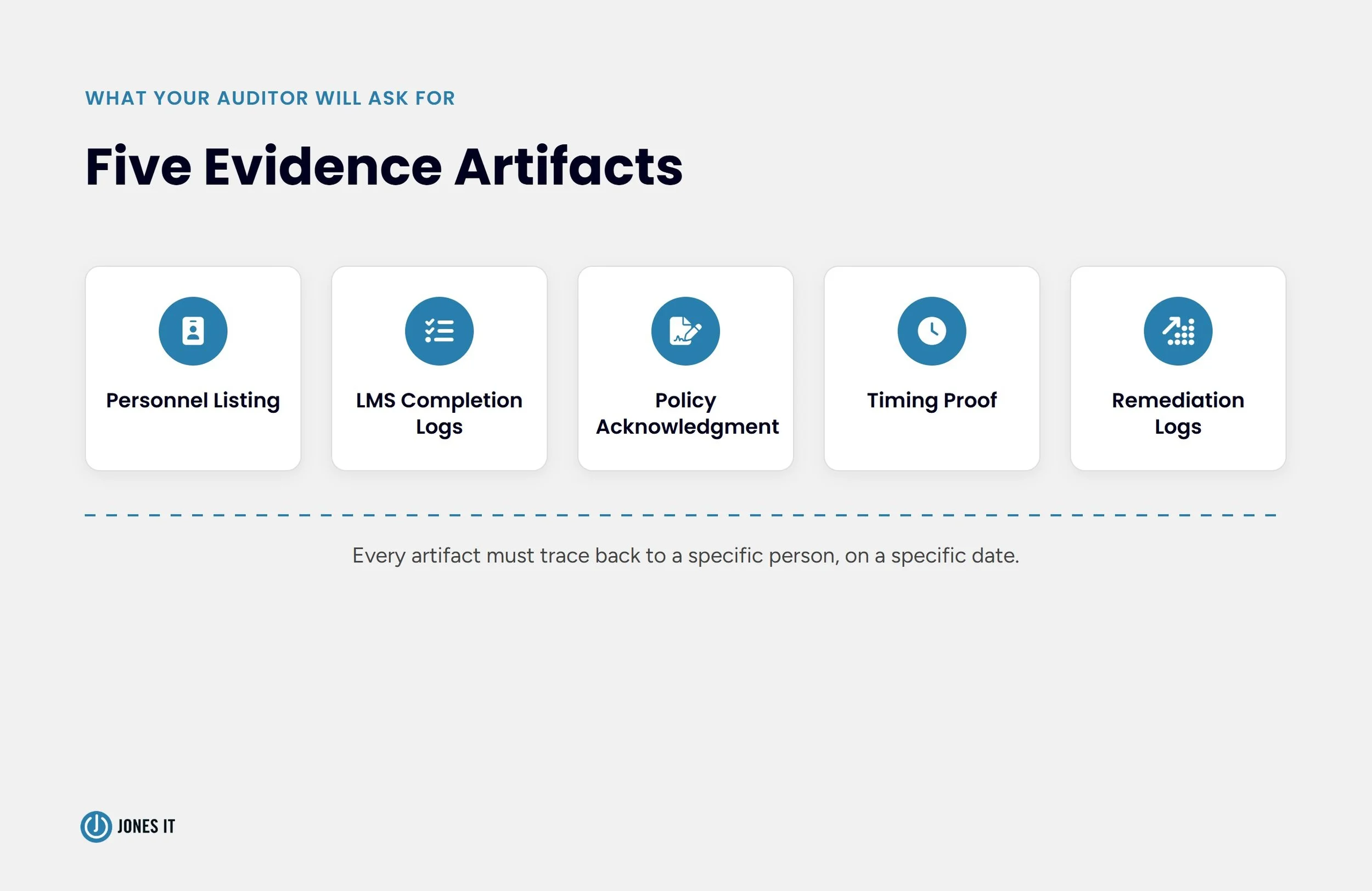
The Five Artifacts Your Auditor Will Actually Ask For
If you’re staring at a blank audit request list, it helps to know exactly what the auditor is chasing. They aren't grading your curriculum but auditing your record-keeping. To move from “we think we're compliant” to “we can prove it”, you need to have the following five artifacts ready to go; each one structured so there is no ambiguity about who did what, or when they did it.
Active personnel listing. Pulled directly from your HR system, not maintained by hand, showing the full population (including leavers) of staff, contractors, and executives who need training.
LMS completion logs. A structured export from your learning management system (LMS), not a summary, showing user names, the specific modules assigned, and precise start and end timestamps for each one.
Policy acknowledgment records. A digital signature linking a specific employee to the exact version of the security policy they accepted, not a generic “policy accepted” checkbox.
Timing configuration proof. System-generated evidence that new hires completed training within the required window, tied to the start date in your HR system rather than to memory.
Remediation logs. A documented record of what happened when someone didn’t complete training on time, including who escalated it and how it was resolved.
Where the Paper Trail Usually Breaks SOC 2 Compliance Training
The most common failure point is exactly what tripped up the startup from this post’s opening story: a manually maintained tracker with no system-generated timestamp. A checkbox tells you that something was marked complete. It doesn’t tell you when, and it definitely doesn’t tell you whether that mark was made in real time or reconstructed the week before fieldwork.
We ran into a version of this ourselves during our own SOC 2 Type II process. Learning from the experience of closing that gap in our own program is the reason why we push clients toward automated evidence collection now instead of a spreadsheet.
The second break is the missing link between HR and the LMS. Training completion has to be traceable to a specific start date, and if those two systems don’t talk to each other, someone ends up cross-referencing two spreadsheets by hand during audit prep, which is precisely the reconstruction problem auditors are trained to catch.
The third is an unversioned policy acknowledgment. If your security policy changed in March and an employee signed off in January, you need a record showing which version they actually accepted. Most teams don’t version their policy sign-offs at all, which leaves no way to answer that question either way.
The last, which teams forget entirely, is what happened to the person who didn’t finish on time. Auditors do not expect perfect completion rates. But they do expect a documented process for handling exceptions, and a company with zero remediation records for a 50-person team is often more suspicious than one with a few, because it suggests that probably nobody was actually checking.
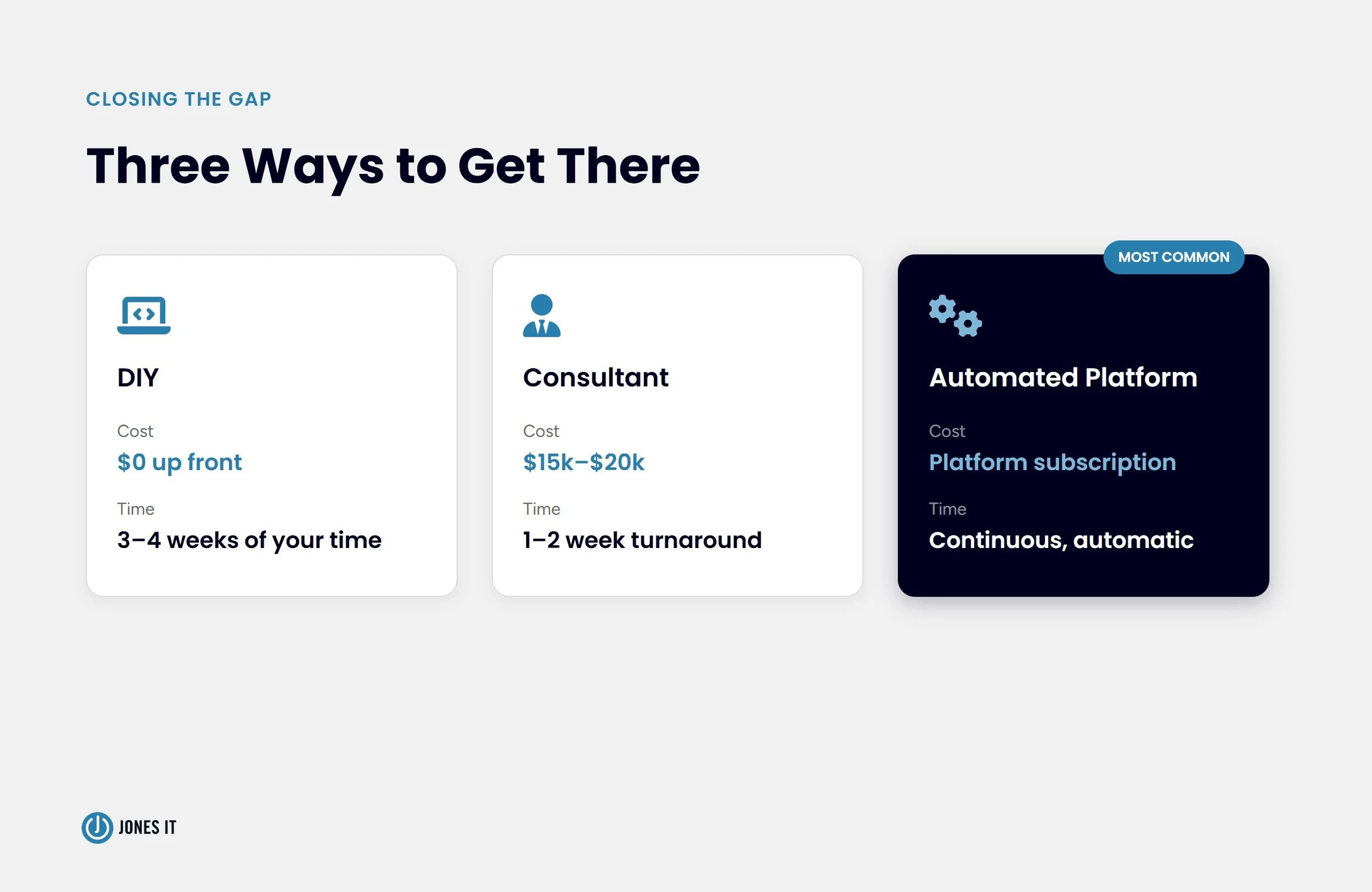
Three Ways to Close the Compliance Training Gap
The 'spreadsheet method' is a guaranteed source of audit friction, but the right way to fix it depends entirely on your current headcount and budget. Whether you’re building this from scratch or looking to replace a manual, error-prone process with something robust, you generally have three paths forward. Here is how they stack up against the realities of a SOC 2 audit.
The DIY Route
Stitching together free courses and a manually maintained tracker costs nothing up front, but it carries a real-time cost. Figuring out what to cover, building a tracking system, and keeping it current typically eats three to four weeks of someone’s attention, and that’s before solving the timestamp and versioning problems we touched upon in the previous sections. For a small, pre-Series-A team without an auditor asking questions yet, this is survivable for a cycle or two. Past that, the opportunity cost of the lost time usually outweighs what a paid solution would have cost.
The Consultant Route
Bringing in a security educator to build a tailored curriculum is fast, usually a one to two week turnaround, but it isn’t cheap. Programs like this typically run in the $15,000 to $20,000 range for a curriculum built around your specific policies and risk profile. You still own the evidence collection unless the consultant also sets up the tracking infrastructure, which is worth confirming before you sign anything.
The Automated Platform Route
Pairing a training vendor like KnowBe4 with a GRC platform (governance, risk, and compliance software) like Drata or Vanta is the option that actually solves the problem encountered at the beginning of this post. Completions, timestamps, and policy acknowledgments get logged and mapped to the relevant Trust Services Criteria automatically, in real time, as they happen. For a growing team, this is usually the difference between an evidence request that takes an afternoon and one that turns into a week of spreadsheet archaeology, and it’s the route we point most clients toward once they’re past a dozen or so employees.
If your team is already running one of these GRC platforms for other parts of your compliance stack, extending it to cover training is usually easier than you might expect. We’ve written about the broader SOC 2 tool stack if you’re still deciding what to invest in first.
Training That Doesn’t Stop at the Renewal Date
Closing the evidence gap solves the audit problem, but it’s worth asking a second question: whether the training itself is any good? Auditors increasingly look for a program treated as ongoing rather than an annual event, with periodic phishing simulations and drills that keep the material top of mind throughout the observation period, along with remedial trainings assigned for those that fail tests.
Engineering teams need a different track entirely. General phishing and password awareness don’t cover secure coding practices or a Secure SDLC (Software Development Life Cycle), and if your technical staff is only getting the same module as sales and support, that’s a gap worth closing separately.
None of this requires turning training into a chore that employees dread. A few of the more effective programs we’ve seen use leaderboards or small rewards for people who consistently flag phishing simulations, which does more for a security culture than a mandatory annual click-through ever will.
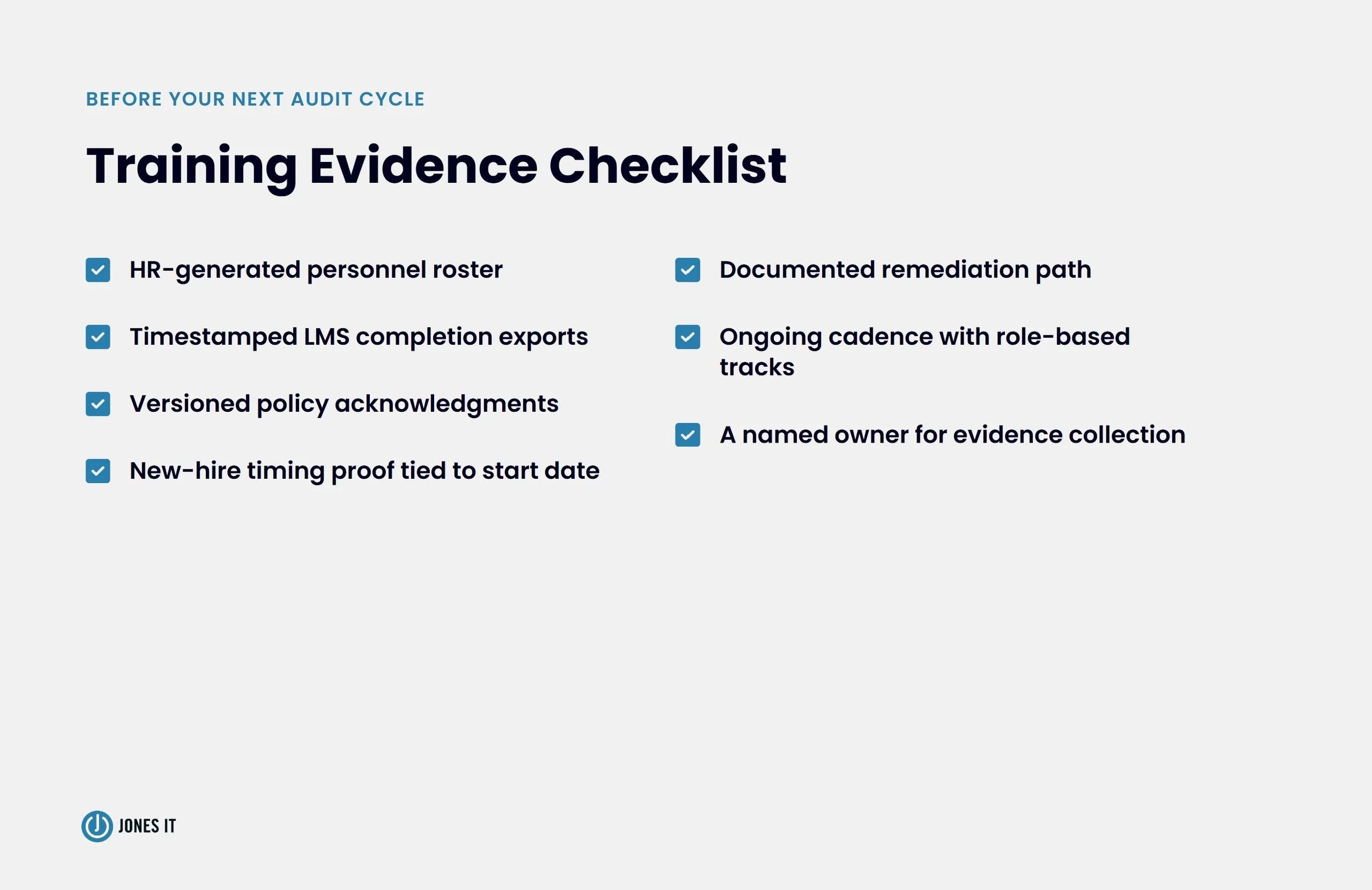
SOC 2 Security Awareness Training Evidence Checklist
Before your next audit cycle, confirm the following:
Your personnel roster is generated from HR, not maintained in a separate manual list.
Your LMS produces an export with user, module, and timestamp data for every completion, and that export can be regenerated on demand rather than assembled by hand.
Policy acknowledgments are tied to a specific, dated version of the policy.
New-hire completions are timestamped against the HR start date, not tracked by memory.
A documented remediation process exists, with a clear escalation point for anyone who misses the training window.
Training runs on an ongoing cadence, with role-based tracks for technical staff.
Someone owns this evidence collection as a defined responsibility, not a side task picked up during audit prep.
The Bar Worth Setting
Back to the engineer who started on May 12th. The problem was never that the company didn’t care about security. It’s just that “we did the training” and “we can prove exactly who completed which training, when, and against which policy” turned out to be two different claims, and only one of them satisfies an auditor. The fix wasn’t more training. It was building the paper trail as a part of the program, instead of an afterthought assembled the week the audit starts.
That’s the bar. Not a perfect completion rate, but a training program you can document and defend the moment someone asks. If your next SOC 2 renewal is on the calendar and your training evidence still lives in a spreadsheet, which someone updates by hand, we can help you close that gap before an auditor finds it.
Reach out to us, and we’ll walk through what your security awareness training program looks like against SOC 2 requirements and what it would take to close any gaps before your next observation period.

EU AI Act compliance applies the moment your AI system's output reaches one EU user, no EU office required. Don't let compliance stall your next deal.