
When founders start researching SOC 2 compliance tools, they usually end up in one of two places. Either they find a vendor's marketing page that makes it sound like they need seventeen different platforms to pass an audit, or they find a bare-bones checklist that dramatically undersells how much infrastructure is actually required.
While the truth lies somewhere in the middle, the answer usually depends on where you are in your compliance journey.
When we went through our own SOC 2 Type 2 compliance process at Jones IT, one of the things that surprised us most was how many tools we were already using that counted toward compliance, and how few genuinely new purchases we actually needed to make. We've seen the same pattern with the startups we've helped since. The question isn't usually "which tools do I need?" It's "which tools do I need right now, and which can wait?"
This post is our attempt to answer that question clearly, drawing directly from what we implemented ourselves and what we've seen work for Series A startups navigating the same path.
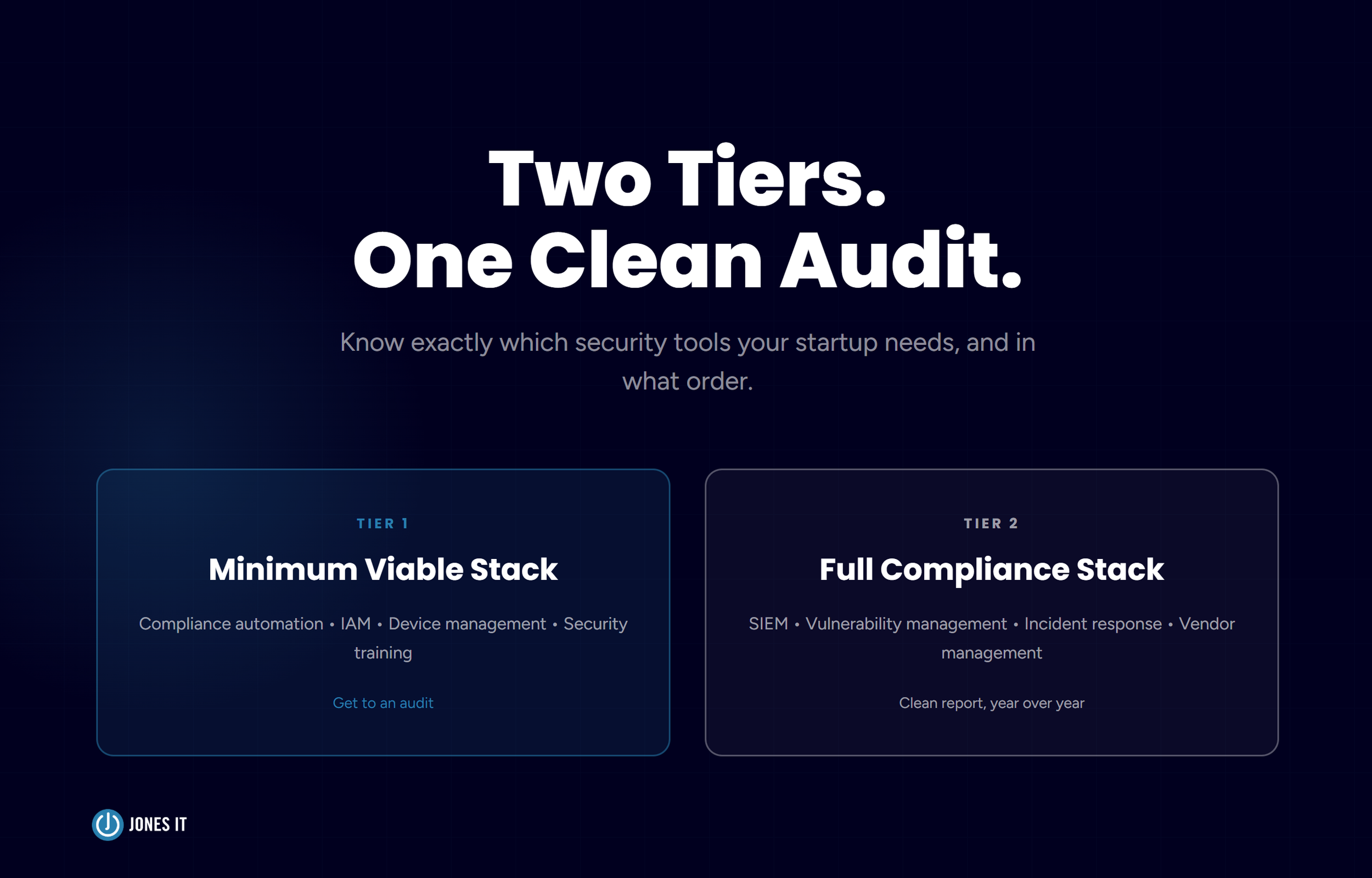
SOC 2 compliance tools generally fall into two tiers: a minimum viable stack you need to be fully operational before your observation period begins, and a full stack that produces a clean report and keeps compliance sustainable year over year. This post covers both in sequence.
Why SOC 2 Compliance Automation Is Non-Negotiable
Before we get into minimum viable vs. full stack, one thing needs to be said plainly: you cannot run a SOC 2 compliance program manually and expect it to succeed.
Manual SOC 2 means someone on your team taking screenshots of log outputs, building spreadsheets to track access reviews, emailing employees to confirm training completion, and hoping nothing slips through the cracks across a 3-to-6-month observation period. We tried elements of this ourselves early on and learned quickly how brittle it is. One missed screenshot, one broken spreadsheet, one integration that silently stopped working, and you have an evidence gap that your auditor will find.
The solution is a compliance automation platform, and it's the only tool category we'd describe as truly mandatory before anything else. In our own compliance journey, we used both Vanta and Drata at different points, and both were indispensable. These platforms integrate with your cloud infrastructure, identity systems, code repositories, and security tools to collect evidence continuously in the background. They map your controls to SOC 2 requirements, flag gaps in real time, and give your auditor a structured view of everything they need to review.
Budget $12,000-$40,000 per year for this, and treat it as a prerequisite rather than a line item to negotiate away. The time savings alone (in our experience, these tools dramatically reduced the effort required for audit preparation) justify the cost well before the audit itself.
Everything else in this post is layered on top of that foundation.
The Minimum Viable SOC 2 Compliance Tools Stack
If you're in the early stages of your compliance program and need to get to an audit-ready state as efficiently as possible, here's what is truly essential.
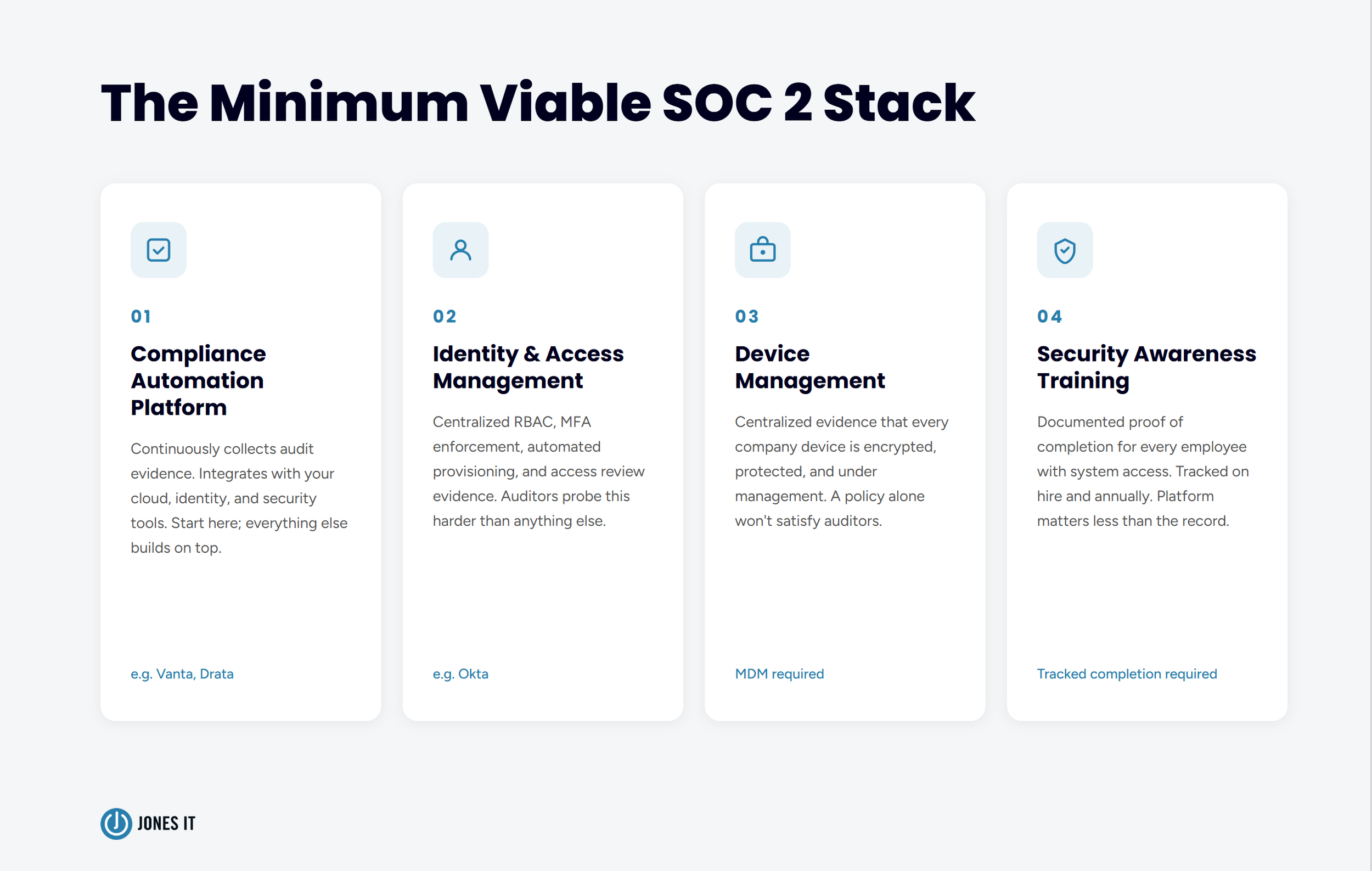
Compliance automation platform
A compliance automation platform like Drata or Vanta centralizes fragmented evidence into a single source of truth, allowing organizations to proactively manage risks and ensure regulatory compliance with greater efficiency. By replacing manual spreadsheets with automated workflows, these platforms provide real-time visibility into potential compliance violations such as cloud misconfigurations, missed offboarding SLAs, and whether personnel responsibilities (e.g., policy acknowledgement, training, background checks) are properly met.
Identity and access management
SOC 2's access control requirements are among the most thoroughly tested by auditors. You need a centralized system for managing who has access to what, enforcing MFA without exception, and producing evidence of quarterly access reviews. We implemented Okta for this, and it addressed more SOC 2 requirements in a single tool than almost anything else we bought: centralized RBAC, automated provisioning and deprovisioning, detailed activity logs, and seamless integration with our compliance platform. For most startups, Okta or a comparable IAM solution is the second purchase after your compliance platform.
Device management
Auditors need to see that every company-issued device is encrypted, running endpoint protection, and under centralized management. "Everyone's got FileVault turned on" doesn't satisfy this; you need centralized evidence of enforcement, not a policy that relies on individual employees. This doesn't have to be expensive or complex, but it does need to be in place before your observation period begins.
Security awareness training with tracked completion
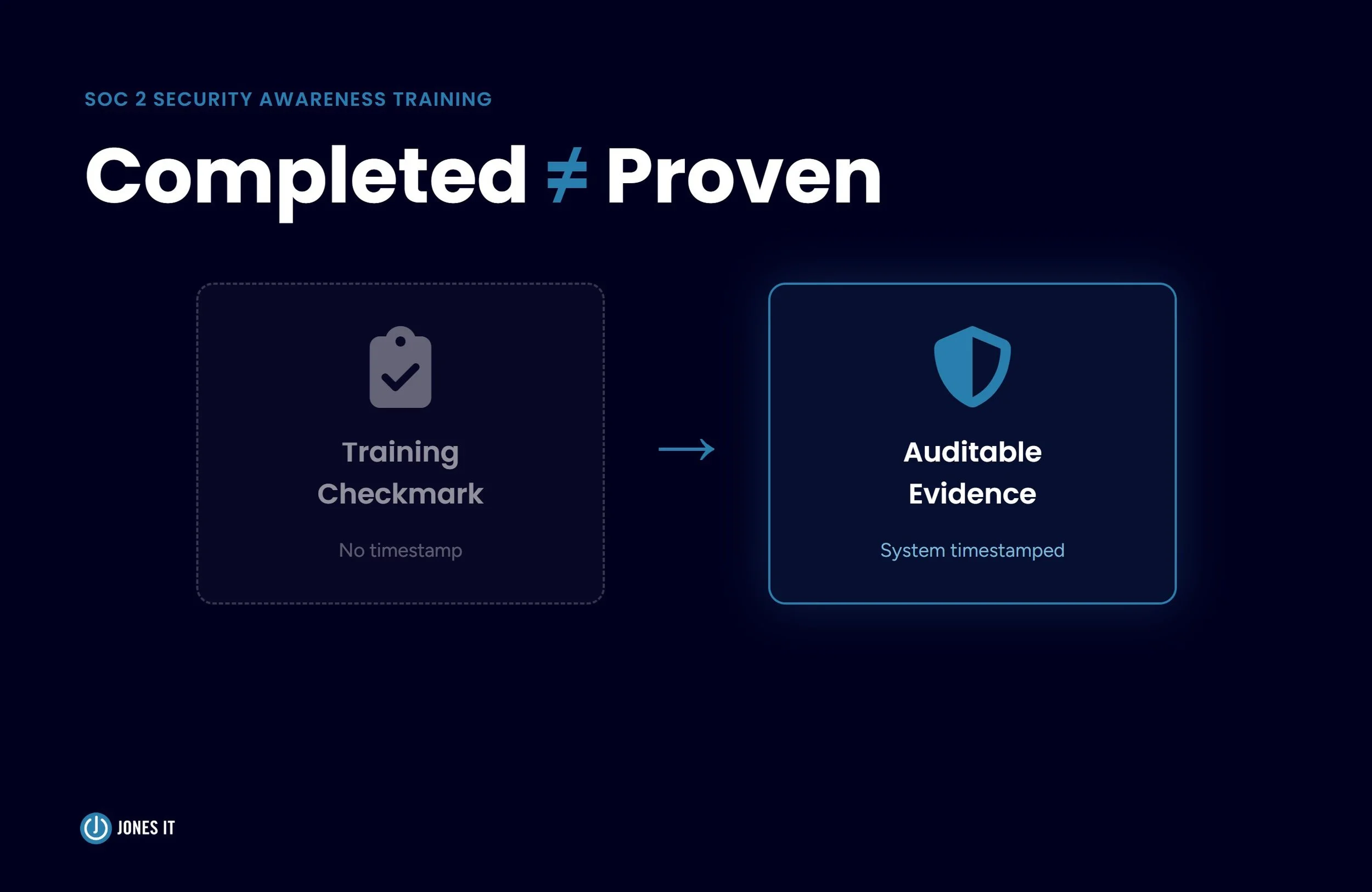
SOC 2 requires documented proof that all employees with access to in-scope systems have completed security training. The specific platform matters less than the tracking. What auditors want to see is a completion record tied to each employee, showing they completed training upon hire and annually thereafter.
That's the minimum viable stack. Compliance automation platform, IAM, device management, and training tracking. If you have all four in place and operating before your observation period starts, you can get to an audit.
The Full SOC 2 Software Stack: What to Add Next
The minimum viable stack gets you through the door, but the full stack is what gives you a clean report, a defensible security posture, and the operational infrastructure to maintain compliance year over year without heroic effort at renewal time.
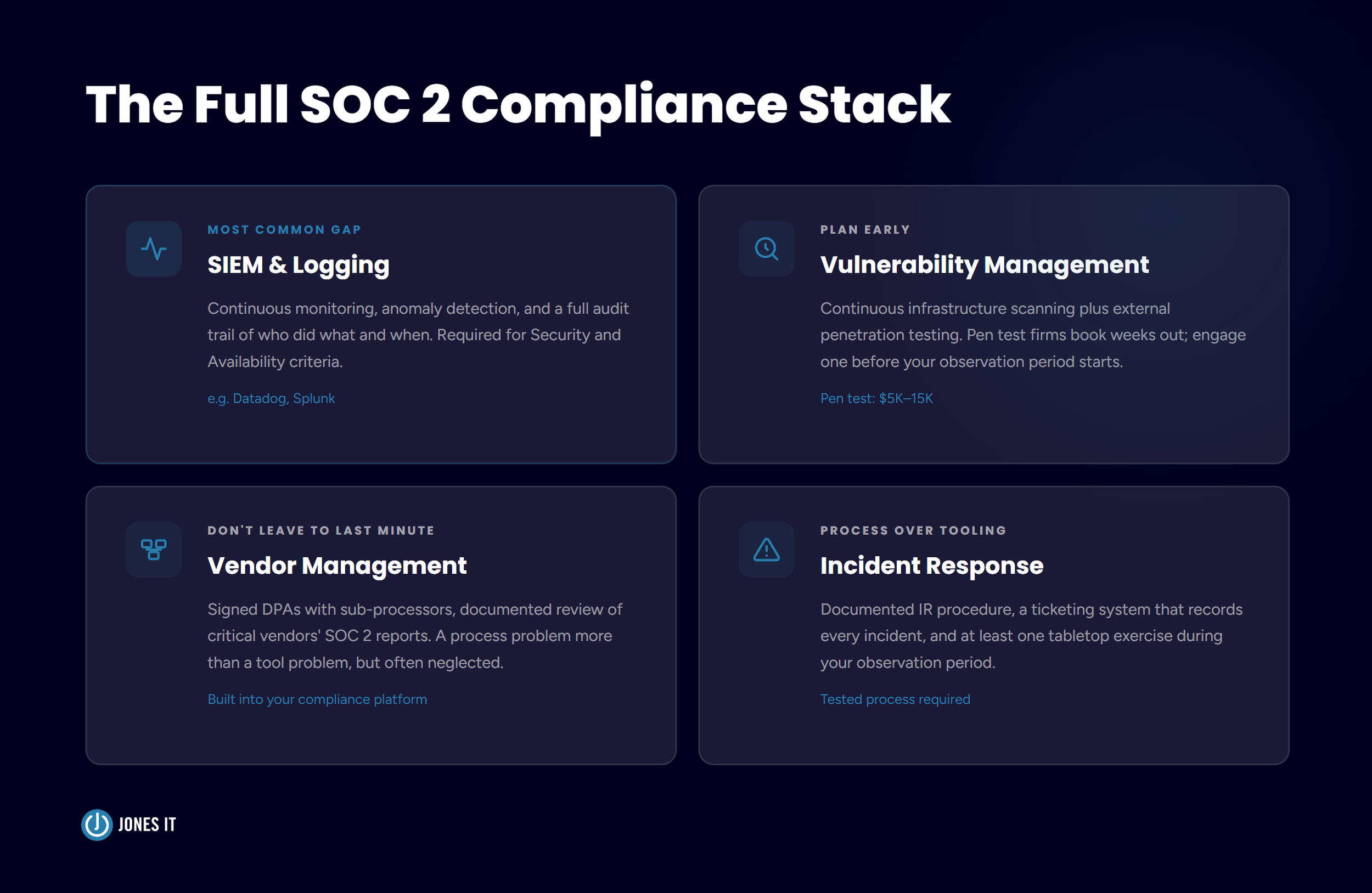
SIEM and logging
SIEM and logging are the most common gaps we see in startups that tried to get by on the minimum viable stack. SOC 2's Security and Availability criteria require you to demonstrate continuous monitoring of your environment: that you're collecting logs, that someone is watching for anomalies, and that you have an audit trail of who did what and when.
We used Splunk and Datadog in our own program; both are strong choices for this, though Datadog tends to be the more natural fit for cloud-native startup environments given how well it integrates with AWS, GCP, and Azure infrastructure. Without something in this category, an auditor will certainly identify this absence as a major compliance gap.
Vulnerability management
SOC 2 requires you to demonstrate that you're actively identifying and remediating security weaknesses in your environment. SOC 2 vulnerability management breaks down into two activities. Continuous scanning, i.e., running automated checks against your infrastructure and code dependencies on an ongoing basis, is the baseline.
We typically recommend working with a platform like Aikido as they consolidate scanning for your cloud environments and codebase into one space, reducing noise and ensuring engineering resources are dedicated to the most severe issues. External penetration testing is also required by most auditors for the Security criteria, and it's the one that catches startups off guard on timing: good pen test firms book weeks out, the engagement itself takes time, and the report takes additional time after that.
If you're planning to start your observation period and haven't already engaged a pen test firm, do it immediately.
Vendor management documentation
Every third-party vendor that touches your customer data is a sub-processor, and SOC 2 requires you to demonstrate that you've evaluated your supply chain. In practice, this means signed Data Processing Agreements with sub-processors and a documented process for reviewing the SOC 2 reports of your own critical vendors. This is less a "tool" problem than a process problem (your compliance automation platform will have workflow support for it), but it's something that gets neglected until it becomes a last-minute scramble during fieldwork.
Formal incident response infrastructure
Your auditor will want evidence that you have a documented incident response process and that it's been tested. The tooling here is less important than the process: a ticketing system that creates a record for every incident, a documented response procedure, and at least one tabletop exercise completed during your observation period. We saw significant operational benefit from formalizing this, as our average response time to security incidents dropped substantially once we had a structured process rather than ad hoc responses.
SOC 2 Tools You Probably Already Have
One thing that reliably surprises founders during the scoping phase: a lot of what SOC 2 requires, you're probably already doing. You just aren't capturing it as evidence.
If you're using GitHub or GitLab with branch protection rules and required code review approvals, that's your change management control. Your compliance platform will integrate directly and collect pull request data as evidence automatically. If you're on AWS, CloudTrail is already logging API activity; you may just need to ensure it's retained appropriately and feeding into your monitoring stack. If you have a human resource information system (HRIS) that tracks employee onboarding, that's the foundation for your background check and training completion records.
The first thing your compliance automation platform does when you connect your integrations is show you exactly where you stand against the controls that you need to satisfy. That picture is almost always better than founders expect, and more honest than a consultant's gap assessment, because it's based on what's actually running in your environment rather than what your documentation says should be running.
How to Prioritize Your SOC 2 Tool Purchases
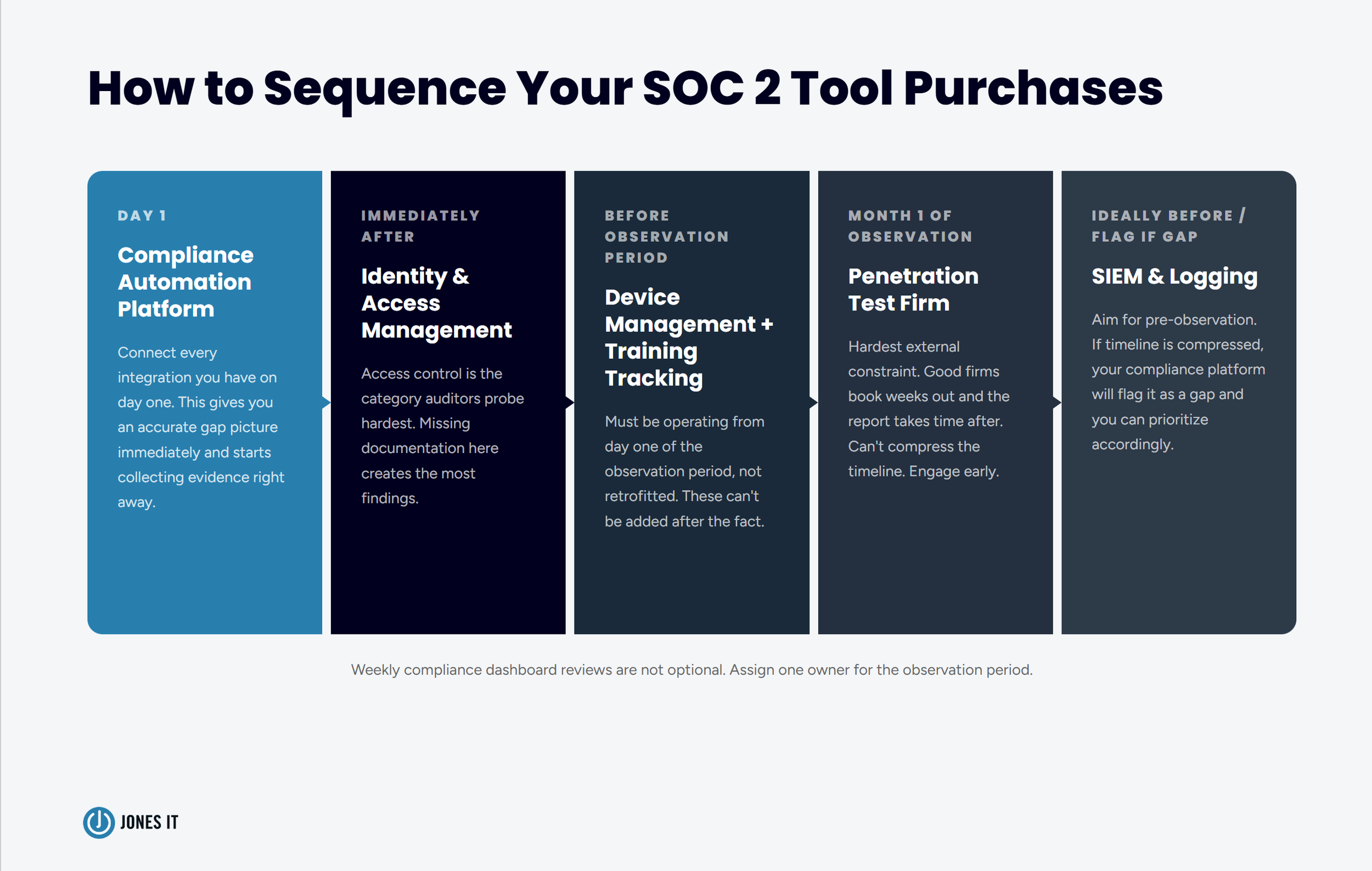
Given all of the above, here's the sequencing we'd recommend for a Series A startup starting from scratch:
Start with your compliance automation platform and connect every integration you have on day one. This gives you an accurate baseline gap picture faster than anything else, and it starts collecting evidence right away.
Immediately after, organize your IAM layer if you don't have one already. Access control is the category auditors probe hardest, and it's the one where missing documentation creates the most findings.
Before your observation period begins, make sure device management is in place, and your security training system can produce completion records. These are the bare minimum requirements that need to be operating from day one of the observation period, not retrofitted afterward.
During the first month of your observation period, engage your pen test firm. This is the one that has the hardest external constraint since you can't compress the timeline by being organized, as it depends on a third party's schedule and process.
The SIEM and logging layer should ideally be in place before the observation period starts, but if you're working with a compressed timeline, your compliance platform will flag it as a gap, and you can prioritize accordingly.
The SOC 2 Tool Mistake That Derails Compliance Programs
After going through this ourselves and helping dozens of startups through it, we’ve noticed that the single most common failure mode isn't missing the right tools. It's letting integrations break silently during the observation period.
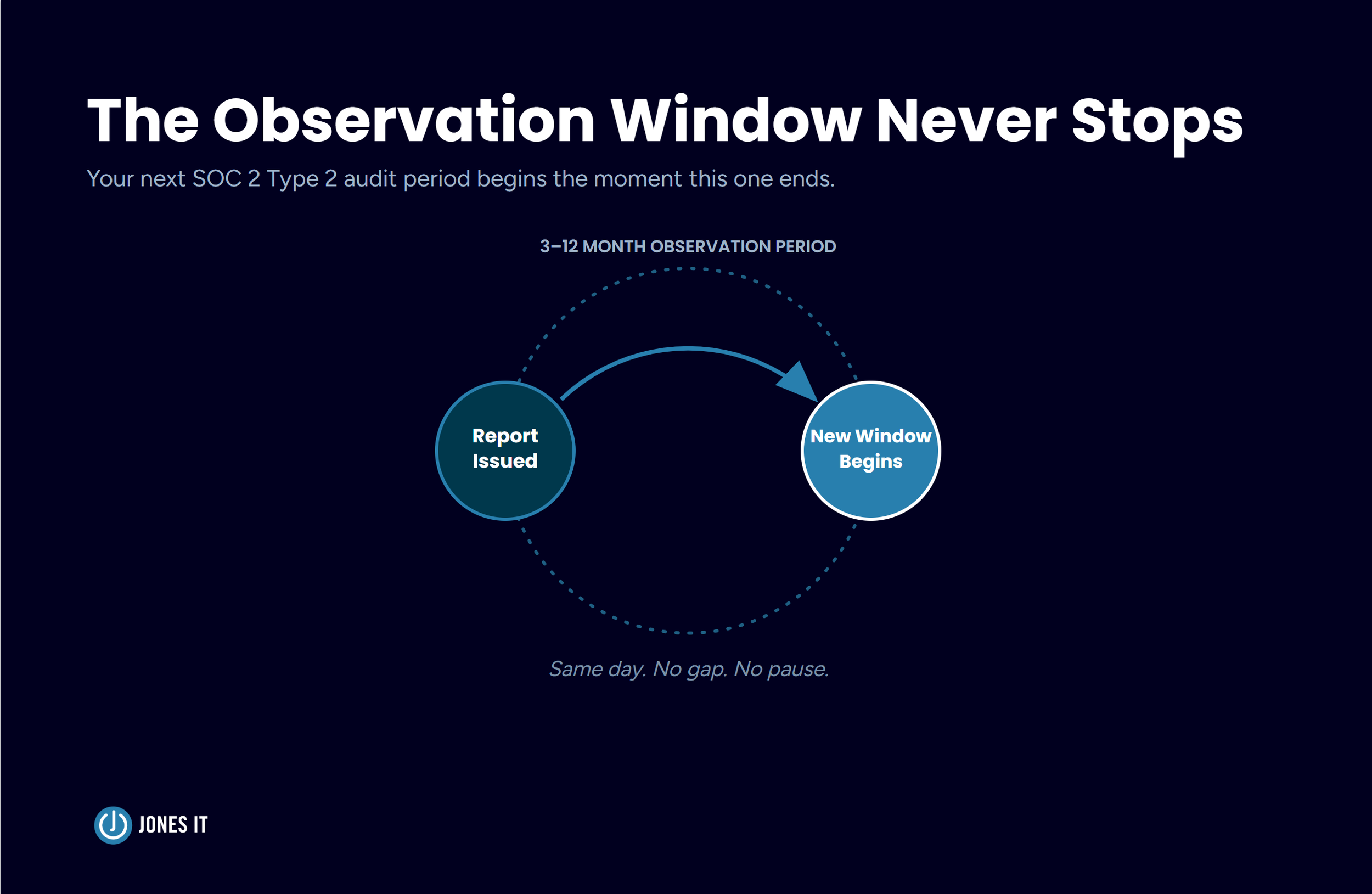
Your compliance automation platform integrations can and, occasionally, do fail: API credentials expire, integration updates break connections, and monitoring agents stop running. If nobody checks the dashboard and three months of evidence go uncollected, you may need to restart your observation period entirely. This can happen even to companies that have the right tools, the right controls, and a solid readiness assessment, who assume that the automation will handle itself.
Weekly dashboard reviews are not optional. Assign one person to own compliance operations during the observation period, and make it a standing agenda item. Although the automation handles the heavy lifting, the oversight remains your responsibility.
How Jones IT Helps Startups Build Their SOC 2 Stack
We built our own compliance program from scratch, used the tools discussed here ourselves, and came out the other side with a SOC 2 Type 2 report and a clearer view of what actually matters. We've since helped dozens of startups navigate the same path; many of them under the kind of time pressure that comes from an enterprise deal that's waiting on a compliance report.
If you're figuring out where to start, trying to decide what to prioritize given your timeline and budget, or trying to understand whether your existing environment will hold up to auditor scrutiny, schedule a consultation with our team. We'll give you an honest read on where you are and what needs to happen next.
Frequently Asked Questions About SOC 2 Compliance Software Stack
Q: We already use some of these tools. Do we need to replace them?
A: Probably not. The key question is whether your existing tools integrate with your compliance automation platform. If Vanta or Drata has a native integration for it, the tool qualifies, and evidence collection is automatic. If there's no integration, you'll be collecting evidence manually for that control, which is a risk worth addressing early.
Q: How much does the full stack cost?
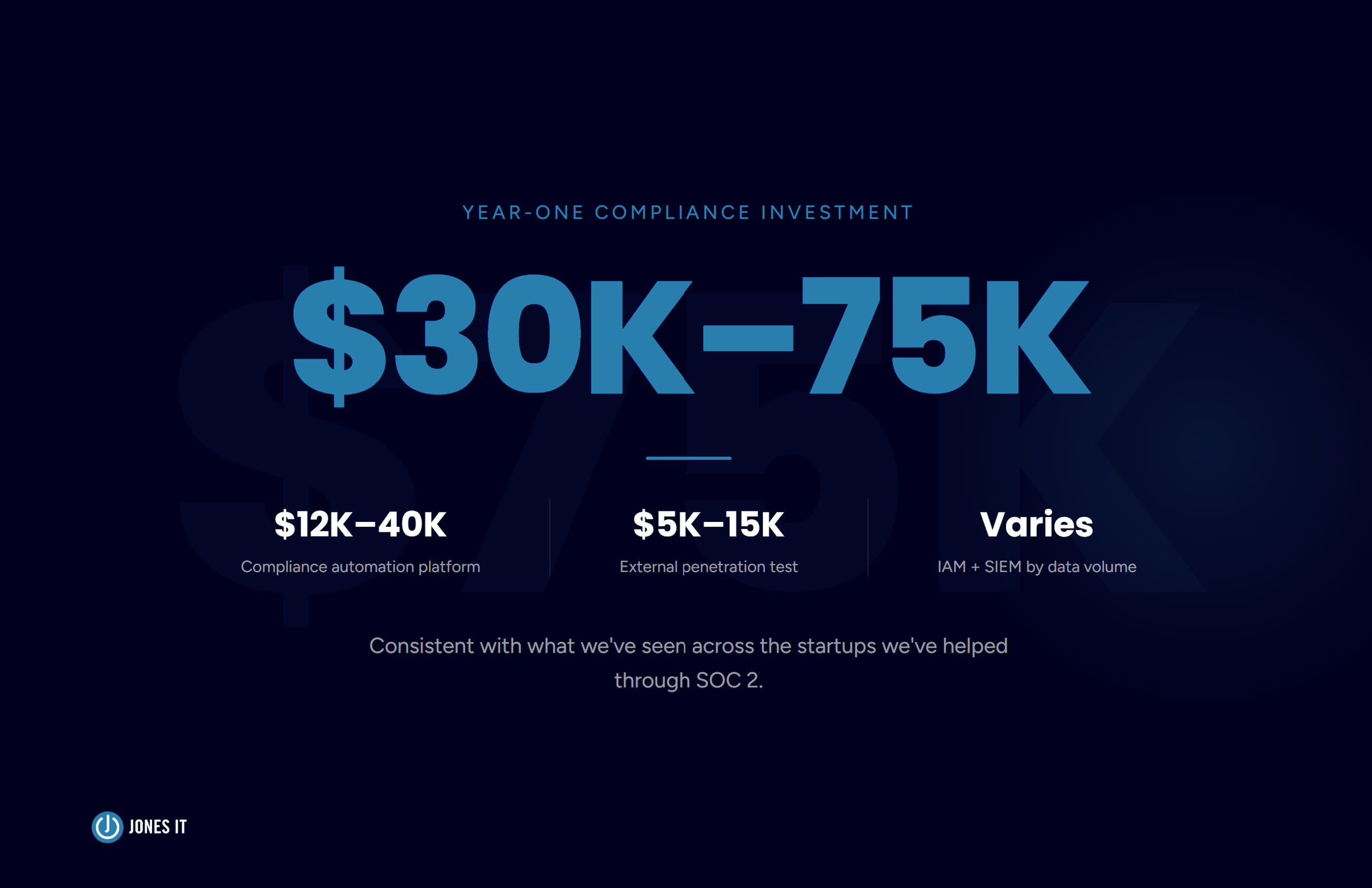
A: The compliance automation platform is typically $12,000-$40,000 per year. Okta for IAM runs $6000-$15000. An external penetration test typically costs $5,000-$15,000. Datadog or Splunk pricing varies significantly by data volume. Budget $30,000-$75,000 in total compliance infrastructure investment for year one on the accelerated path, which is consistent with what we've seen across the startups we've worked with.
Q: Does the specific compliance platform matter, or are they all equivalent?
A: The major platforms: Vanta, Drata, and a handful of others, cover the same core requirements. The meaningful differences are in integration depth, UX, and how well they fit your specific environment. We used both Vanta and Drata at Jones IT and found both genuinely useful. We'd recommend getting demos from both and choosing based on which one maps better to the integrations you actually use.
Q: What if we don't have time to implement the full stack before our observation period?
A: Be honest with your auditor about where you are. A good auditor who works with startups understands that companies come from different starting points. The critical thing is to have your minimum viable stack fully operational before the observation period starts, not to have everything in place on day one. Work with your auditor to confirm which controls need to be running from the start and which can be phased in during the early part of the observation period.
Jones IT is a San Francisco-based Managed IT Services provider with over two decades of experience helping startups and scale-ups build secure, compliant, and efficient technology operations. We are SOC 2 Type 2 compliant and help clients navigate their own compliance journeys.


Learn how to establish an AI tool approval process for startups with this 5-step workflow, vendor review checklist, and data loss prevention controls.