
IT Roadmap for Startups: A 3-Year Plan Your CFO Can Budget Against
A finance lead at a 32-person Series A startup sat down with the IT lead to build next year's budget and found three costs landing in the same two quarters. The laptops bought during one hiring push had all reached their refresh window, the firewall from the office build-out was nearing the end of its supported life, and the SOC 2 audit fee was renewing. Each date had been visible for over a year, but none of them sat on one page beside a price and an owner. That page is an IT roadmap, and its absence is what turns predictable costs into a crisis.
I have seen versions of that budget meeting at enough companies between seed and Series B that I now treat the missing roadmap as a serious problem. Founders tend to assume IT costs are unpredictable by nature, yet most of them are calendar events: for example, warranty expirations, license renewals, vendor end-of-support dates, and audit cycles. If those costs are so foreseeable, why do they keep arriving as surprises? Because nobody has scheduled them, and a cost that is known but unscheduled behaves exactly like a surprise.
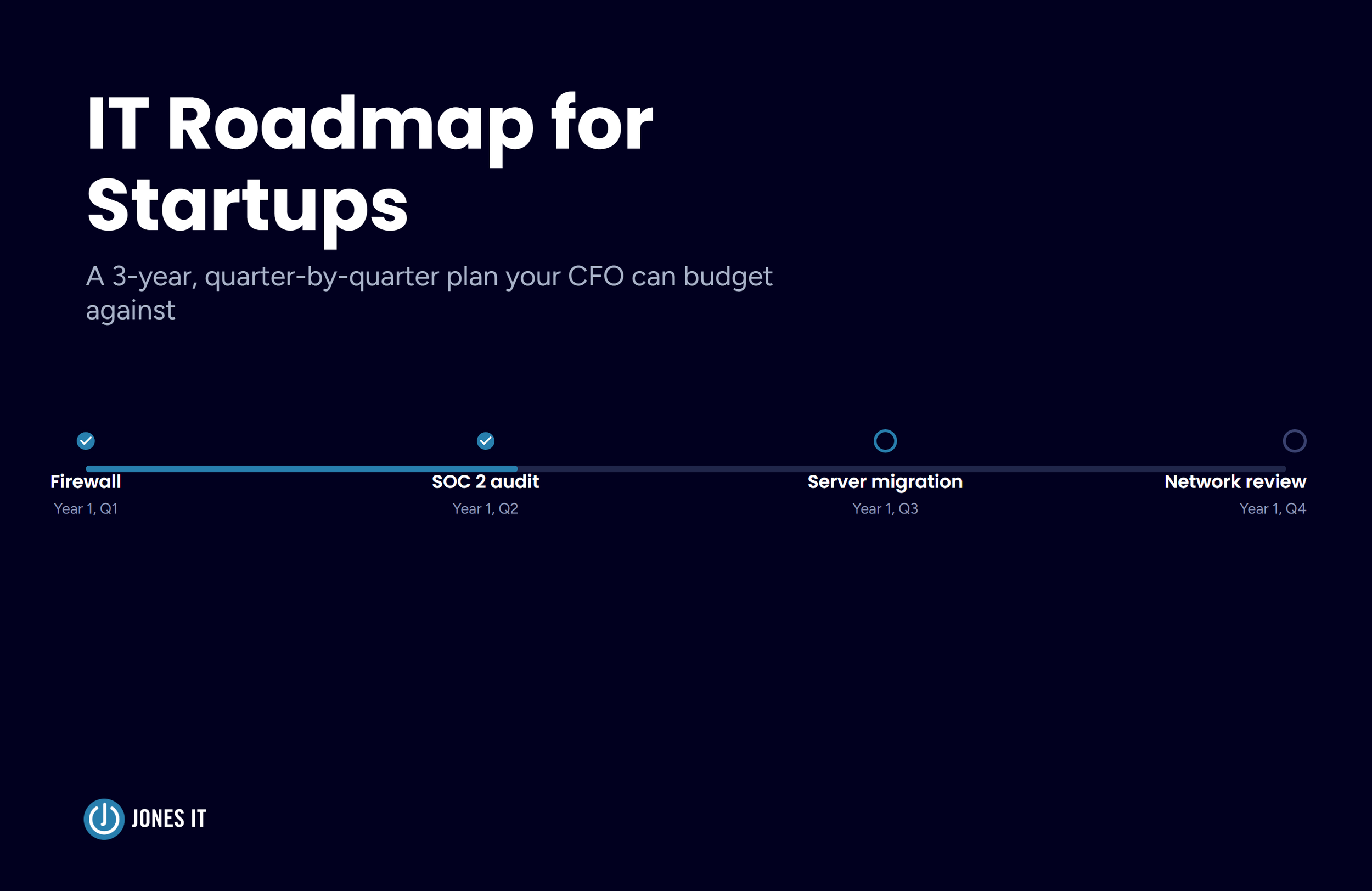
What is an IT Roadmap and what does it mean for Startups
An IT roadmap for startups is a dated, budgeted blueprint detailing a company's planned technology initiatives across a 12-to-36-month horizon. Priorities are driven by business requirements, upcoming technical vulnerabilities, and end-of-support deadlines. Every line in the roadmap carries a reason for being on the list, an owner, a date, and a budget line. A list missing any of those four fields is a wish list, which is what most startups have instead of an actual plan.
The roadmap’s audience is internal and includes your leadership team, your finance lead, and whoever approves spending. A product roadmap tells customers what is coming, while an IT roadmap tells your CFO what is about to reach the checkbook and when. Four kinds of work belong in it:
Lifecycle events: hardware refresh, operating system and server end-of-support dates, and warranty expirations.
Renewals and cancellations: SaaS contracts and managed services agreements, each with its notice window attached.
Compliance milestones: SOC 2 observation periods, audit fees, penetration tests, and policy reviews.
Growth projects: office moves, hiring waves, identity and device management upgrades, and cloud changes.
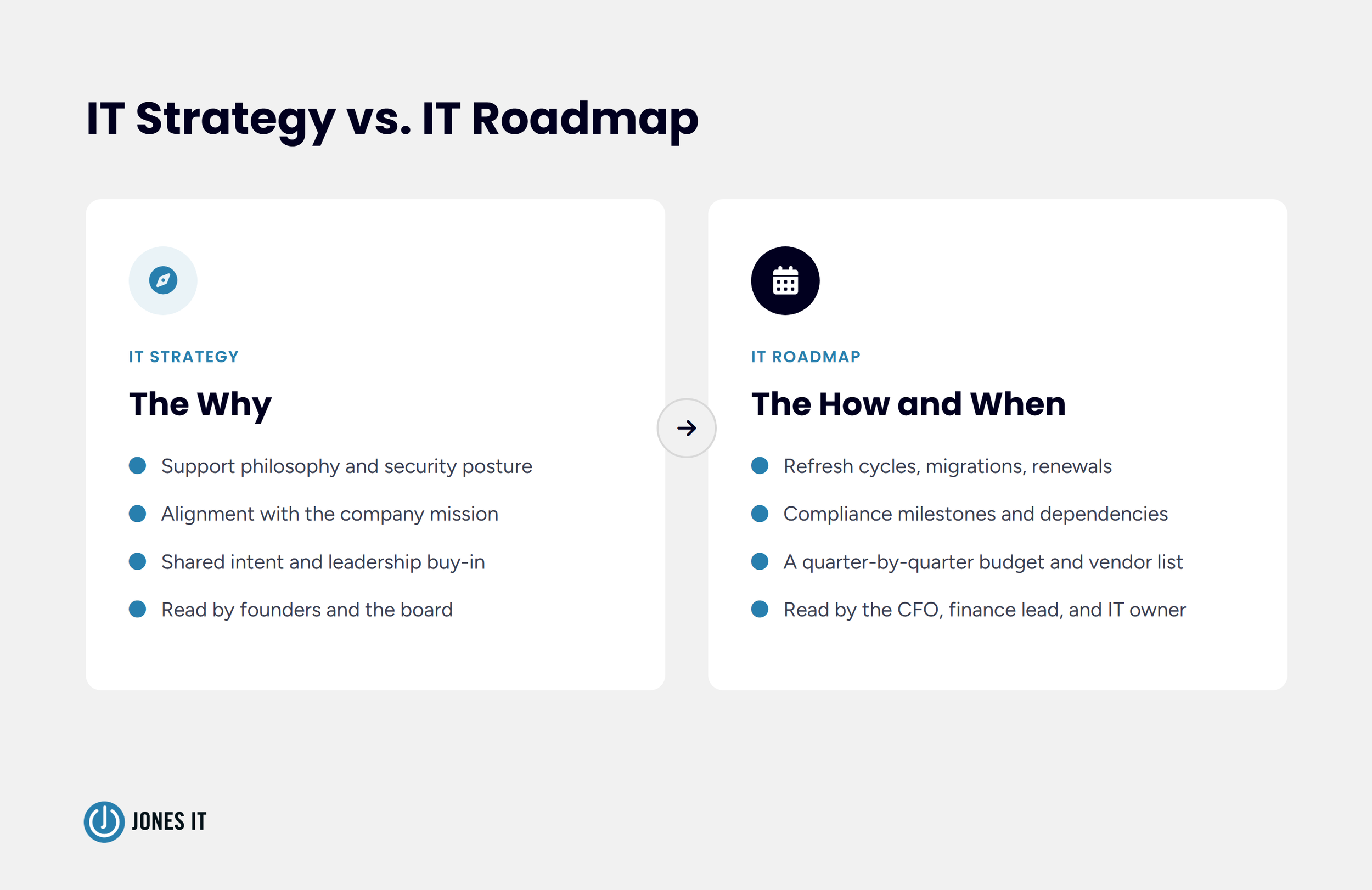
IT Strategy vs. IT Roadmap: Where the Difference Shows Up
IT strategy states why the company invests in technology, while the IT roadmap lays out what gets done, in which quarter, and at what cost. Founders usually hold the strategy part in their heads but have the roadmap nowhere, which implies that the leadership agrees on the direction but no one owns the schedule.
| IT strategy | IT roadmap | |
|---|---|---|
| Question answered | Why does technology matter to this business? | What gets done, in which quarter, at what cost? |
| Contents | Support philosophy, security posture, and alignment with the company mission | Refresh cycles, migrations, renewals, compliance milestones, and project dependencies |
| Output | Shared intent and leadership buy-in | A quarter-by-quarter budget, vendor shortlists, and a project sequence |
| Reader | Founders and the board | The CFO, the finance lead, and the IT owner |
Write the strategy first, deciding how much downtime the business can tolerate, which compliance obligations are coming, and how much of IT you want to run in-house. The roadmap then turns each of those decisions into scheduled, budgeted work.
Three Inputs to Gather Before You Create The IT Roadmap
The Business Plan
Start with the hiring plan by quarter, the expected timing of your next raise, any customer commitments that require a security attestation, and any planned office move. Headcount drives device, license, and access costs directly, so the hiring plan sets the pace for everything below it.
The Environment Inventory
List every device with its purchase date, every server with its operating system version, every SaaS and managed services contract with its renewal date and cancellation notice window, and every administrator account with a named owner. Where only one person can log in to a critical system, record that as a finding, because a single administrator is a continuity risk that earns its own line on the roadmap. Our IT asset management guide covers the tracking side.
The Risk and Compliance Register
Record each obligation alongside the specific date it starts to matter. For instance, a SOC 2 Type 2 report needs an observation period of at least six months that cannot be compressed, so a customer deadline in the fall tells you exactly when you must initiate the process. To help sequence these milestones effectively, our SOC 2 compliance timeline walks through that sequence month by month, and our IT due diligence checklist covers what investors examine before funding.
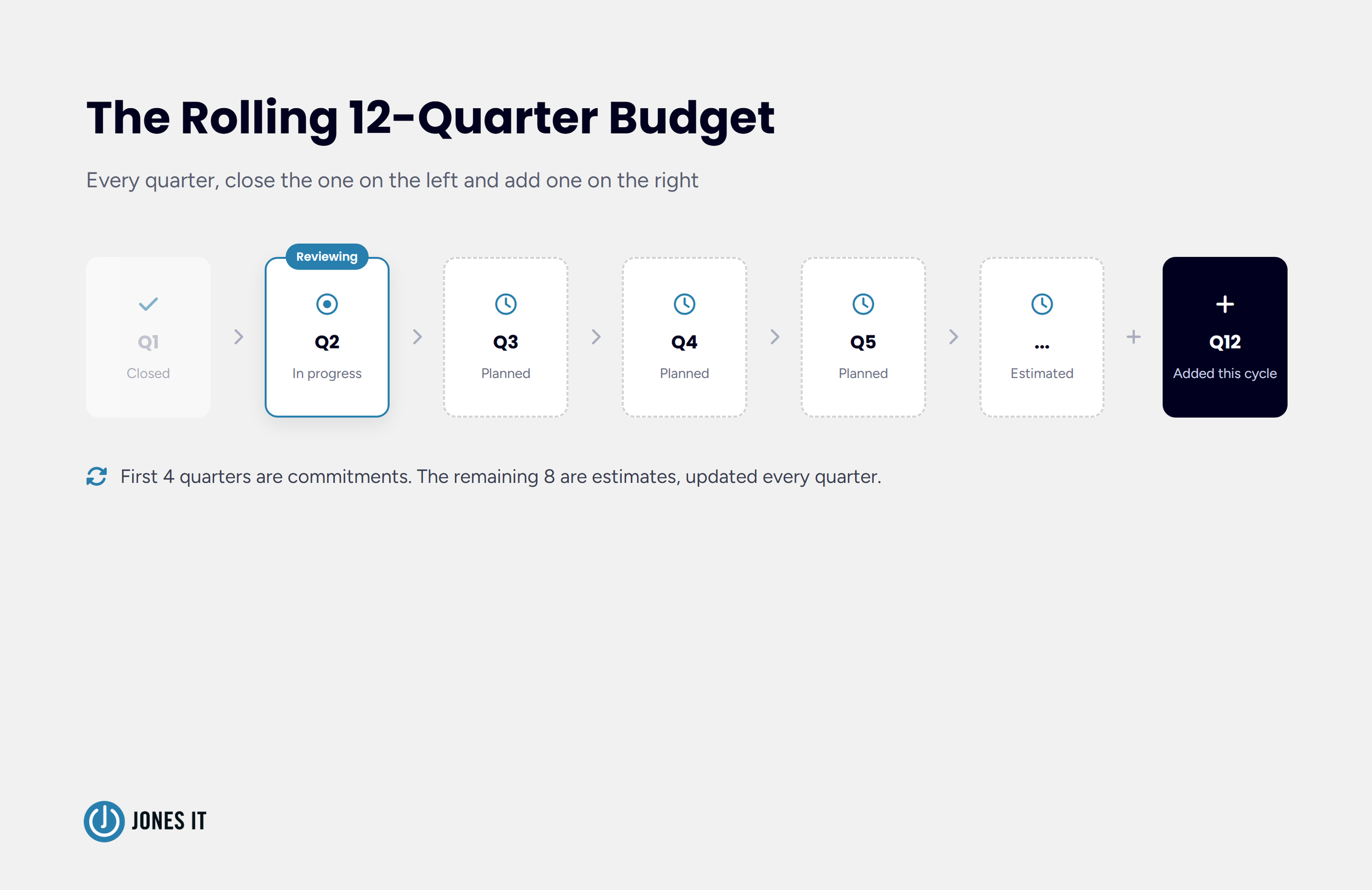
Building the 3-Year Rolling IT Budget, Quarter by Quarter
A rolling budget keeps twelve quarters visible at all times. Each quarter, you close the one that just ended and add a new one at the far edge, so the horizon never shrinks to the end of the fiscal year. The table below shows what the first few quarters might look like for the company in our opening story.
| Quarter | Initiative | Reason on the list | Owner | Budget type and cost source |
|---|---|---|---|---|
| Year 1, Q1 | Replace the firewall | Hardware nearing end of supported life | IT lead | CapEx; reseller quote |
| Year 1, Q1 | Refresh laptops from the first hiring push | Device lifecycle policy | IT lead | CapEx; per-device quote |
| Year 1, Q2 | Renew the SOC 2 audit | Annual attestation cycle | Compliance owner | OpEx; auditor renewal quote |
| Year 1, Q3 | Migrate an on-premises server before its operating system loses support | Vendor end-of-support date | IT lead | CapEx; migration quote vs. paid extended updates |
| Year 1, Q4 | Review device management and endpoint contracts | Renewal notice window opens | Finance lead | OpEx; current invoices |
| Year 2, Q1 | Review the office network before the next hiring wave | Hiring plan adds 20 people | IT lead | CapEx; assessment first, then quote |
Hardware and Operating System Refresh Cycles
Structure infrastructure refreshes as a predictable, recurring yearly expense to avoid sudden budget spikes. In our startup IT budget planning guide, we put annual hardware refresh and provisioning at $30,000 to $80,000 for Series A companies and $60,000 to $150,000 for Series B, and the roadmap is what allocates those ranges into specific quarters.
Operating system end-of-support dates are fixed points on that calendar. Microsoft set the end of extended support for Windows Server 2016 at January 12, 2027, and it offers paid Extended Security Updates to customers who cannot migrate in time. Every operating system has a date like it, and the roadmap should price that kind of program against a planned migration, since paying for extra time buys runway rather than a plan.
Companies that run entirely on cloud services, with no on-premises server, face the same calendar in different places: the support window for each laptop operating system, the office network equipment, and the renewal date on every SaaS contract.
The Renewal and Cancellation Calendar
Every SaaS contract and managed services agreement carries a renewal date and a notice window, and a missed window commits you to another term. Enter the decision date for each contract instead of the renewal date, and set a reminder at least 30 days before it. Where you plan to consolidate tools, put a hard cancellation date on the roadmap so the overlap period has an end. If the contract in question is with your provider, our post on switching MSPs mid-contract explains how exit fees and notice periods work.
Compliance Milestones
Schedule compliance work backward from the date a customer or investor needs the result. In our budget guide, we estimate first-year SOC 2 costs for a small startup at $30,000 to $80,000, spread across auditor fees, a compliance platform, tooling gaps, and internal staff time, and each of those costs lands in a specific quarter your CFO can see in advance.
CapEx vs. OpEx
Mark every line as bought or subscribed. Hardware purchased outright reaches cash flow in a single quarter, while subscriptions and device leasing spread the cost across many. Neither approach is correct in general, and your CFO should decide line by line with the whole roadmap in view.
How Headcount Changes the IT Roadmap
The contents of the roadmap change as the company grows. We use the same stage definitions as our startup IT budget planning guide, which covers what each stage should spend.
| Stage | Headcount | Roadmap emphasis |
|---|---|---|
| Seed | 0 to 15 | Foundation and key-person risk: two administrators on every critical system, a password manager, encrypted devices, and a policy for personal devices. |
| Series A | 15 to 50 | Structure: company-managed devices under mobile device management (MDM), automated off-site backups, stronger email filtering, the start of the SOC 2 program, and outside advisory support. |
| Series B | 50 to 150 | Governance: a central SaaS registry, standard procurement, formal security policies, security monitoring with an incident response process, and dedicated IT staff or a managed partner. |
Application sprawl tends to appear in the upper half of the Series A range and throughout Series B, when departments begin buying tools on their own, and our post on Shadow IT covers how to manage it. Past Series B, the roadmap usually adds a dedicated IT leader so that daily support and strategic planning stop competing for the same person, and our post on right-sizing IT to your growth stage compares the staffing models.
Keeping the Roadmap Alive: Quarterly Reviews
A roadmap reviewed once a year, at budget time, goes stale quickly. Hold a review every quarter with your finance lead and your IT owner: close the quarter that ended, add a new one at the far edge, and re-rank the list against the current hiring plan and any incidents. Compare actual spend against each budget line, and record why any line moved.
If your leadership team already runs on the Entrepreneurial Operating System (EOS), Scaling Up, or Pinnacle, put roadmap items into the same quarterly cycle as the company's other priorities. A firewall replacement then competes for attention on the same list as everything else, in place of living in a separate IT conversation.
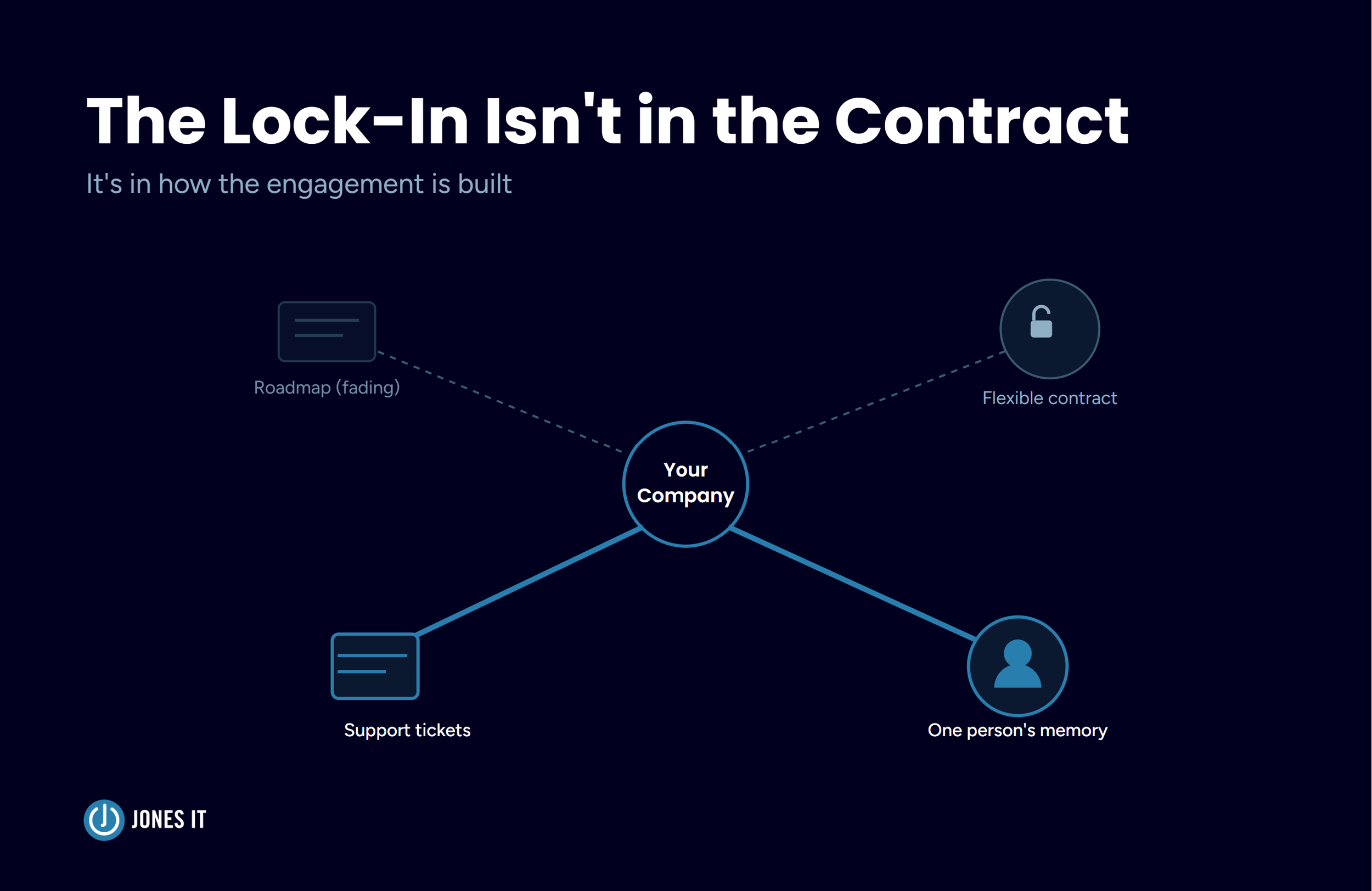
Keep the document in your own systems. If a vCIO (a fractional chief information officer) or an MSP (managed services provider) maintains the roadmap for you, you should be able to open it, edit it, and take it with you if the relationship ends, and our post on vCIO engagements covers how to avoid lock-in.
IT Roadmap Checklist
Confirm each item before you circulate the first version:
A one-page IT strategy that leadership has agreed on.
A device inventory with purchase dates.
Every server and operating system, with its end-of-support date.
Every SaaS and managed services contract, with its renewal date and notice window.
Two named administrators on every critical system.
Compliance milestones scheduled backward from customer and investor deadlines.
Twelve quarters drawn, with a reason, an owner, and a budget line on every item.
A quarterly review on the calendar with your finance lead.
Building Your First Version This Quarter
The finance lead from our opening rebuilt her plan as twelve quarters on one page. The laptop refresh, the firewall, and the audit fee each gained an owner, a quarter, and a price source, so the budget conversation happened before the bills did. Nothing about the technology changed; what changed was that every cost had a date beside it before the date arrived.
A first version comes together quickly once the three inputs are gathered, though gathering them takes the longest, and the first quarterly review exists to fix whatever the draft gets wrong. If you would like a second set of eyes on yours, or want to build it together, we are happy to start with your inventory.
Frequently Asked Questions About IT Roadmaps for Startups
How far ahead should a startup plan its IT roadmap?
Plan 12 quarters ahead, and treat the first four as commitments and the remaining eight as estimates. Hardware lifecycles, renewals, and compliance dates are known well in advance, while growth projects shift with the hiring plan.
How often should an IT roadmap be updated?
Update the IT roadmap every quarter, and again after a funding round or a major change to the hiring plan. A quarterly review keeps the twelve-quarter horizon intact and catches cost changes while there is still time to respond.
Who should own the IT roadmap at a startup?
The IT lead or vCIO owns the document, the finance lead approves the budget lines, and the founder signs off on the strategy above it. Each line on the roadmap still needs one named owner.
Does a startup need a vCIO to build an IT roadmap?
No. A founder or an IT lead can build the first version from the three inputs above. A vCIO becomes useful when no one has the time, or the vendor-neutral experience, to keep the roadmap current as the company grows.

About The Author

Evan JonesFounder and CEO of Jones IT
With over two decades of IT experience in San Francisco, Evan guides Jones IT's long-term strategy, finances, and culture, with a vision of building the city's highest-rated IT services firm. Outside of work, you'll find him on the golf course or running Bay Area Warriors, his non-profit connecting Bay Area kids to college through basketball.
Discover how to build a 3-year rolling IT roadmap for startups. Turn lumpy tech expenses into a predictable budget your CFO can plan against.